Math Statistics: Mode, Median and Mean
Related Pages
Mean
Median
Central Tendency
More Statistics Lessons
In these lessons, we will learn how to determine the mode of a given set of data. We will also compare between mode, mean, and median.
What Is Mean, Median, Mode and Range?
Mean, Median, and Mode are three of the most common ways to describe the “center” or “average” of a set of data. They are known as measures of central tendency. Each provides a different kind of insight into the data.
Mean is the average of all the values. For example, a teacher may want to know the average marks of a test in his class.
Median is the middle value, dividing the number of data into 2 halves. In other words, 50% of the observations is below the median and 50% of the observations is above the median.
Mode the value that appears most frequently in a data set. A data set can have one mode, multiple modes, or no mode at all.
For example, a person who sells ice creams might want to know mode to know which flavor is the most popular.
Range tells how spread out the data is by showing the difference between the highest and lowest values in a data set.
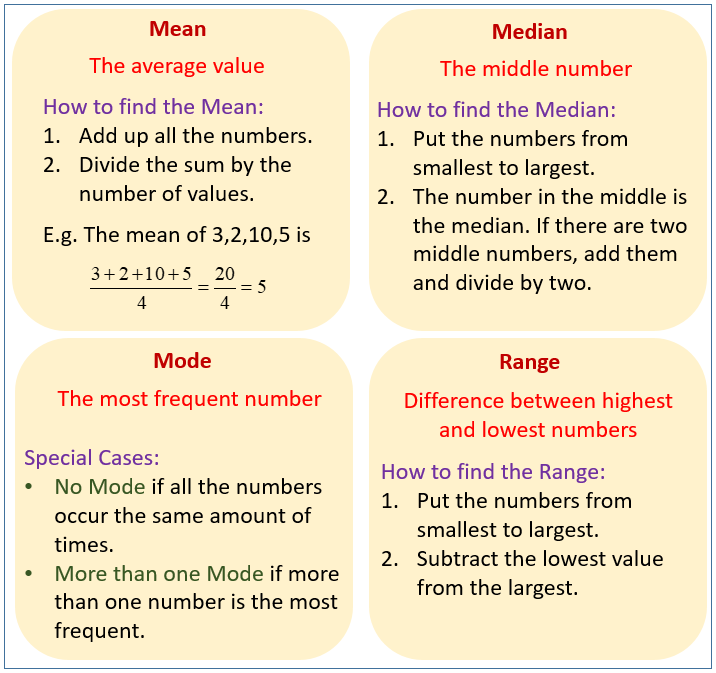
The following diagrams show how to find the mean, median, mode and range. Scroll down the page for examples and solutions.
Statistics Worksheets
Practice your skills with the following Statistics worksheets:
Printable & Online Statistics Worksheets
I. Mean (Arithmetic Mean or Average)
The mean is calculated by adding up all the numbers in a data set and then dividing by the total count of numbers in that set.
How to calculate the Mean:
- Sum all the values: Add all the numbers together.
- Count the number of values: Determine how many numbers are in the set.
- Divide the sum by the count: (Sum of values) / (Number of values)
II. Median
The median is the middle value in a data set when the values are arranged in numerical order (either ascending or descending). It represents the exact middle point of the data.
How to calculate the Median:
- Order the data: Arrange all the numbers from smallest to largest (or largest to smallest).
- Find the middle value:
If the count of numbers is odd: The median is the single middle number.
If the count of numbers is even: The median is the average (mean) of the two middle numbers.
III. Mode
The mode is the value that appears most frequently in a data set. A data set can have one mode, multiple modes, or no mode at all.
How to find the Mode:
- Count frequencies: Go through the data set and count how many times each value appears.
- Identify the most frequent value(s): The value(s) with the highest frequency is/are the mode(s)
IV. Range
The range of a set of data is simply the difference between the highest (maximum) value and the lowest (minimum) value in that data set. It tells you how spread out your data is from the lowest value to the highest value.
How to Calculate the Range:
- Identify the highest value in the data set.
- Identify the lowest value in the data set.
- Subtract the lowest value from the highest value.
Example:
Find the mode of the following set of scores.
14 11 15 9 11 15 11 7 13 12
Solution:
The mode is 11 because 11 occurred more times than the other numbers.
If the observations are given in the form of a frequency table, the mode is the value that has the highest frequency.
Example:
Find the mode of the following set of marks.
| Marks | 1 | 2 | 3 | 4 | 5 |
| Frequency | 6 | 7 | 7 | 5 | 3 |
Solution:
The marks 2 and 3 have the highest frequency. So, the modes are 2 and 3.
Note: The above example shows that a set of observations may have more than one mode.
Example:
Find the mode for each of the following frequency tables:
The frequency table below shows the weights of different bags of rice.
| Weight (kg) | 45 | 50 | 55 | 60 | 65 | 70 | 75 | 80 |
| Bags of rice (Frequency) | 8 | 11 | 7 | 10 | 9 | 10 | 12 | 8 |
There are 8 number cards with values 0 – 7. Each time a card is drawn at random and the card value is recorded. The frequency refers to the number of times a value is shown.
| Card values | 0 | 1 | 2 | 3 | 4 | 5 | 6 | 7 |
| Frequency | 8 | 12 | 7 | 10 | 12 | 13 | 12 | 10 |
Solution:
a) Mode: 75 kg (highest frequency of 12)
b) Mode: 5 (highest frequency of 13)
Example:
The following frequency table shows the marks obtained by students in a quiz. Given that 4 is
the mode, what is the least value for x?
| Marks | 1 | 2 | 3 | 4 | 5 | 6 |
| Number of students (Frequency) | 7 | 9 | 10 | x | 9 | 11 |
Solution:
x is as least 12
(if x is less than 12 then 4 will not be the mode)
Mean, Median, Mode, Range, Interquartile Range
This lesson shows you how to find the mean, median, mode, range and interquartile range for a list of numbers.
Example:
Find the mean, median, mode, range and interquartile range for the following data.
5, 7, 9, 9, 10, 11, 11, 11, 12
Frequency Table - Mean, Median, Mode, Range And Interquartile Range
This lesson shows you how to find the mean, median, mode, range and interquartile range from a frequency table.
Mean, Mode And Median From Frequency Tables
How to find the mean, mode and median from a frequency table for both discrete and grouped data?
For grouped data:
- Mean: multiply midpoints by frequencies and add the sub-totals. Divide by the total of the frequencies.
- Mode: find the largest frequency - the corresponding value is the modal value or modal class.
- Median: calculate a running total of the frequencies - the first interval that is above half the total contains the median.
| Check out our most popular games! | ||
|---|---|---|
 Fraction Concoction |
 Fact Family Game |
 Number Bond Garden |
 Online Addition Subtraction Game |
 Penguin Solitaire |
 Sawayama Solitaire |
 Ark Solitaire |
 Eldritch Invasion |
 Shenzhen Solitaire |
Check out more Solitaire games here.
We welcome your feedback, comments and questions about this site or page. Please submit your feedback or enquiries via our Feedback page.