Maths Formulas
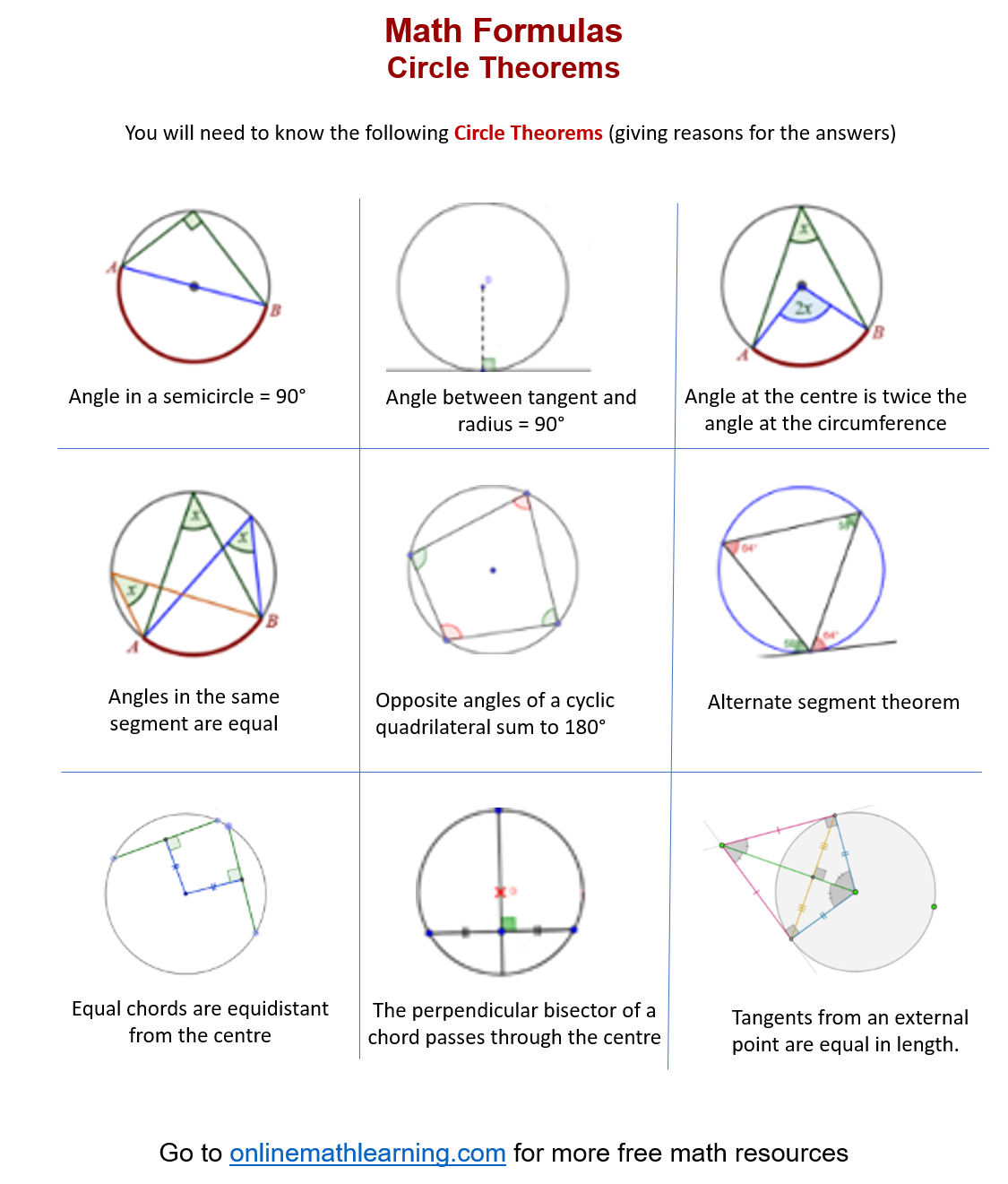
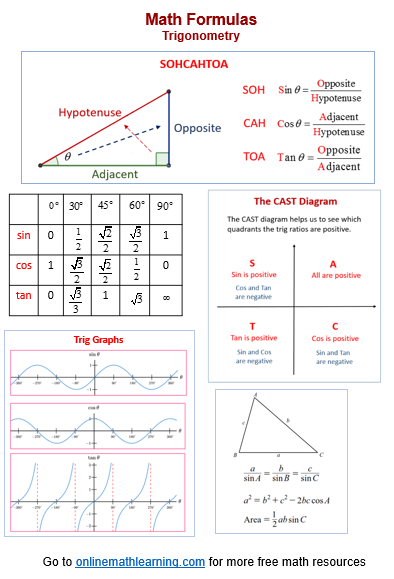
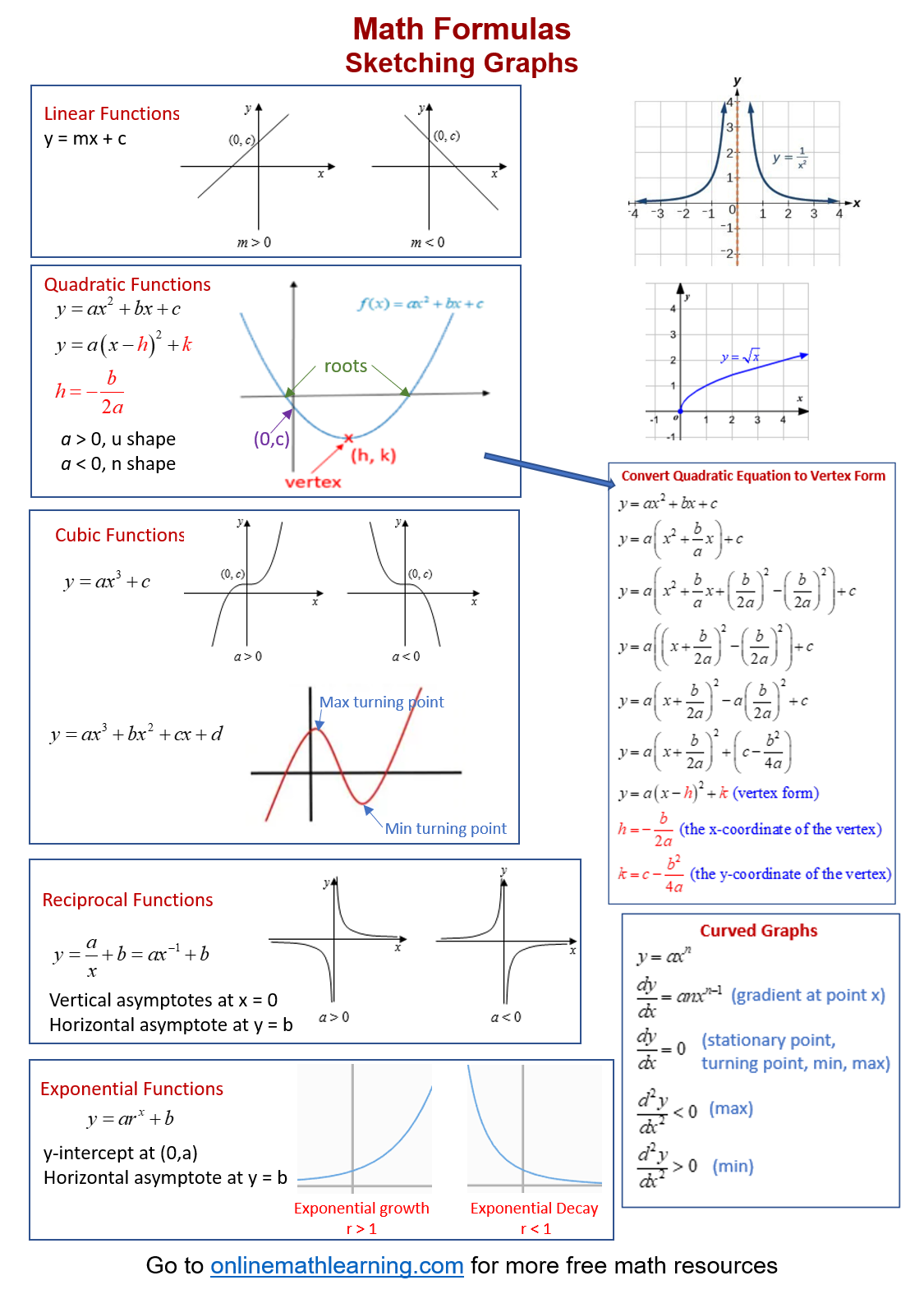
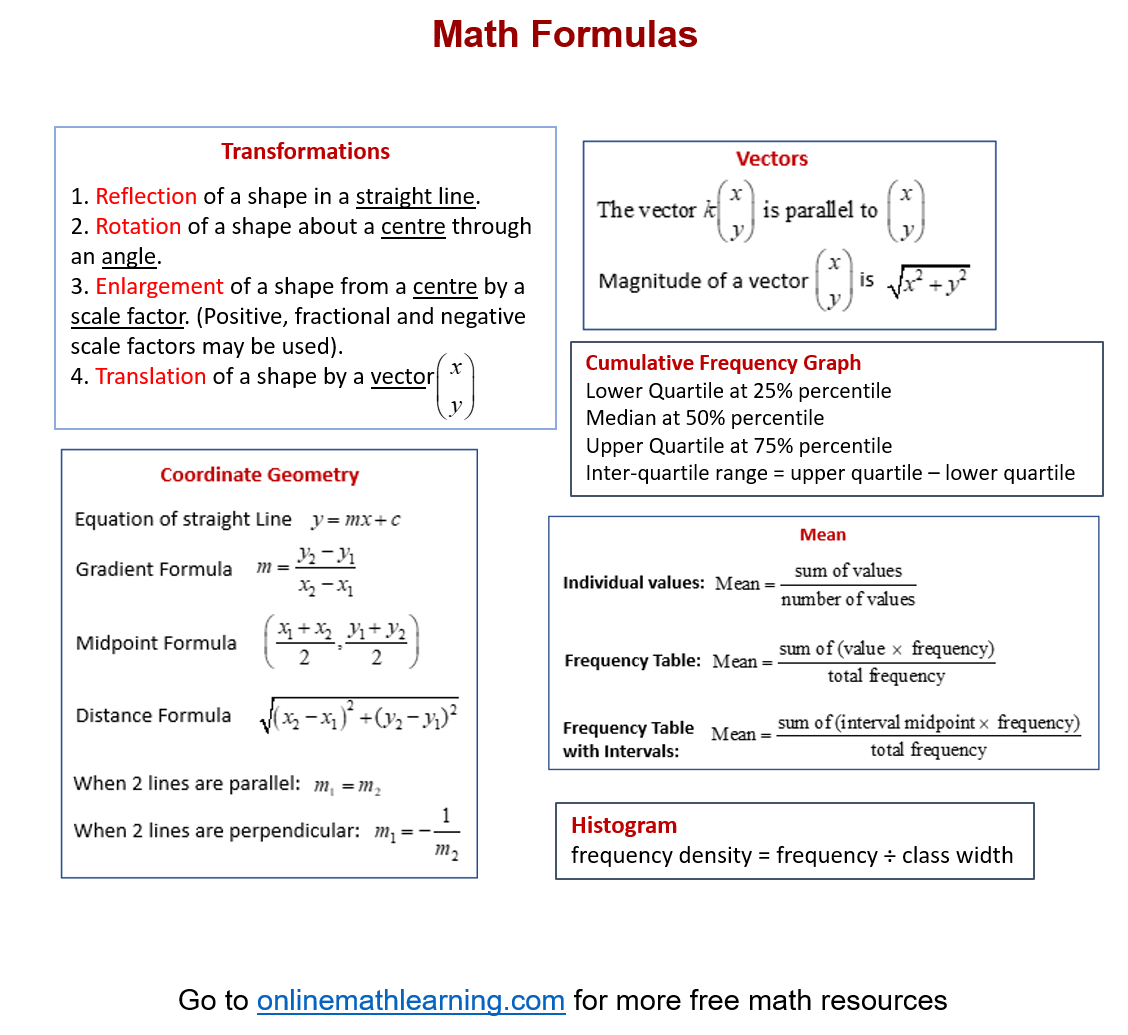
The following tables give the formulas that useful for GCSE/IGCSE Maths: Number, Algebra, Geometry, Circle Theorems, Trigonometry, Coordinate Geometry, Sketching Graphs, and Statistics. Scroll down the page for more examples and videos to help you remember the formulas.
IGCSE Maths Formulas (pdf)
Videos
Formulas for IGCSE Maths
Formulas for IGCSE Maths
I. Number
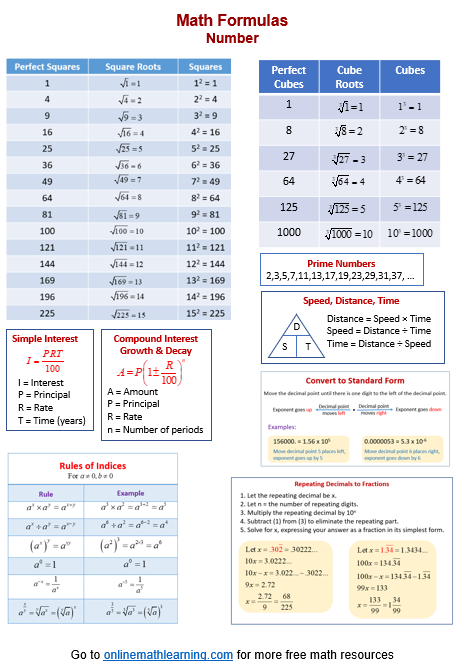
- Percentage Change: \(\frac{\text{Change}}{\text{Original Value}}\times 100\text{%}\)
- Simple Interest: \(I=\frac{PRT}{100}\)(where P = Principal, R = Rate, T = Time in years)
- Compound Interest / Growth & Decay: \(A=P\left( 1\pm \frac{R}{100} \right)^{n}\) (where A = Amount, P = Principal, R = Rate, n = Number of periods)
- Distance = Speed × Time
- Standard Form: A × 10n (where 1 ≤ A < 10 and n is an integer)
- Rules of Indices
II. Algebra
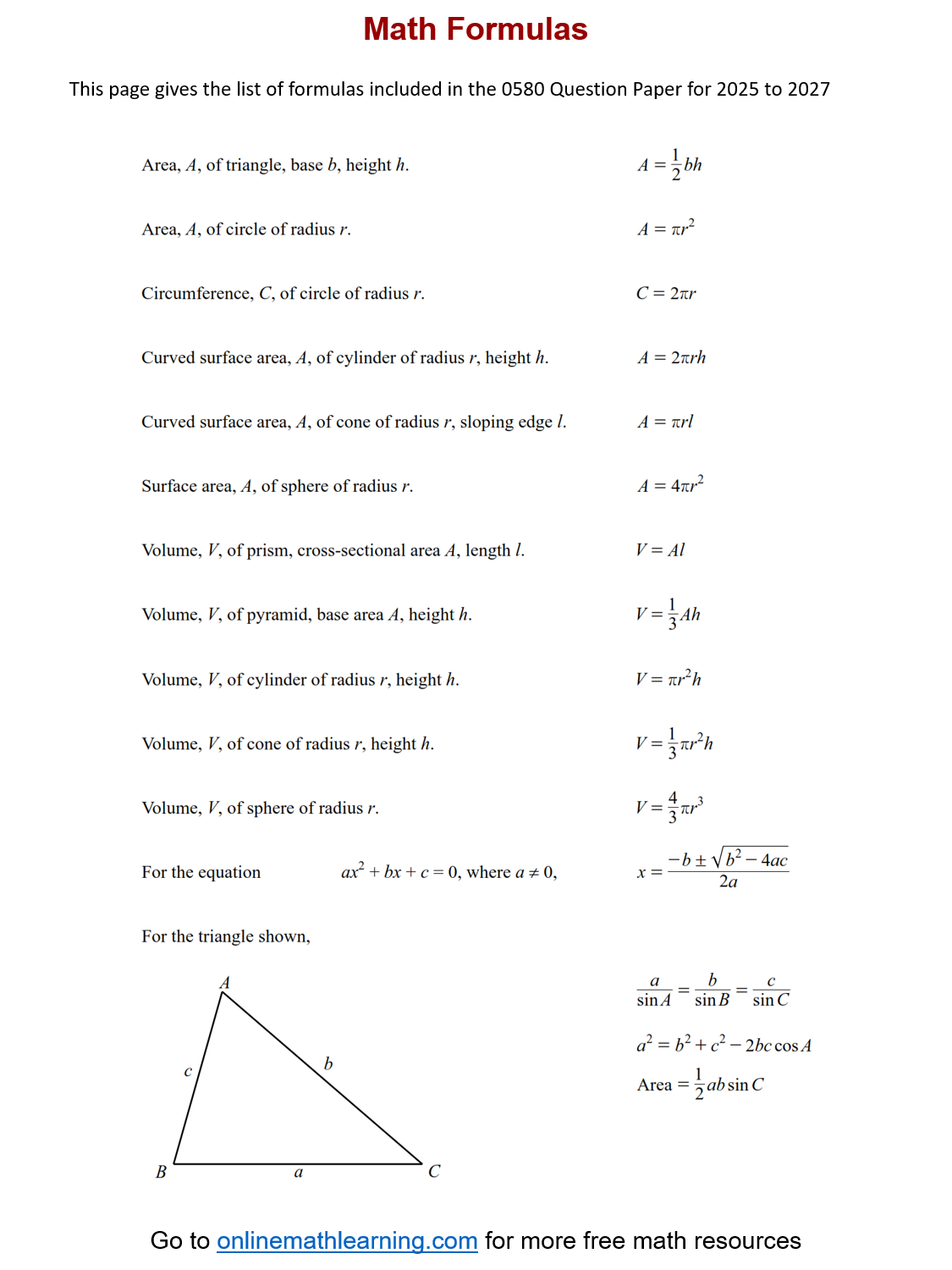
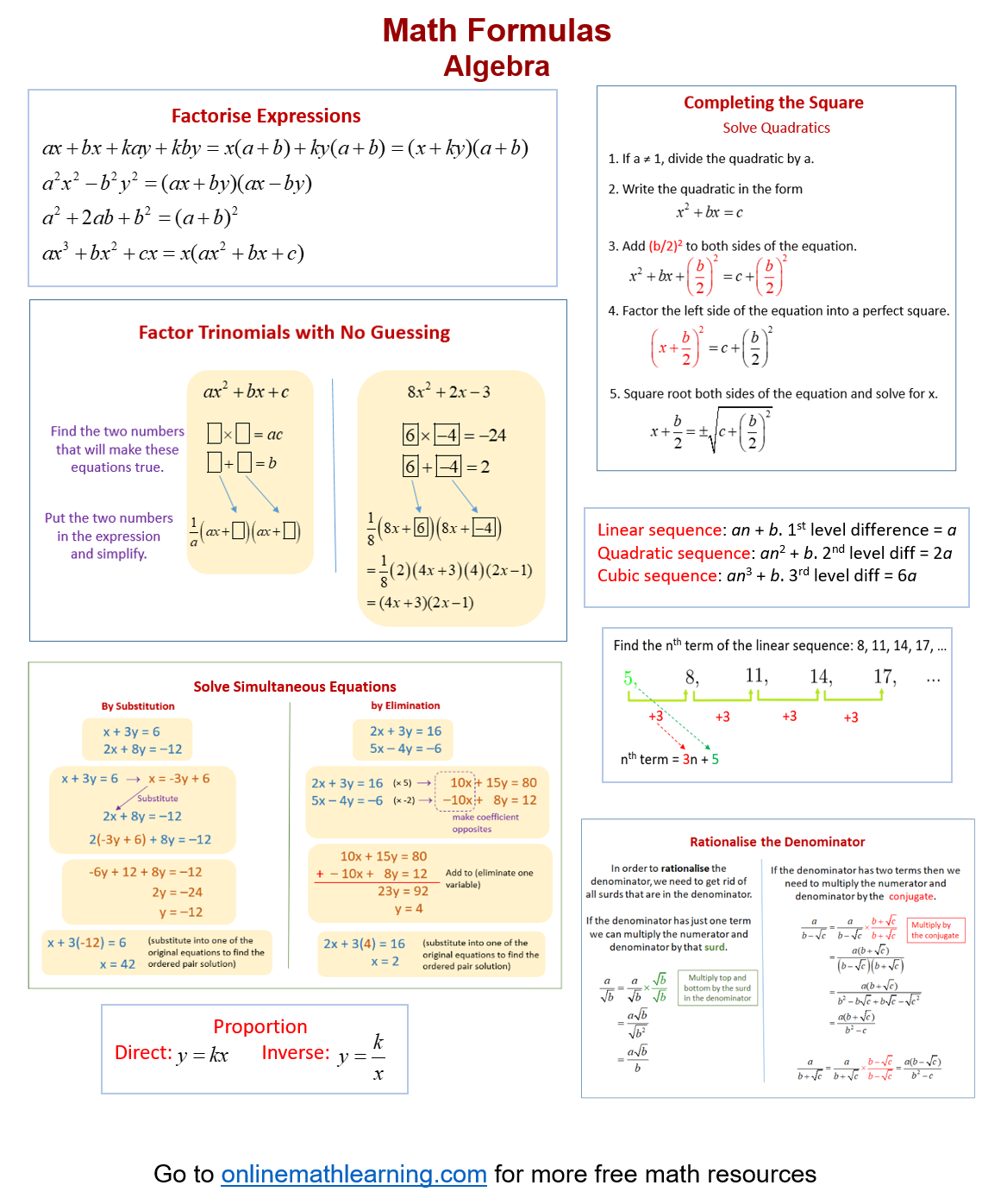
- Quadratic Formula: For ax2+bx+c=0, the solutions are \(x=\frac{-b\pm \sqrt{b^2-4ac}}{2a}\)
- nth term of an Arithmetic Sequence: Tn=a+(n−1)d (where a is the first term, d is the common difference)
- Direct Proportion: y=kx (where k is a constant)
- Inverse Proportion: \(y=\frac{k}{x}\) (where k is a constant)
III. Coordinate Geometry
- Gradient (m) of a Line: \(m=\frac{y_2-y_1}{x_2-x_1}\)
- Equation of a Straight Line: y=mx+c
- Distance between two points (x1, y1) and (x2, y2): \(\sqrt{\left( x_2-x_1 \right)^{2}+\left( y_2-y_1 \right)^{2}}\)
- Midpoint of a Line Segment between (x1, y1) and (x2, y2): \(\left( \frac{x_1+x_2}{2},\frac{y_1+y_2}{2} \right)\)
- Perpendicular Lines: m1 × m2 = -1
IV. Mensuration (Area and Volume)
Circles:
Circumference: C=πd or C=2πr
Area: A=πr2
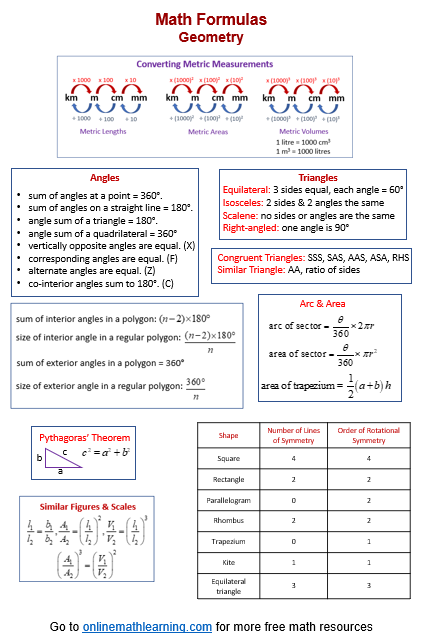
Arc Length: \(L=\frac{\theta}{360^\circ }\times 2\pi r\)
Area of Sector: \(A=\frac{\theta}{360^\circ }\times \pi r^2\)
Rectangle:
Area: A=length×width
Perimeter: P=2(length+width)
Area of Triangle: A= ½×base×height
Area of Parallelogram: A=base×height
Area of Trapezium: A= ½(a+b)h (where a and b are parallel sides, h is perpendicular height)
Volume of Prism: V=Area of cross-section×length
Cylinder:
Volume: V=πr2
Curved Surface Area: CSA=2πrh
Total Surface Area: TSA=2πr2+2πrh
Volume of Pyramid: V= ⅓×base area×height
Cone:
Volume: V= ⅓ πr2h
Curved Surface Area: CSA=πrl (where l is slant height)
Total Surface Area: TSA=πr2+πrl
Sphere:
Volume: \(V=\frac{4}{3}\pi^3\)
Surface Area: SA=4πr2
V. Probability and Statistics
- Probability of an Event: \(P\left( Event \right)=\frac{\text{Number of favourable outcomes}}{\text{Total Number of possible outcomes}}\)
- Mutually Exclusive Events: P(A or B)=P(A)+P(B)
- Independent Events: P(A and B)=P(A)×P(B)
- Mean from a Frequency Table: Mean= \(\frac{\sum{fx}}{\sum{f}}\) (where f is frequency, x is value/midpoint)
- Frequency Density (for Histograms): Frequency ÷ Class Width
| Check out our most popular games! | ||
|---|---|---|
 Fraction Concoction |
 Fact Family Game |
 Number Bond Garden |
 Online Addition Subtraction Game |
 Penguin Solitaire |
 Sawayama Solitaire |
 Ark Solitaire |
 Eldritch Invasion |
 Shenzhen Solitaire |
Check out more Solitaire games here.
We welcome your feedback, comments and questions about this site or page. Please submit your feedback or enquiries via our Feedback page.