Mapping Diagram Game
Related Pages
Printable Math Worksheets
Online Math Quizzes
Math Games
Math Worksheets
This Mapping Diagram Game/Worksheet is a great way to put your skills to the test in a fun environment. By practicing, you’ll start to work out the answers efficiently.
Mapping Diagram Game
This game tests your ability to identify a Mathematical Function using a mapping diagram. The core logic is based on the relationship between the Domain and the Range. Scroll down for a detailed explanation.
How to Play the Mapping Diagram Game
-
The Ultimate Rule
To win this game, you only need to remember one rule:
A Function is a relation where every input (Domain) has exactly ONE output (Range). -
How to Analyze the Diagram
Look at the green circles on the left (the Domain).
Focus on the lines: Count how many lines start from each individual green circle.
Ignore the right side: It doesn’t matter how many lines point to an amber circle (A, B, or C). Multiple inputs can point to the same output. It is still a function. -
Making Your Choice
Pick “FUNCTION” if:
Every green circle has exactly one line coming out of it.
Pick “NOT A FUNCTION” if:
You see any green circle that has two or more lines coming out of it. This means one input is trying to give you two different results at the same time, which is impossible for a function. -
Game Controls
Look at the mapping lines in the center box.
Decide: Click the green FUNCTION button if the rule is followed, or the red NOT A FUNCTION button if it is broken.
Learn: Read the Logic Text that appears. It will explain specifically why that mapping passed or failed.
Repeat: Click NEXT MAPPING -
Pro-Tips
Crossing lines are okay: Just because lines cross doesn’t mean it’s not a function. Follow the line back to the green circle—if that circle only has that one line, it’s still a function.
Shared outputs are okay: If all three inputs (1, 2, and 3) point to the same output (A), it is still a function.
Explain why “Many-to-One” is a function, but “One-to-Many” is not?
In mathematics, the definition of a function is all about predictability. For any given input, you must know exactly what the output will be.
Here is the breakdown of why one relationship works as a function and the other does not.
Many-to-One (The Function)
In a Many-to-One relationship, different inputs can lead to the same output.
Why it works: It is still a function because if you pick any specific input, there is only one path to follow. There is no confusion about the result.
One-to-Many (Not a Function)
In a One-to-Many relationship, a single input points to multiple different outputs.
Why it fails: It is not a function because it lacks predictability. If you provide the input, the “machine” doesn’t know which output to give you.
This video gives a clear, step-by-step approach to understand the mapping diagram test.
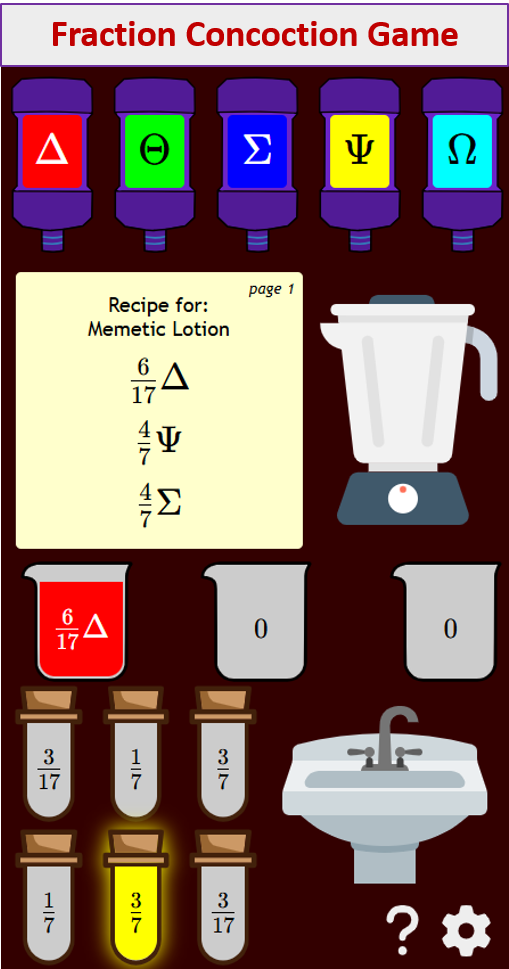
Try out our new and fun Fraction Concoction Game.
Add and subtract fractions to make exciting fraction concoctions following a recipe. There are four levels of difficulty: Easy, medium, hard and insane. Practice the basics of fraction addition and subtraction or challenge yourself with the insane level.
We welcome your feedback, comments and questions about this site or page. Please submit your feedback or enquiries via our Feedback page.