Logarithmic Equations
Related Topics:
More Lessons for Algebra
Math Worksheets
In this lesson, we will look into how to solve logarithmic equations using the Properties of Logarithms.
Logarithmic Equations
Logarithmic equations are equations that involve one or more logarithms where the variable is part of the argument of the logarithm. To solve them, you typically use the properties of logarithm to simplify the equation and then convert it into an exponential or algebraic form that you already know how to solve.
The most critical step in solving logarithmic equations is always to check your solutions at the end, because the argument of a logarithm must always be positive. Any solution that makes the argument negative or zero in the original equation is an extraneous solution and must be discarded.
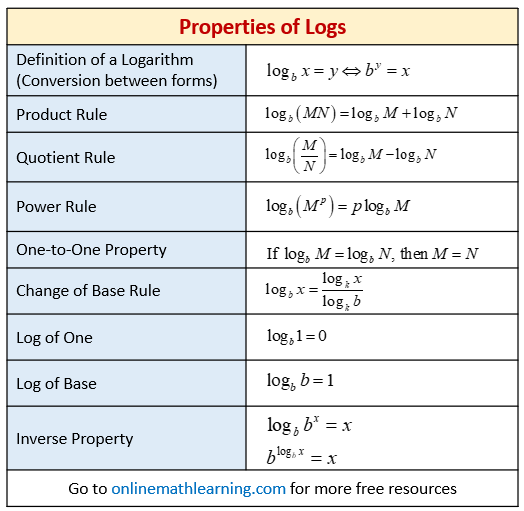
The following table gives the key properties of logarithms for solving equations. Scroll down the page for more examples and solutions.
Logarithm Worksheets
Practice your skills with the following worksheets:
Printable & Online Logarithm Worksheets
General Strategy for Solving Logarithmic Equations
1. Isolate Logarithmic Terms: Get all logarithmic terms on one side of the equation.
2. Combine Logarithms: Use the product, quotient, or power rules to combine multiple logarithmic terms into a single logarithm, if possible.
3. Convert to Exponential Form OR Use One-to-One Property:
If you have logb (expression) = constant, convert it to bconstant = expression.
If you have logb (expression 1) = logb (expression 2), convert it to expression 1 = expression 2
4. Solve the Resulting Algebraic Equation: This will typically be a linear or quadratic equation.
5. Check for extraneous solutions: Substitute each potential solution back into the original logarithmic equation. If a solution causes the argument of any logarithm to be zero or negative, it is extraneous and must be discarded.
Example:
Solve the logarithmic equation
log 2 (x – 1) + log 2 (x – 4) = log 2 (2x – 6)
Solution:
log 2 (x – 1) + log 2 (x – 4) = log 2 (2x – 6)
log 2 (x – 1)(x – 4) = log 2 (2x – 6)
(x – 1)(x – 4) = (2x – 6)
x2 – 5x + 4 = 2x – 6
x2 – 7 x + 10 = 0
(x – 2)(x – 5) = 0
x = 2 or 5
We need to check whether each logarithm is defined for these values of x.
When x = 2,
log 2 (x – 1) = log 2 1
log 2 (x – 4) = log 2 (– 2) , whuch is undefined
log 2 (2x – 6) = log 2 (– 2) , whuch is undefined
So, x = 2 is rejected
When x = 5,
log 2 (x – 1) = log 2 4
log 2 (x – 4) = log 2 1
log 2 (2x – 6) = log 2 4
So, x = 5 is the answer
Example:
Solve the logarithmic equation
log 3 2 + log 3 (x + 4) = 2log 3 x
Solution:
log 3 2 + log 3 (x + 4) = 2log 3 x
log 3 2(x + 4) = log 3 x2
2(x + 4) = x2
x2 – 2x – 8 = 0
(x – 4)(x + 2) =0
x = 4 or –2
x = –2 is rejected because log 3 (–2) is undefined
So the answer is x = 4
Videos
Properties of Logarithms - Part 1
Properties of Logarithms - Part 2 - Solving Logarithmic Equations
| Check out our most popular games! | ||
|---|---|---|
 Fraction Concoction |
 Fact Family Game |
 Number Bond Garden |
 Online Addition Subtraction Game |
 Penguin Solitaire |
 Sawayama Solitaire |
 Ark Solitaire |
 Eldritch Invasion |
 Shenzhen Solitaire |
Check out more Solitaire games here.
We welcome your feedback, comments and questions about this site or page. Please submit your feedback or enquiries via our Feedback page.