Has and Have
Related Pages
Phonic Sounds
Consonant Digraph
Other Consonant Sounds
Lessons On English Grammar
English for Kids
Videos and songs to help First Grade kids learn how and when to use “has” and “have”. “Has” and “have” are both forms of the verb “to have” in the present tense. They are used to express possession, experience, or as auxiliary verbs in perfect tenses. The correct choice depends on the subject of the sentence.
“Has” and “Have” are both forms of the verb “to have”, which means to own, possess, or experience something. The difference lies in subject agreement and usage.
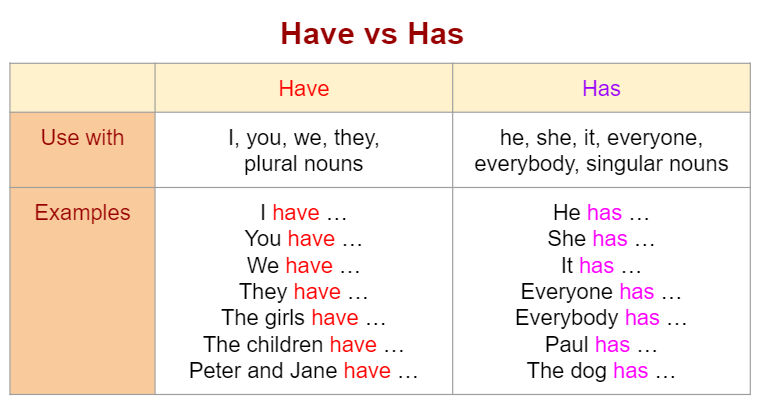
The following diagram shows when to use have and when to use has. Scroll down the page for more examples and solutions.
-
When to Use “Has”
Used with:
Singular third-person subjects (he, she, it, singular nouns).
Examples:
She has a cat.
The dog has a bone.
He has a new toy. -
When to Use “Have”
Used with:
Plural subjects (we, you, they, plural nouns).
First-person (I).
Second-person (you).
Examples:
I have a car.
You have a great idea.
They have two children.
We have a meeting today. -
Special Cases
With the past participle, “have” and “has” are used to form the present perfect tense:
He has eaten lunch.
They have finished their work.
HAVE vs HAS
What’s the difference?
Learn with examples
Have and Has Song
have/has (I have, you have, he has…)
Is, Am, Are, Verb. Song
I Am, You Are, He/She Is Song
Present Simple “To Be” Lesson
Types of Verbs
Action Verbs
Is, Am, Are
Has, Have
Spelling Rules for Verbs
Adding -ed
Irregular Verbs
Adding -ing
| Check out our most popular games! | ||
|---|---|---|
 Fraction Concoction |
 Fact Family Game |
 Number Bond Garden |
 Online Addition Subtraction Game |
 Penguin Solitaire |
 Sawayama Solitaire |
 Ark Solitaire |
 Eldritch Invasion |
 Shenzhen Solitaire |
Check out more Solitaire games here.
We welcome your feedback, comments and questions about this site or page. Please submit your feedback or enquiries via our Feedback page.