Distributive Property of Multiplication
Examples, videos, worksheets, stories, and solutions to help Grade 6 students learn about the Distributive Property of Multiplication.
The following diagram shows the distributive property over addition. Scroll down the page for more examples of the distributive property.
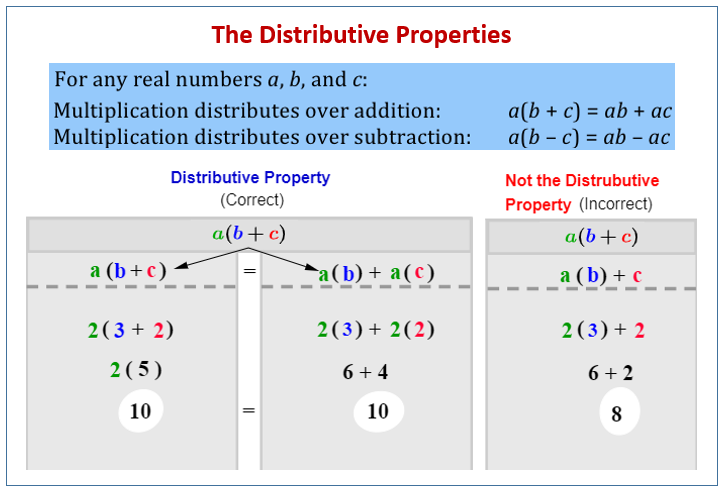
The distributive property states that multiplying a sum by a number is the same as multiplying each addend by that number and then adding the two products.
3(1 + 4) = (3 × 1) + (3 × 4)
If we let a, b, and c be any whole numbers, then a(b + c) = ab + ac
Introduction to the Distributive Property
Examples:
2(5 + 3) =
2(x + 3) =
2(7 - 3) =
2(7 - 3 + 2) =
2(43)
6(143)
This lesson teaches the basics of the distributive property.
Examples:
5(7 + 8) =
6(2 + 4) =
7(40 - 2) =
4(x + 8) =
3(x - 7) =
-2(x + 4) =
4 (x + 2 + z) =
(x + 3) 4 =
3(2x - 4 + 3x) =
Learn the distributive property, which states that a(b + c) = ab + ac.
In other words, the number or variable that is outside the set of parentheses “distributes” through the parentheses, multiplying by each of the numbers inside.
Distributive property
Simplify the following expression two ways: One time by applying the distrbutive property and one time without applying it.
-12(8 - 4) =
| Check out our most popular games! | ||
|---|---|---|
 Fraction Concoction |
 Fact Family Game |
 Number Bond Garden |
 Online Addition Subtraction Game |
 Penguin Solitaire |
 Sawayama Solitaire |
 Ark Solitaire |
 Eldritch Invasion |
 Shenzhen Solitaire |
Check out more Solitaire games here.
We welcome your feedback, comments and questions about this site or page. Please submit your feedback or enquiries via our Feedback page.