Demonstrative Pronouns
Related Pages
Types of Pronouns
Possessive Pronouns
Personal Pronouns
Subject Pronouns, Object Pronouns, Reflexive Pronouns
More Lessons On English Grammar
English as a Second Language
Welcome to our collection of English as a Second Language (ESL) tools & resources for students, teachers, and educators. We have lots of free videos that will help you improve your English and also advice and tips that will help you in English proficiency examinations like TOEFL and IELTS.
In these lessons, we will learn what demonstrative pronouns are and when to use them.
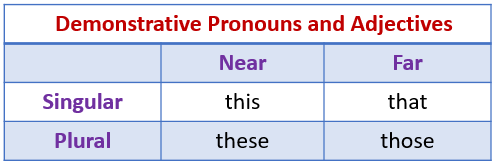
The words this, that, these, and those are called demonstrative pronouns. They are used to identify someone or something.
This and these are used to refer to items fairly close at hand, while that and those tend to refer to items that are further away.
This and that are singular, while these and those are plural.
The following table gives the demonstrative adjectives: this, that, these, those. Scroll down the page for examples and explanations.
Example:
This is my house.
That is Paul’s house.
These are my shoes.
Those are his clothes.
Did you drop this?
We can do better than that.
What are those?
Who put these here?
The following video describes demonstrative pronouns. Understand the difference between “this” and “that” and how to use them in English. Also, learn the plural form of the demonstrative pronouns “this” and “that” which are “these” and “those”
Difference between Demonstrative Pronouns and Demonstrative Adjectives
A demonstrative pronoun stands alone whereas a demonstrative adjective describes a noun.
Example:
That is good. (that is a demonstrative pronoun)
That soup is good. (that is a demonstrative adjective because it describes the soup)
The following table gives some examples to illustrate the difference between Demonstrative Adjectives and Pronouns.
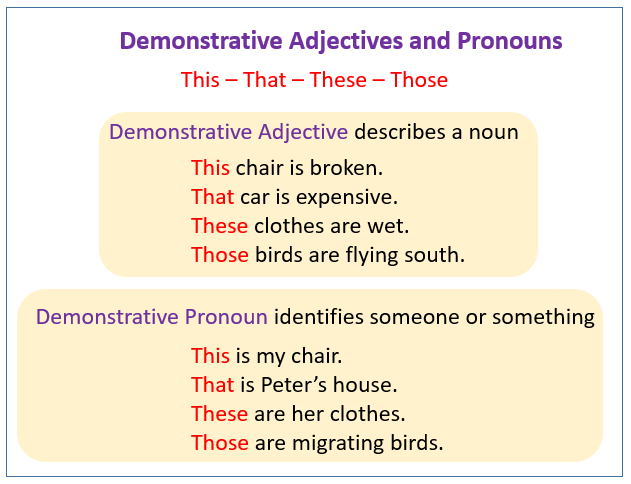
The core difference between demonstrative pronouns and demonstrative adjectives lies in their function within a sentence, even though they use the exact same words: this, that, these, and those.
A demonstrative pronoun stands alone in a sentence and replaces a noun that is either understood from the context or has been previously mentioned. It acts as the subject, object, or complement of a verb.
Examples:
“Look at that!” (Here, “that” replaces an implied noun, like “that building” or “that bird.”)
“I want this.” (Referring to an object nearby, without saying “this apple” or “this shirt.”)
“These are my favorite cookies.” (“These” stands in for “These cookies.”)
“Were those the ones you picked?” (“Those” replaces “those shoes” or “those items.”)
“He said he was tired. That made me sad.” (“That” refers to the entire preceding statement.)
A demonstrative adjective comes immediately before a noun (or a noun phrase) and modifies that noun. It specifies which particular noun is being referred to.
Examples:
“Look at that building!” (“That” modifies “building,” specifying which one.)
“I want this apple.” (“This” modifies “apple,” specifying which apple.)
“These cookies are my favorite.” (“These” modifies “cookies,” specifying which cookies.)
“Were those shoes the ones you picked?” (“Those” modifies “shoes,” specifying which shoes.)
“That decision made me sad.” (“That” modifies “decision,” specifying which decision.)
| Check out our most popular games! | ||
|---|---|---|
 Fraction Concoction |
 Fact Family Game |
 Number Bond Garden |
 Online Addition Subtraction Game |
 Penguin Solitaire |
 Sawayama Solitaire |
 Ark Solitaire |
 Eldritch Invasion |
 Shenzhen Solitaire |
Check out more Solitaire games here.
We welcome your feedback, comments and questions about this site or page. Please submit your feedback or enquiries via our Feedback page.