Verbs: Simple Present Tense
In these lessons, we will learn
- when to use the Present Tense
- the different spellings for present tense verbs
- how “do” is used as a helping verb in the present tense
- how to make questions in the present tense
- the differences between the present tense and the present continuous tense
Related Pages
Present Continuous Tense
Simple Past Tense For Irregular Verbs
IELTS, TOEFL And English As A Second Language
More Lessons On English Grammar
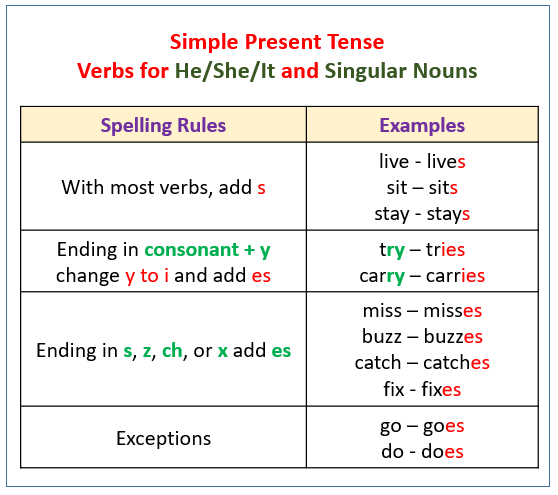
The following table shows the spelling rules for verbs in the Simple Present Tense. Scroll down the page for more examples and explanations.
When Do We Use The Present Tense?
We use the Present Tense when we are talking about facts or things that we know are true.
Examples:
The earth goes round the sun.
Mary enjoys cooking.
He likes bananas.
She wants to be a dentist.
Cows eat grass.
Penguins live in the Antarctica.
We use the Present Tense for situations that are quite permanent.
Examples:
She lives in Los Angeles.
They work in the bank.
We use the Present Tense for things that are done regularly or at some intervals. They may be used with adverbs of frequency, for example always, often, usually, sometimes, rarely, never.
Examples:
Mark goes to school by bus.
Simon brushes his teeth after every meal.
She goes to the bank every Tuesday.
He sometimes goes to the park.
Wendy often listens to the radio.
Spelling For Present Tense Verbs
When a verb is used with I, We, You or They or plural nouns the spelling is not changed.
Examples:
I enjoy cooking.
We live in New York.
They work in the bank.
Cows eat grass.
When a verb is used with the pronouns he, she, and it and with singular nouns, we may change the spelling of the verb.
For some verbs, we add an s at the end of the verb.
Examples:
He sings well.
She likes to dance.
It moves very quietly.
Susan enjoys cooking.
For verbs that end with o, s, z, sh, ch or x, we add es to the end of the verb.
Examples:
Mary goes to the market every week.
My dad sometimes does the shopping.
She misses her mother.
He brushes his teeth every morning.
Joe polishes his shoes every day.
A plumber is a person who fixes pipes.
He watches television every night.
For verbs that end with a y. If there is a consonant before the y, we drop the y and add an ies. If there is a vowel before the y, we add an s after the y.
| Consonant + y | |
| carry | carries |
| fry | fries |
| copy | copies |
| bury | buries |
| cry | cries |
| try | tries |
| fly | flies |
| Vowel + y | |
| buy | buys |
| stay | stays |
| say | says |
| obey | obeys |
| play | plays |
| enjoy | enjoys |
| sway | sways |
This Video Demonstrates The Simple Present Tense Using The Verb “learn”
Example:
Singular: I learn, You learn, He learns, She learns, It learns
Plural: We learn, You learn, They learn
This Video Explains How “Do” Is Used As A Helping Verb In The Present Tense
Example:
Singular: I learn, You learn, He does, She does, It does
Plural: We do, You do, They do
Negatives: do not or don’t, does not or doesn’t.
In yes-no questions, the helping verb goes first.
This Video Explains Some Uses For The Verb “do.”
Example:
What do you do?
She did the dishes.
Have you done your homework?
She does her shopping on the weekend.
Can you do me a favor?
How To Make Present Tense Questions With The Verb “do” Or “does”?
This video explains how to make questions in the present tense. The answer to these kinds of questions is “yes” or “no.”
Example:
Singular: Do I, Do you, Does he, Does she, Does it
Plural: Do we, Do you, Do they
This video shows some of the differences between the present tense and the present continuous tense in English.
| Check out our most popular games! | ||
|---|---|---|
 Fraction Concoction |
 Fact Family Game |
 Number Bond Garden |
 Online Addition Subtraction Game |
 Penguin Solitaire |
 Sawayama Solitaire |
 Ark Solitaire |
 Eldritch Invasion |
 Shenzhen Solitaire |
Check out more Solitaire games here.
We welcome your feedback, comments and questions about this site or page. Please submit your feedback or enquiries via our Feedback page.