Factoring Quadratic Equations - Trial and Error
In these lessons, we will learn how to factor quadratic equations, where the coefficient of x2 is 1, using the trial and error method (or guess and check method).
Related Pages
Factoring Out Common Factors (GCF)
Factoring Quadratic Equations (Square of a sum, Square of a difference, Difference of 2 squares
Factoring Quadratic Equations where the coefficient of x2 is greater than 1
Factoring Quadratic Equations by Completing the Square
Solving Quadratic Equations using the Quadratic Formula
More Lessons for Algebra
Math Worksheets
There are several techniques that can be used to factor quadratic equations.
In this trial and error method, we will need to try out different possibilities to get the right factors for the given quadratic equation.
We also have another technique that does not need require guessing or trial and error.
If the Coefficient Of x2 Is 1
To factorize quadratic equations of the form: x2 + bx + c, you will need to find two numbers whose product is c and whose sum is b.

Example 1: (b and c are both positive)
Solve the quadratic equation: x2 + 7x + 10 = 0
Solution:
Step 1: List out the factors of 10:
1 × 10, 2 × 5
Step 2: Find the factors whose sum is 7:
1 + 10 ≠ 7
2 + 5 = 7 
Step 3: Write out the factors and check using the distributive property.
(x + 2)(x + 5) = x2 + 5x + 2x + 10 = x2 + 7x + 10
The factors are (x + 2)(x + 5)
Step 4: Going back to the original quadratic equation
x2 + 7x + 10 = 0 Factorize the left side of the quadratic equation
(x + 2)(x + 5) = 0
We get two values for x.

Answer: x = – 2, x = – 5
Example 2: (b is positive and c is negative)
Get the values of x for the equation: x2 + 4x – 5 = 0
Solution:
Step 1: List out the factors of – 5:
1 × –5, –1 × 5
Step 2: Find the factors whose sum is 4:
1 – 5 ≠ 4
–1 + 5 = 4
Step 3: Write out the factors and check using the distributive property.
(x – 1)(x + 5)= x2 + 5x – x – 5 = x2 + 4x – 5
Step 4: Going back to the original quadratic equation.
x2 + 4x – 5 = 0 Factorize the left hand side of the equation
(x – 1)(x + 5) = 0
We get two values for x.

Answer: x = 1, x = – 5
Example 3: (b and c are both negative)
Get the values of x for the equation: x2 – 5x – 6
Solution:
Step 1: List out the factors of – 6:
1 × –6, –1 × 6, 2 × –3, –2 × 3
Step 2: Find the factors whose sum is –5:
1 + ( –6) = –5
Step 3: Write out the factors and check using the distributive property.
(x + 1)(x – 6) = x2 – 6 x + x – 6 = x2 – 5x – 6
Step 4: Going back to the original quadratic equation
x2 – 5x – 6 = 0 Factorize the left hand side of the equation
(x + 1)(x – 6) = 0
We get two values for x.

Answer: x = –1, x = 6
Example 4: (b is negative and c is positive)
Get the values of x for the equation: x2 – 6x + 8 = 0
Solution:
Step 1: List out the factors of 8:
We need to get the negative factors of 8 to get a negative sum.
–1 × – 8, –2 × –4
Step 2: Find the factors whose sum is –6:
–1 + ( –8) ≠ –6
–2 + ( –4) = –6
Step 3: Write out the factors and check using the distributive property.
(x – 2)(x – 4) = x2 – 4 x – 2x + 8 = x2 – 6x + 8
Step 4: Going back to the original quadratic equation
x2 – 6x + 8 = 0 Factorize the left hand side of the equation
(x – 2)(x – 4) = 0
We get two values for x.

Answer: x = 2, x = 4
Examples of solving quadratic equations
Examples:
- Solve x2 + 6x + 8 = 0
- Solve 2x2 + 20x + 50 = 0
- Solve x2 - x - 30 = 0
Factoring Quadratic Expressions
coefficient of x2 = −1
Examples:
- Factor x2 + 10x + 9
- Factor x2 - 11x + 24
- Factor x2 - x - 56
- Factor -x2 - 5x + 24
- Factor -x2 + 18x - 72
Solve quadratic equation by factoring
Example:
Solve x2 - 3x = 4
How to factor quadratics?
Examples:
- x2 - 3x - 18
- x2 - 6x - 16
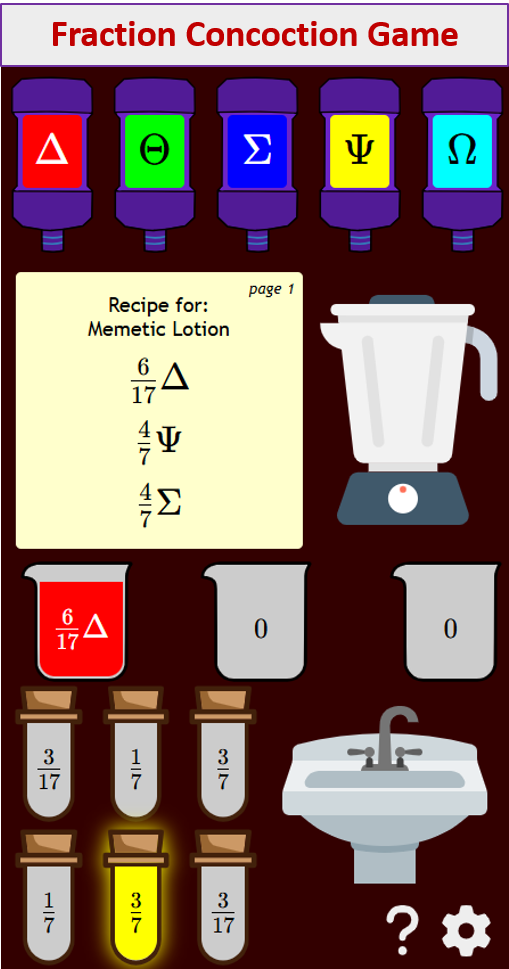
Try out our new and fun Fraction Concoction Game.
Add and subtract fractions to make exciting fraction concoctions following a recipe. There are four levels of difficulty: Easy, medium, hard and insane. Practice the basics of fraction addition and subtraction or challenge yourself with the insane level.
We welcome your feedback, comments and questions about this site or page. Please submit your feedback or enquiries via our Feedback page.