Using Matrices To Solve A System Of Equations Or Simultaneous Equations
Related Pages
Types Of Matrices
Solving Systems of Equations using Algebra
More Lessons On Matrices
Algebra Lessons
In these lessons, we will learn how to solve Systems of Equations or Simultaneous Equations using Matrices. We can use matrices to solve a system of linear equations.
Simultaneous equations or system of equations of the form:
ax + by = h
cx + dy = k
can be solved using algebra.
Simultaneous equations can also be solved using matrices.
How to Represent the System of Equations as a Matrix Equation
A system of linear equations can be represented in matrix form as:
AX = B
Where:
A is the coefficient matrix, containing the coefficients of the variables in the equations.
X is the variable matrix (a column matrix), containing the variables you want to solve for.
B is the constant matrix (a column matrix), containing the constants on the right side of the equations.
How To Solve Matrix Equations
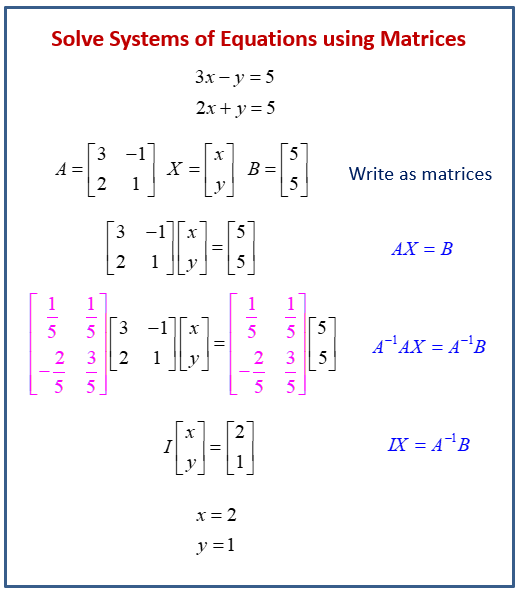
The following diagrams show how to solve a systems of equations using matrices. Scroll down the page for more
examples and solutions.
Methods to Solve using Matrices
There are several methods to solve the matrix equation AX = B for X. In this lesson, we will solve using the inverse matrix.
We have other lessons that show how to solve matrices using Gaussian Elimination and the Gauss-Jordan Method.
Using the Inverse Matrix:
If the coefficient matrix A is invertible (meaning its determinant is not zero), you can find the solution by multiplying both sides of the equation by the inverse of A (denoted as A⁻¹):
A⁻¹AX = A⁻¹B
IX = A⁻¹B (A⁻¹A = I, where I is the identity matrix)
X = A⁻¹B (IX = X, any matrix multiplied with the identity matrix will be unchanged)
So, to solve for X, you need to:
Find the inverse of matrix A (A⁻¹).
Multiply A⁻¹ by matrix B.
Review how to find the inverse of a matrix, if necessary.
Matrices & Systems of Equations
Example:
Using matrices, calculate the values of x and y for the following simultaneous equations:
2x – 2y – 3 = 0
8 y = 7x + 2
Solution:
Step 1: Write the equations in the form ax + by = c
2x – 2y – 3 = 0 ⇒ 2x – 2y = 3
8y = 7x + 2 ⇒ 7x – 8y = –2
Step 2: Write the equations in matrix form.

Step 3: Find the inverse of the 2 × 2 matrix.
Determinant = (2 × –8) – (–2 × 7) = – 2
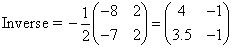
Step 4: Multiply both sides of the matrix equations with the inverse.

So, x = 14 and y = 12.5
How Matrices Can Be Used To Solve A System Of Equations?
Using the inverse of a matrix to solve a system of equations.
3x + 2y = 7
-6x + 6y = 6
How To Use A Matrix Equation To Solve A System Of Equations?
This video shows how to solve a system of equations by using a matrix equation.
AX = B
A-1AX = A-1B
IX = A-1B
X = A-1B
A 2 x 2 example and a 3 x 3 example are given.
Example:
Solve the system using a matrix equation
3x - y = 5
2x + y = 5
Example:
Solve the system using a matrix equation
x - 3y + 3z = -4
2x + 3y - z = 15
4x - 3y - z = 19
The graphing calculator is integrated into the lesson.
How To Solve Simultaneous Equations Using Matrices?
Step by step solution.
Example:
2x + 3y = 8
x - 2y = -3
Simultaneous Equations - Matrix Method
Try out our new and fun Fraction Concoction Game.
Add and subtract fractions to make exciting fraction concoctions following a recipe. There are four levels of difficulty: Easy, medium, hard and insane. Practice the basics of fraction addition and subtraction or challenge yourself with the insane level.
We welcome your feedback, comments and questions about this site or page. Please submit your feedback or enquiries via our Feedback page.