Remainder Theorem
In these lessons, we will look at the Remainder Theorem and how it relates to the Factor Theorem. We will also show how to solve polynomial problems using the Remainder Theorem.
Related Pages
Factor Theorem
Solving Cubic Equations
Remainder And Factor Theorems
More Algebra Lessons
Remainder Theorem And Factor Theorem
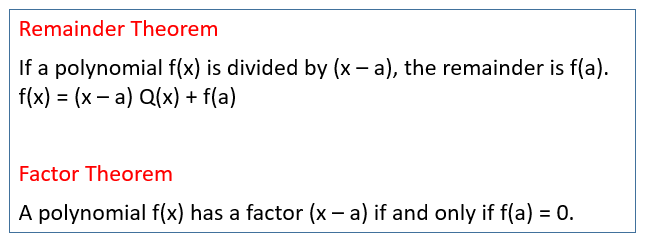
The following table gives the Remainder Theorem and Factor Theorem. Scroll down the page for more
examples and solutions on how to use the Remainder Theorem and Factor Theorem.
What is the Remainder Theorem?
Recall that for long division for integers, the dividing process stops when the remainder is less than the divisor.
dividend = divisor × quotient + remainder
The process is similar for division of polynomials. The dividing stops when the remainder is less that the degree of the divisor.
The Remainder Theorem states that:
If a polynomial f(x) is divided by a linear divisor (x – a), the remainder is f(a)
Hence, when the divisor is linear, the remainder can be found by using the Remainder Theorem.
How to use the Remainder Theorem?
Example:
Find the remainder when 4x3 – 5x + 1 is divided by
a) x – 2
b) x + 3
c) 2x – 1
Solution:
Let f(x) = 4x3– 5x + 1
a) When f(x) is divided by x – 2, remainder,
R = f(2) = 4(2)3– 5(2) + 1 = 23
b) When f(x) is divided by x + 3, remainder,
R = f(–3) = 4(–3)3– 5(–3) + 1 = –92
c) When f(x) is divided by 2x – 1, remainder,

Example:
The expression 4x2 – px + 7 leaves a remainder of –2 when divided by x – 3.
Find the value of p.
Solution:
Let f(x) = 4x2– px + 7
By the Remainder Theorem,
f(3) = –2
4(3)2– 3p + 7 = –2
p = 15
How to use the Remainder Theorem to find the remainder?
Examples:
Use the Remainder Theorem to find the remainder
- (3x3 - 2x2 + x - 6) ÷ (x - 4)
- (-4x3 + 8x2 + 12x + 16) ÷ (x + 2)
- (x6 + 4x5 + 9x3 - 4x2 + 10) ÷ (x + 1)
How to find the remainder in a polynomial division?
Examples:
Find the remainder using the Remainder Theorem
(4x4 + 2x2 + 1) ÷ (x - 3)
Finding The Remainders Of Polynomial Divisions
How to use the remainder and factor theorem in finding the remainders of polynomial divisions and also the factors of polynomial divisions?
The Remainder Theorem states that if a polynomial f(x) is divided by (x - k) then the remainder r = f(k). It can assist in factoring more complex polynomial expressions.
The Factor Theorem states that a polynomial f(x) has a factor (x - k) if and only f(k) = 0. It is a special case of the Remainder Theorem where the remainder = 0.
How to use the Remainder Theorem to test the factor of a polynomial?
Example:
Is x - 3 a factor of 24 - 11x3 + 15x2 + 4x - 12?
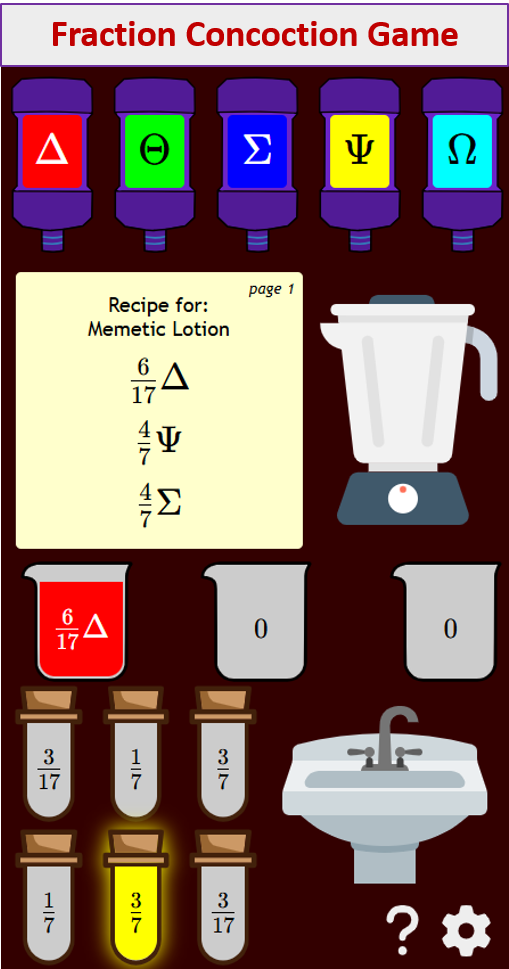
Try out our new and fun Fraction Concoction Game.
Add and subtract fractions to make exciting fraction concoctions following a recipe. There are four levels of difficulty: Easy, medium, hard and insane. Practice the basics of fraction addition and subtraction or challenge yourself with the insane level.
We welcome your feedback, comments and questions about this site or page. Please submit your feedback or enquiries via our Feedback page.