

Factoring Quadratic Equations
In this lesson, we will learn how to factor quadratic equations, where the coefficient of x2 is greater than 1, using the trial and error method. In this method, we will need to try out different possibilities to get the right factors for the given quadratic equation. In this lesson, we will also learn how to factor quadratic equations by grouping
We also have another lesson that will show you how to factor quadratic equations without trial and error.
Related Topics:
Other Factoring Techniques
More Algebra Lessons
Factoring Out Common Factors (GCF).
Factoring Quadratic Equations using Perfect Square Trinomial (Square of a Sum or Square of a Difference) or Difference of Two Squares.
Factoring Quadratic Equations where the coefficient of x2 is 1.
Factoring Quadratic Equations by Completing the Square
Factoring Quadratic Equations using the Quadratic Formula.
If the Coefficient of x2 Is Greater Than 1
Sometimes the coefficient of x in quadratic equations may not be 1, but the expression can be simplified by first finding common factors.
When the coefficient of x2 is greater than 1 and we cannot simplify the quadratic equation by finding common factors, we would need to consider the factors of the coefficient of x2 and the factors of c in order to get the numbers whose sum is b. If there are many factors to consider you may want to use the quadratic formula instead.
Example 1: Get the values of x for the equation 2x2 – 14x + 20 = 0
Step 1: Find common factors if you can.
2x2 – 14x + 20 = 2(x2 – 7x + 10)
Step 2: Find the factors of (x2 – 7x + 10)
List out the factors of 10:
We need to get the negative factors of 10 to get a negative sum.
–1 × –10, –2 × –5
Step 3: Find the factors whose sum is – 7:
1 + ( –10) ≠ –7
–2 + ( –5) = –7

Step 4: Write out the factors and check using the distributive property.
2(x – 2) (x – 5) = 2(x2 – 5 x – 2x + 10)
= 2(x2 – 7x + 10) = 2x2 – 14x + 20
Step 5: Going back to the original equation
Answer: x = 2, x = 52x2 – 14x + 20 = 0 Factorize the left hand side of the equation
2(x – 2) (x – 5) = 0We get two values for x

Step 1: List out the factors of 7 and 11
Factors of 7:
1 × 7Factors of 11:
1 × 11Since 7 and 11 are prime numbers there are only two possibilities to try out.
Step 2: Write down the different combinations of the factors and perform the distributive property to check.
(7x + 1)(x + 11) ≠ 7x2 + 18x + 11
(7x + 11)(x + 1) = 7x2 + 18x + 11
Step 3: Write out the factors and check using the distributive property.
(7x + 11)(x + 1) = 7x2 + 7x + 11x + 11 = 7x2 + 18x + 11
Step 4: Going back to the original equation
7x2 + 18x + 11= 0 Factorize the left hand side of the equation
(7x + 11)(x + 1) = 0We get two values for x

Answer: 
Example 3: Get the values of x for the equation 4x2 + 26x + 12 = 0
Step 1: Find common factors if you can.
4x2 + 26x + 12 = 2(2x2 + 13x + 6)
Step 2: List out the factors of 2 & 6
Factors of 2:
1 × 2Factors of 6:
1 × 6, 2 × 3
Step 3: Write down the different combinations of the factors and perform the distributive property to check. When there are many factors to check, this becomes a tedious method to solve such quadratic equations, so you may want to try the quadratic formula instead.
(x + 1)(2x + 6) ≠ (2x2 + 13x + 6)
(x + 6)(2x + 1) = (2x2 + 13x + 6)
Step 4: Going back to the original quadratic equation
4x2 + 26x + 12 = 0 Factorize the left side of the equation
2(x + 6)(2x + 1) = 0We get two values for x

Answer: 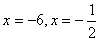
How to solve quadratic equations by factoring?
The method for solving quadratic equations by factoring is based on the zero-factor property of real numbers.
The zero factor property states that it two numbers a and b are multiplied together and the rsulting product is 0, then at least one of the numbers must be 0.
Examples:
Solve
1. x2 - 9x = 0
2. x2 - 3x - 10 = 0
3. x2 - 36 = 0
4. 3x2 + 4x - 7 = 0
Solving Quadratic Equations by Factoring
Examples:
Solve
a) x2 - 9x + 14 = 0
b) 2x2 - 5x = 3
Factoring Quadratic Equations by Grouping
Factoring by Grouping - 3 complete examples of solving quadratic equations using factoring by grouping are shown.Examples:
1. x(x + 1) - 5(x + 1)
2. 2x2 + 5x + 2 = 0
3. 7x2 + 16x + 4 = 0
4. 6x2 - 17x + 12 = 0
Solving Quadratic Equations by Factoring Using the Grouping Method
Examples:
25x2 - 20x + 4 = 0
Examples:
1. x(x - 2) + 7(x - 2) = 0
2. 3x2 + 6x + 4x + 8 = 0 How to factor and solve a quadratic equation by using the factor by grouping method?
Examples:
1. x(2x - 3) + 2x - 3 = 0
2. 3x2 - 3x - x + 1 = 0
Try the free Mathway calculator and
problem solver below to practice various math topics. Try the given examples, or type in your own
problem and check your answer with the step-by-step explanations.

We welcome your feedback, comments and questions about this site or page. Please submit your feedback or enquiries via our Feedback page.