Number Sequences
Related Pages
Linear Sequences
Geometric Sequences
Quadratic and Cubic Sequences
Number sequences are ordered lists of numbers that follow a particular pattern or rule. These sequences can be either finite or infinite, and can have different types of patterns. Some number sequences have a simple pattern, such as adding a fixed number to each term, while others may have more complex patterns that are not immediately obvious.
In these lessons, we will look at various types of number sequences and how to solve problems related to number sequences. In another set of lessons, we have some examples of Integer Word Problems that involve two unknowns.
Arithmetic and geometric sequences are two common types of number sequences that follow specific patterns.
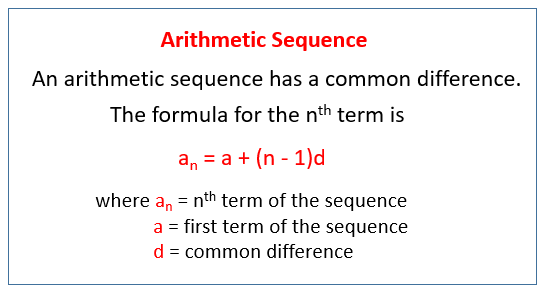
An arithmetic sequence is a sequence in which each term is obtained by adding a fixed number to the previous term. For example, 2, 4, 6, 8, 10, 12, … is an arithmetic sequence, where each term is obtained by adding 2 to the previous term. The fixed number that is added to each term is called the common difference.
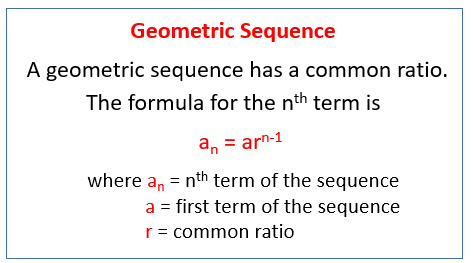
A geometric sequence, on the other hand, is a sequence in which each term is obtained by multiplying the previous term by a fixed number. For example, 2, 4, 8, 16, 32, 64, … is a geometric sequence, where each term is obtained by multiplying the previous term by 2. The fixed number that is multiplied by each term is called the common ratio.
The following diagrams give the formulas for Arithmetic Sequence and Geometric Sequence.
Scroll down the page for examples and solutions.
Printable & Online Sequence Worksheets
How To Find The Next Term In A Number Sequence?
A number sequence is a list of numbers arranged in a row. Let us look
at two examples below.
(i) 4, 6, 1, 10, 14, 5, …
(ii) 4, 7, 10, 13, ….
Number sequence (i) is a list of numbers without order or pattern. You cannot tell what number comes after 5.
Number sequence (ii) has a pattern. Do you observe that each number is obtained by adding 3 to the preceding number (i.e. the number just before it)?
In these lesson, we will only study number sequences with patterns.
Some other examples of number sequences are:
| Number Sequence | Pattern |
| 3, 6, 9, 12, ... | add 3 |
| 12, 17, 22, 27, ... | add 5 |
| 70, 65, 60, 55, ... | subtract 5 |
| 15, 19, 23, 27, … | add 4 |
| 81, 27, 9, 3, … | divide by 3 |
How To Complete Missing Terms In A Number Sequence?
Each of the number in the sequence is called a term. In order to find the missing terms in a number sequence, we must first find the pattern of the number sequence.
Example:
Find the missing terms in the following sequence:
8, ______, 16, ______, 24, 28, 32
Solution:
To find the pattern, look closely at 24, 28 and 32. Each term in the number sequence is formed by
adding 4 to the preceding number. So, the missing terms are 8 + 4 = 12 and 16 + 4 = 20. Check that the
pattern is correct for the whole sequence from 8 to 32.
Example:
What is the value of n in the following number sequence?
16, 21, n, 31, 36
Solution:
We find that the number pattern of the sequence is “add 5” to the preceding number.
So, n = 21 + 5 = 26
How To Find The Next Term In A Number Sequence?
The following video shows some examples of how to determine the next term in a number sequence.
Examples:
Find the next number
- 1, 8, 15, 22, …
- 1, 8, 64, 512, …
- 1, 8, 27, 64, …
- 1, 8, 16, 15, …
How To Find The nth Term Of An Arithmetic Sequence
Example:
7, 9, 11, 13, 15, …
How To Find The nth Term Of A Geometric Sequence
Example:
5, 10, 20, 40, …
| Check out our most popular games! | ||
|---|---|---|
 Fraction Concoction |
 Fact Family Game |
 Number Bond Garden |
 Online Addition Subtraction Game |
 Penguin Solitaire |
 Sawayama Solitaire |
 Ark Solitaire |
 Eldritch Invasion |
 Shenzhen Solitaire |
Check out more Solitaire games here.
We welcome your feedback, comments and questions about this site or page. Please submit your feedback or enquiries via our Feedback page.