

Techniques for Multiplying Polynomials
Related Topics:
More Lessons for Algebra
Math Worksheets
A series of free Basic Algebra Lessons.
Multiplication of Polynomials using the distributive property
Many examples of multiplying polynomials including binomial, trinomials, and squaring a binomial.
The following are special case examples of how to multiply binomials. When we multiply conjugate pairs we get the difference of squares.
When we square binomials we get perfect square trinomials.

More Lessons for Algebra
Math Worksheets
A series of free Basic Algebra Lessons.
In this lesson, we will learn
- how to multiply monomials
- how to multiply a monomial by a polynomial
- how to multiply binomials using the FOIL method
- how to multiply polynomials using the area model
- how to multiply polynomials using the distributive property
- how to multiply special cases polynomials
Multiplying Monomials and/or Binomials and FOIL
We multiply monomials and binomials using different methods, including the distributive property and FOIL. FOIL is a mnemonic device to remember how to find the product of two binomials: we multiply the First, Outer, Inner, and then Last terms in each binomial. When multiplying monomials and binomials, it is important to remember the rules of multiplying exponents.Multiplying Monomials
When multiplying monomials: multiply the coefficients, and add the exponents for like factors only. The following lesson looks at Multiplying MonomialsMultiplying monomials and polynomials
Multiplying a monomial by a polynomial combines several skills - all of which you have probably seen before: distributive multiplication, multiplying monomials, and combining like terms. To multiply a monomial and a polynomial we can use the distributive and exponent properties.Multiply Binomials using FOIL
The following looks at multiplying binomials (2 term polynomials). When multiplying binomials we use what we call the F.O.I.L Method. First, Outer, Inner, Last. Step by step demonstration of multiplying two binomials.Multiplying Polynomials using Area Models
Polynomials can be trickier than binomials when we multiply. Without FOIL, when multiplying polynomials we use different methods such as area models. Multiplying polynomials will be encountered often in Algebra II when solving equations. In order to understand multiplying polynomials, one must first understand multiplying monomials and binomials, and know the rules of multiplying exponents.Multiplying Polynomials using Distributing
There are different methods for multiplying polynomials. One method is to use an area model, but another way to multiply polynomials without having to draw diagrams, is to multiply polynomials using distribution. In order to understand multiplying polynomials using distribution, we need knowledge of multiplying monomials and binomials and to know the rules of multiplying exponents.Multiplication of Polynomials using the distributive property
Many examples of multiplying polynomials including binomial, trinomials, and squaring a binomial.
Multiplying Polynomials: Special Cases
When multiplying binomials and working with polynomials, sometimes we come up with polynomial special products. Examples of a special polynomial products include perfect square trinomials (a2 + 2ab + b2) and polynomials where the inner and outer terms are additive inverses and cancel each other out (a2 - b2). Knowing these types of special product patterns help us easily solve polynomial problems.The following are special case examples of how to multiply binomials. When we multiply conjugate pairs we get the difference of squares.
When we square binomials we get perfect square trinomials.
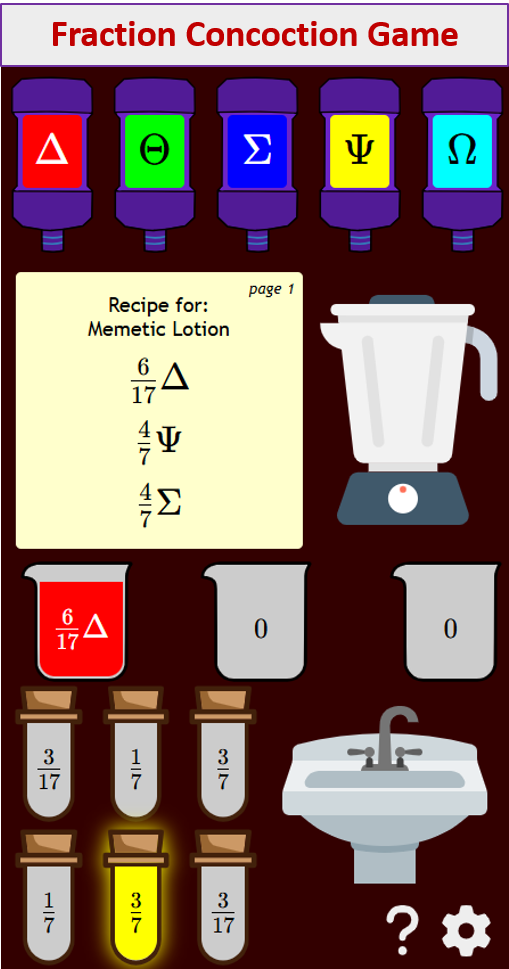
Try out our new and fun Fraction Concoction Game.
Add and subtract fractions to make exciting fraction concoctions following a recipe. There are four levels of difficulty: Easy, medium, hard and insane. Practice the basics of fraction addition and subtraction or challenge yourself with the insane level.
We welcome your feedback, comments and questions about this site or page. Please submit your feedback or enquiries via our Feedback page.