What Is Transformation In Math?
Related Pages
Geometric Transformations
Transformations In The Coordinate Plane
Translation
Rotation
More Geometry Lessons
In these lessons, we will learn the different types of transformation in Math: Translation, Reflection, Rotation, Dilation (enlargement)
Transformation involves moving an object from its original position to a new position. The object in the new position is called the image. Each point in the object is mapped to a corresponding point in the image.
The following figures show the four types of transformations: Translation, Reflection, Rotation, and Dilation. Scroll down the page for more examples and solutions using the transformations.
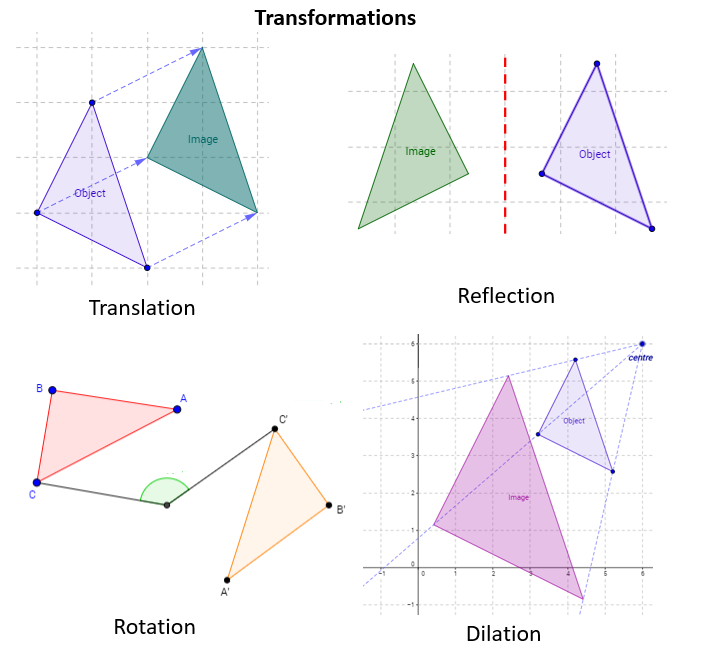
In these lessons, we will study the following types of transformations in math:
- Translation
- involves “sliding” the object from one position to another.
- Reflection
- involves “flipping” the object over a line called the line of reflection.
- Rotation
- involves “turning” the object about a point called the center of rotation.
- Dilation
- involves a resizing of the object. It could result in an increase in size (enlargement) or a decrease in size.
Translation, reflection and rotations are called isometric transformations because the image is the same size and shape as the original object. The original object and the image are congruent.
Dilation is not an isometric transformation because the size of the image is not the same as the object. The original object and the image are similar i.e. they have the same shape but different size.
Translation
How to translate a polygon on the coordinate plane?
How to translate a shape using translation vectors or column vectors?
Translations GCSE foundation maths transformations translating shape using translation vectors or column vectors.
Reflection
How to reflect a figure across the y-axis and the x-axis?
The following video shows examples of math reflection across the y-axis and x-axis.
How to reflect across horizontal and vertical lines?
GCSE Maths transformations: Reflections made easy in horizontal and vertical lines.
Rotation
How to rotate about the origin?
The following video shows examples of math rotation about the origin (0, 0).
Rotations in the Coordinate Plane
Dilation
The following video shows examples of math dilation (enlargement) with different scale factors.
Enlargement by a positive and negative scale factor
| Check out our most popular games! | ||
|---|---|---|
 Fraction Concoction |
 Fact Family Game |
 Number Bond Garden |
 Online Addition Subtraction Game |
 Penguin Solitaire |
 Sawayama Solitaire |
 Ark Solitaire |
 Eldritch Invasion |
 Shenzhen Solitaire |
Check out more Solitaire games here.
We welcome your feedback, comments and questions about this site or page. Please submit your feedback or enquiries via our Feedback page.