

Mechanical, Potential and Kinetic Energy
Related Topics:
More Lessons for High School Physics
Math Worksheets
A series of free Online High School Physics Video Lessons.
In this lesson, we will learn about
Understanding and recognizing mechanical energy.
Gravitational potential energy and kinetic energy
Viewers will see how energy can be transferred from one one to the other and will be introduced to frictional losses. Kinetic and potential energy.
Understanding and recognizing potential energy.
Simple example of how to calculate the gravitational potential energy of an object and to make an energy diagram.
Understanding and recognizing kinetic energy.
Basic kinetic energy calculation How doubling the velocity of an object effects the object's kinetic energy.


More Lessons for High School Physics
Math Worksheets
A series of free Online High School Physics Video Lessons.
In this lesson, we will learn about
- mechanical energy
- potential energy
- kinetic energy
Mechanical Energy
An object's ability to do work is measured by its mechanical energy, or the sum the object's kinetic energy and potential energy. Mechanical energy is due to the position or movement of an object. The formula for mechanical energy is mechanical energy = kinetic energy + potential energy.Understanding and recognizing mechanical energy.
Viewers will see how energy can be transferred from one one to the other and will be introduced to frictional losses. Kinetic and potential energy.
Potential Energy
Objects store energy in the form of potential energy. Chemical potential energy is an object's potential to undergo an exothermic reaction; spring potential energy is a compressed spring's potential to expand; and gravitational potential energy is an object's potential to fall from a high altitude to a low altitude. The formula for potential energy is gravitational potential energy = mass × acceleration due to gravity × height.Understanding and recognizing potential energy.
Simple example of how to calculate the gravitational potential energy of an object and to make an energy diagram.
Kinetic Energy
The energy of an object in motion is called kinetic energy. Kinetic energy is defined as the energy needed for an object to accelerate from a resting position to its current velocity. kinetic energy = 1/2 × mass × velocity2.Understanding and recognizing kinetic energy.
Basic kinetic energy calculation How doubling the velocity of an object effects the object's kinetic energy.
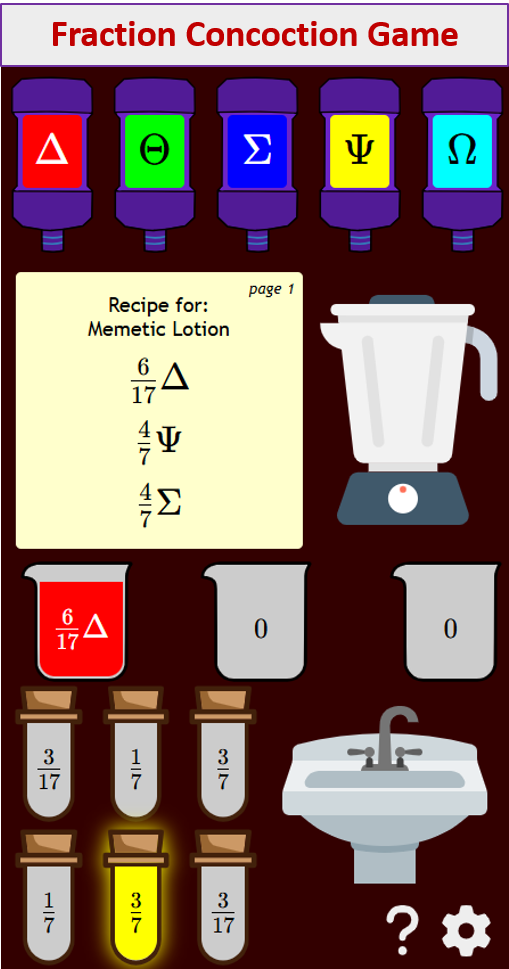
Try out our new and fun Fraction Concoction Game.
Add and subtract fractions to make exciting fraction concoctions following a recipe. There are four levels of difficulty: Easy, medium, hard and insane. Practice the basics of fraction addition and subtraction or challenge yourself with the insane level.
We welcome your feedback, comments and questions about this site or page. Please submit your feedback or enquiries via our Feedback page.