Fraction Word Problems (Difficult)
Related Pages
Fraction Word Problems
Singapore Math Lessons
Fraction Problems Using Algebra
Algebra Word Problems
Here are some examples of more difficult fraction word problems. We will illustrate how block models (tape diagrams) can be used to help you to visualize the fraction word problems in terms of the information given and the data that needs to be found.
How to solve fraction word problems using bar models?
Bar modeling (also known as tape diagrams or block models) are widely used in Singapore Math and the Common Core to help students visualize and understand math word problems.
Rectangular bars are used to represent whole amounts, parts, and the relationships between them. For fractions, the bar is divided into equal units based on the denominator. Once the bar model is drawn, a common strategy is to find the value of one “unit” (or one part of the bar) and then multiply or combine units to find the unknown quantity.
Example:
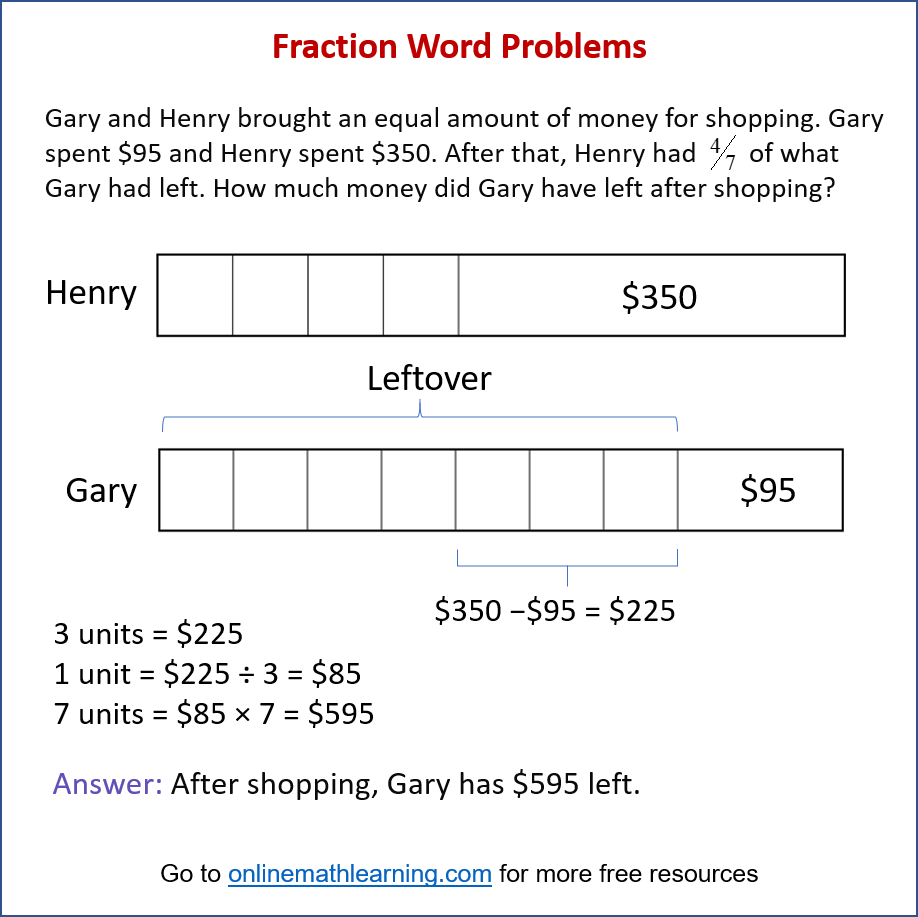
Gary and Henry brought an equal amount of money for shopping. Gary spent $95 and Henry spent $350.
After that Henry had 4/7 of what Gary had left. How much money did Gary have left after shopping?
The following diagram shows how to solve a fraction word problem using tape diagrams or block diagrams (Singapore Math). Scroll down the page for more examples and solutions on how to solve fraction word problems.
Fraction Worksheets
Practice with the following worksheets.
Printable & Online Fractions Worksheets
Example:
2/9 of the people on a restaurant are adults. If there are 95 more children than adults,
how many children are there in the restaurant?
Solution:
Draw a diagram with 9 equal parts: 2 parts to represent the adults and 7 parts to represent the children.
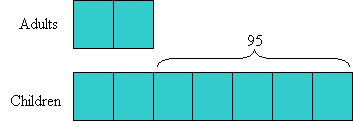
5 units = 95
1 unit = 95 ÷ 5 = 19
7 units = 7 × 19 = 133
Answer: There are 133 children in the restaurant.
Example:
Gary and Henry brought an equal amount of money for shopping. Gary spent $95 and Henry spent $350.
After that Henry had 4/7 of what Gary had left. How much money did Gary have left after shopping?
Solution:
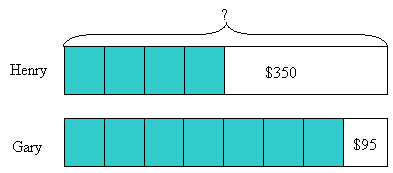
350 – 95 = 255
3 units = 255
1 unit = 255 ÷ 3 = 85
7 units = 85 × 7 = 595
Answer: Gary has $595 after shopping.
Example:
1/9 of the shirts sold at Peter’s shop are striped. 5/8 of the remainder are printed.
The rest of the shirts are plain colored shirts. If Peter’s shop has 81 plain colored
shirts, how many more printed shirts than plain colored shirts does the shop have?
Solution:
Draw a diagram with 9 parts. One part represents striped shirts. Out of the remaining 8
parts: 5 parts represent the printed shirts and 3 parts represent plain colored shirts.
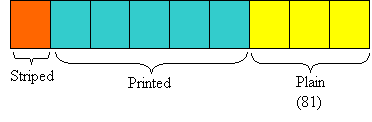
3 units = 81
1 unit = 81 ÷ 3 = 27
Printed shirts have 2 parts more than plain shirts.
2 units = 27 × 2 = 54
Answer: Peter’s shop has 54 more printed colored shirts than plain shirts.
Solve a problem involving fractions of fractions and fractions of remaining parts
Example:
1/4 of my trail mix recipe is raisins and the rest is nuts. 3/5 of the nuts are peanuts
and the rest are almonds. What fraction of my trail mix is almonds?
How to solve fraction word problem that involves addition, subtraction and multiplication using a tape diagram or block model
Example:
Jenny’s mom says she has an hour before it’s bedtime. Jenny spends 3/5 of the hour
texting a friend and 3/8 of the remaining time brushing her teeth and putting on her pajamas.
She spends the rest of the time reading her book. How long did Jenny read?
How to solve a four step fraction word problem using tape diagrams?
Example:
In an auditorium, 1/6 of the students are fifth graders, 1/3 are fourth graders, and 1/4 of the
remaining students are second graders. If there are 96 students in the auditorium, how many
second graders are there?
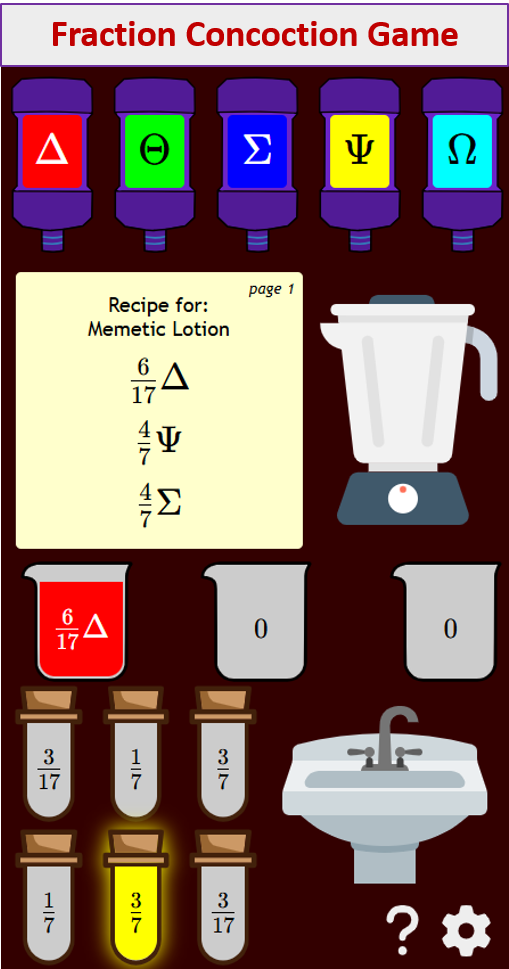
Try out our new and fun Fraction Concoction Game.
Add and subtract fractions to make exciting fraction concoctions following a recipe. There are four levels of difficulty: Easy, medium, hard and insane. Practice the basics of fraction addition and subtraction or challenge yourself with the insane level.
We welcome your feedback, comments and questions about this site or page. Please submit your feedback or enquiries via our Feedback page.