Factoring Quadratic
Related Topics:
More Lessons for Algebra
Math Worksheets
Factoring Quadratics, a = 1
Factoring Quadratics, a ≠ 1
Factoring Quadratics by Completing the Square
Factoring Quadratics using the Quadratic Formula
In these lessons, we will learn how to factor quadratic equations that are the Perfect Square Trinomials (Square of a Sum or Square of a Difference) and Difference of Two Squares.
Perfect Square Trinomials
Perfect Square Trinomials are special types of trinomials that result from squaring a binomial. Recognizing and factoring them is a shortcut that can save time compared to using the AC method or trial and error for trinomials.
A perfect square trinomial is of the form:
\(a^2 + 2ab + b^2\) or \(a^2 - 2ab + b^2\)
These can be factored into:
\(\left( a+b \right)^2\) or \(\left( a-b \right)^2\)
How to Recognize a Perfect Square Trinomial
- Identify the Squares:
Determine if the first and last terms are perfect squares.
Let a2 be the first term and b2 be the last term. - Check the Middle Term:
The middle term should be 2ab or −2ab. - Write the Factored Form:
If the middle term is +2ab, the factored form is (a+b)2.
If the middle term is −2ab, the factored form is (a-b)2.
Difference of Two Squares Form:
A difference of two squares is of the form:
\(a^2 - b^2\)
This can be factored into:
\(\left( a+b \right)\left( a-b \right)\)
How to Recognize the Difference of Two Squares
To use this factoring method, an expression must meet three conditions:
- It must have exactly two terms.
- Both terms must be perfect squares.
- There must be a subtraction sign between the two terms.
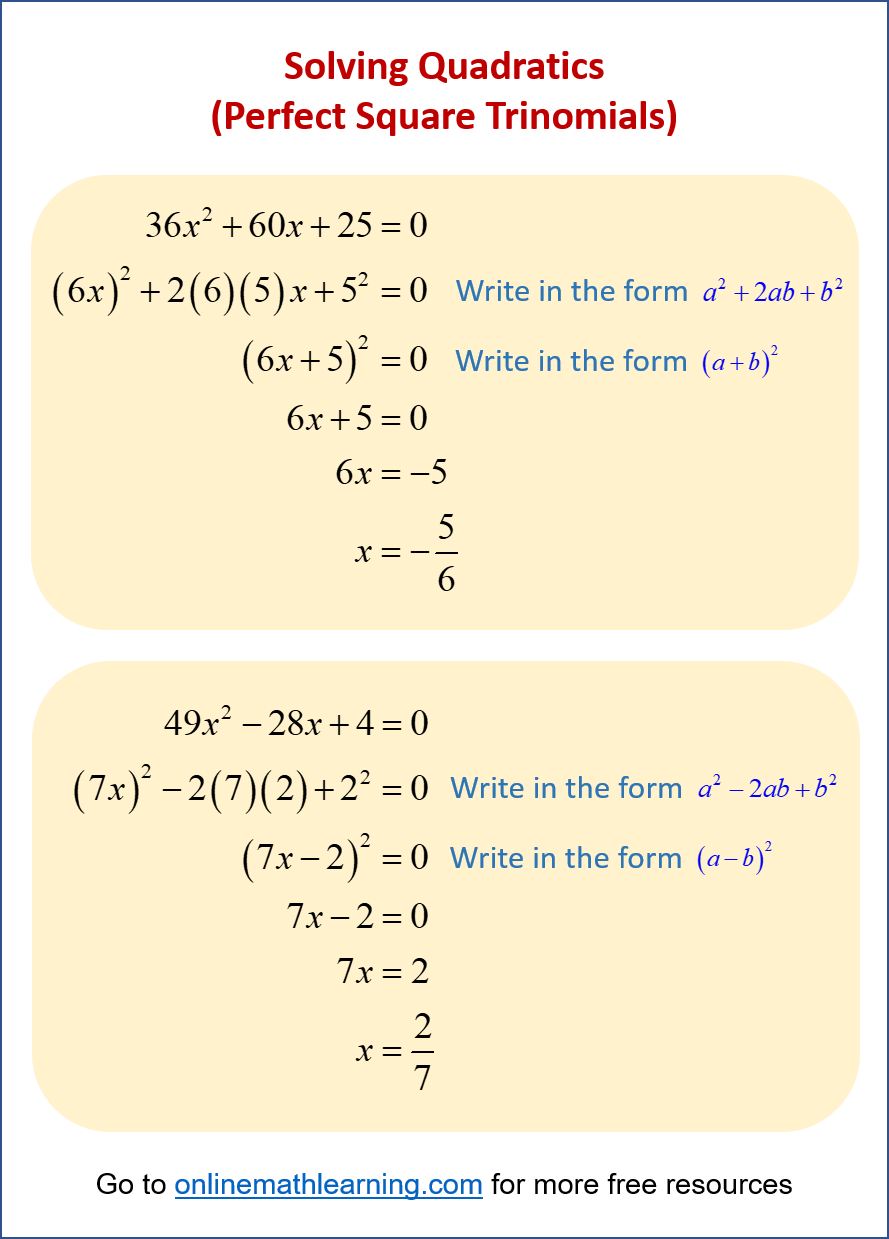
The following diagram shows some examples of solving quadratics by recognizing perfect square trinomials. Scroll down the page for more examples.
Algebra Worksheets
Practice your skills with the following worksheets:
Printable & Online Algebra Worksheets
Perfect Square Trinomial (Square Of a Sum)
A square of a sum or perfect square trinomial is a type of quadratic equations of the form:
x2 + 2bx + b2 = (x + b)2
| Example 1: | x2 + 2x + 1 = 0 |
| (x + 1)2 = 0 | |
 |
|
| Example 2: | x2 + 6x + 9 = 0 |
| x2 + 2(3)x + 32 = 0 | |
| (x + 3)2 = 0 | |
 |
Perfect Square Trinomial (Square of a Difference)
A square of difference is a type of quadratic equations of the form: x2 – 2bx + b2 = (x – b)2
| Example 1: | x2 – 2x + 1 = 0 |
| (x – 1)2 = 0 | |
 |
|
| Example 2: | x2 – 6x + 9 = 0 |
| x2 – 2(3)x + 32 = 0 | |
| (x – 3)2 = 0 | |
| x – 3 = 0 ⇒ x = 3 |
This video provides examples of how to factor and solve quadratic equations when the equations are perfect square trinomials.
Perfect Square Trinomials
One special case when trying to factor polynomials is a perfect square trinomial. Unlike a difference of perfect squares, perfect square trinomials are the result of squaring a binomial. It’s important to recognize the form of perfect square trinomials so that we can easily factor them without going through the steps of factoring trinomials, which can be very time consuming.
Factor perfect square trinomial
Difference of Two Squares
A difference of two squares is a type of quadratic equations of the form:
(a + b)(a – b) = a2 – b2
| Example: | x2 – 25 = 0 |
| x2 – 52 = 0 | |
| (x + 5)(x – 5) = 0 | |
| We get two values for x: | |
 |
Be careful! This method only works for difference of two squares and not for the sum of two squares: *a*2 + *b*2 ≠ (*a* + *b*)(*a* – *b*)
The following videos explain how to factor a difference of squares.
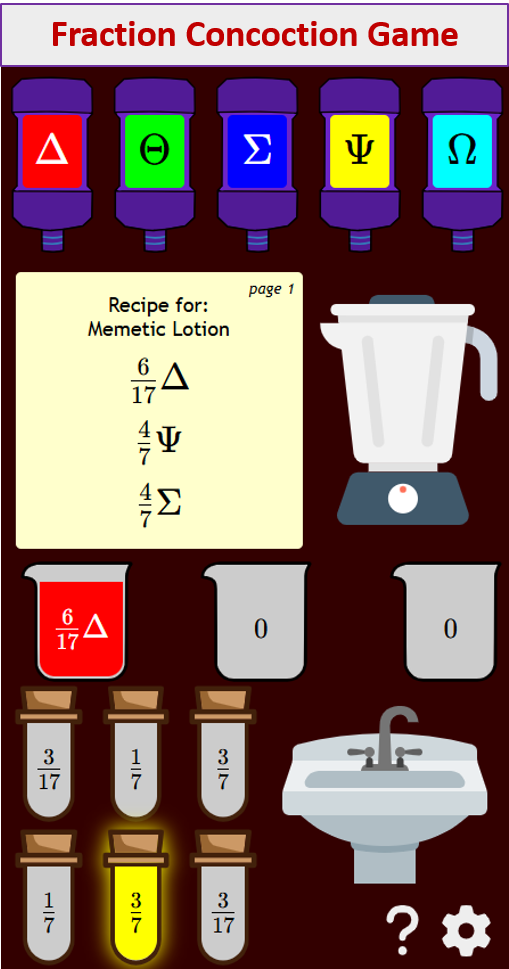
Try out our new and fun Fraction Concoction Game.
Add and subtract fractions to make exciting fraction concoctions following a recipe. There are four levels of difficulty: Easy, medium, hard and insane. Practice the basics of fraction addition and subtraction or challenge yourself with the insane level.
We welcome your feedback, comments and questions about this site or page. Please submit your feedback or enquiries via our Feedback page.