Animal Facts - Okapi
In this page we will look at the Okapi.
If you have any interesting or funny facts about animals or would like to find out more information about a particular animal, please fill up the Feedback form and we will be happy to add it to our list of animal facts.
Is the Okapi a horse, a zebra or neither?
An Okapi is neither a horse nor a zebra; its nearest relative is the giraffe. The body shape is similar to that of the giraffe, except that okapis have much shorter necks. Both species have very long (approx. 30 cm or 12 inch), flexible, blue tongues that they use to strip leaves and buds from trees. The tongue of an okapi is long enough for the animal to wash its eyelids and clean its ears; it is one of the few mammals that can lick its own ears.
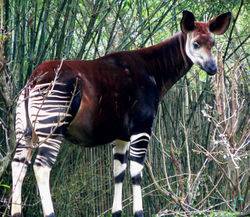
Okapis have dark backs, with striking horizontal white stripes on the front and back legs, making them resemble zebras from a distance. These markings are thought to help young follow their mothers through the dense rain forest; they also serve as camouflage.
Okapis have several methods of communicating their territory, including scent glands on each foot that leave behind a tar-like substance which signals their passage, as well as urine marking. Males are protective of their territory, but allow females to pass through their domain to forage.
Okapis prefer altitudes of 500 to 1,000 m, but may venture above 1,000 m in the eastern montane rainforests. The range of the okapi is limited by high montane forests to the east, swamp forests below 500 m to the west, savannas of the Sahel/Sudan to the north, and open woodlands to the south. Okapis are most common in the Wamba and Epulu areas.
This video shows an Okapi in the African rainforest.
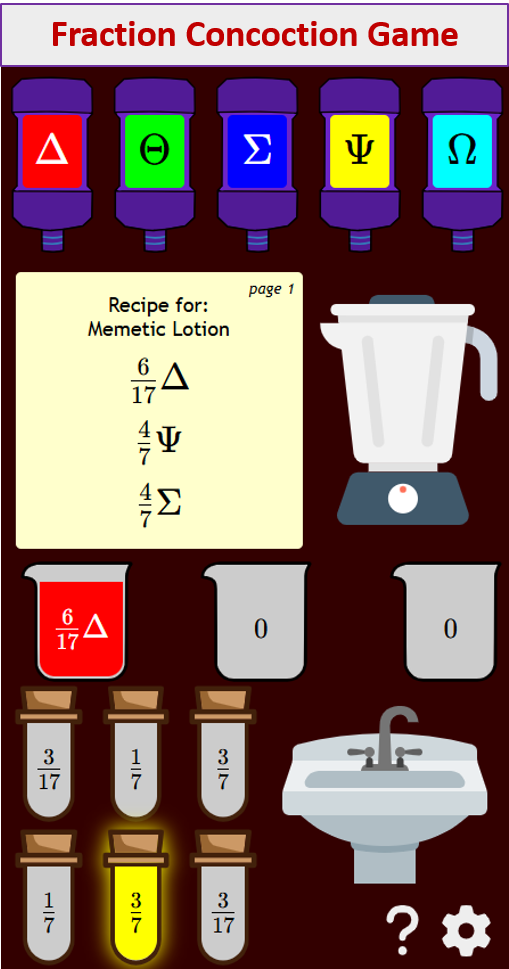
Try out our new and fun Fraction Concoction Game.
Add and subtract fractions to make exciting fraction concoctions following a recipe. There are four levels of difficulty: Easy, medium, hard and insane. Practice the basics of fraction addition and subtraction or challenge yourself with the insane level.
We welcome your feedback, comments and questions about this site or page. Please submit your feedback or enquiries via our Feedback page.