Animal Facts - Chameleon
On this page we will look at the chameleon.
If you have any interesting or funny facts about animals or would like to find out more information about a particular animal, please fill up the Feedback form and we will be happy to add it to our list of animal facts.
Related Topics:
More Amazing Animals
Is a chameleon’s tongue longer than its body?
Yes, chameleons have very long tongues (sometimes longer than their own body) which they can rapidly extend out of their mouths. The tongue extends faster than the human eye can follow, at around 26 body lengths per second. Usually it hits the prey in about 30 thousandths of a second. The tongue’s tip is a bulbous ball of muscle, and as it hits its prey, it rapidly forms a small suction cup. Once the tongue sticks to the prey, it is drawn quickly back into the chameleon’s mouth, where the chameleon’s strong jaws crush it Even a small chameleon is capable of eating a large locust or mantis.
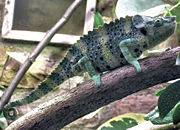
Their eyes are the most distinctive among the reptiles. The upper and lower eyelids are joined, with only a pinhole large enough for the pupil to see through. The eyes can rotate and focus separately to observe two different objects simultaneously, giving them a full 360-degree arc of vision around their body. When prey is located, both eyes can be focused in the same direction, giving sharp stereoscopic vision and depth perception. They have very good eyesight for reptiles, letting them see small insects from a relatively great (5-10cm) distance.
All chameleon species are able to change their skin color. Different chameleon species are able to change into different colors which can include pink, blue, red, orange, green, black, brown and yellow. A change can occur in 20 seconds! Chameleons are naturally colored for their surroundings as a camouflage. Chameleons change their color in response to light exposure and ambient temperature, as well as to express their mood (not for camouflage, as is commonly believed). Emotions and attraction of a mate can induce the color changes seen in a chameleon. The color changes also play a part in communication.
This video shows a chameleon eating a fly, only to be eaten by a snake.
How does a chameleon change color?
This video illustrates how the cells of a chameleon can create color changes to express emotions.
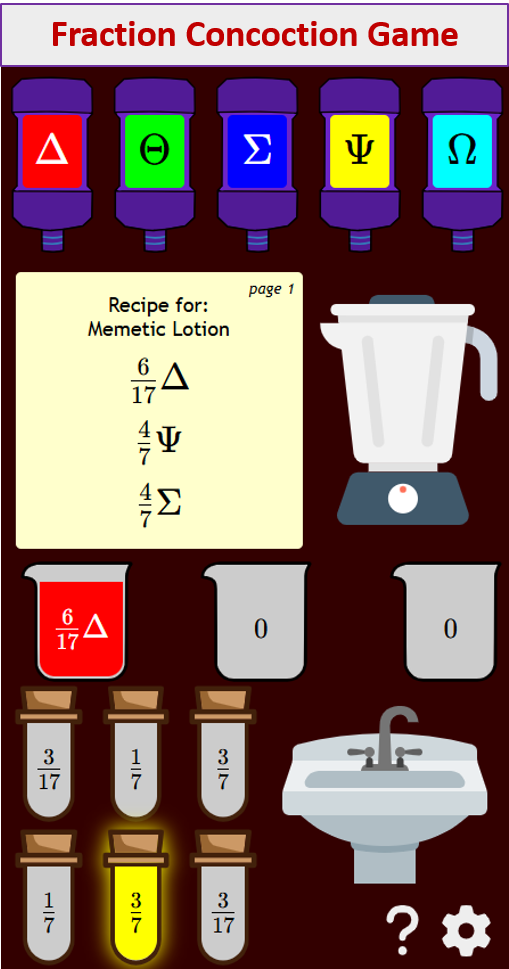
Try out our new and fun Fraction Concoction Game.
Add and subtract fractions to make exciting fraction concoctions following a recipe. There are four levels of difficulty: Easy, medium, hard and insane. Practice the basics of fraction addition and subtraction or challenge yourself with the insane level.
We welcome your feedback, comments and questions about this site or page. Please submit your feedback or enquiries via our Feedback page.