Arithmetic Operations On Functions
Related Pages
Adding & Subtracting Polynomials
Algebra Terms
Algebraic Expressions
More Algebra Lessons
In these lessons, we will look at how functions can be added, subtracted, multiplied or divided. You may also want to look at the lessons on composite functions.
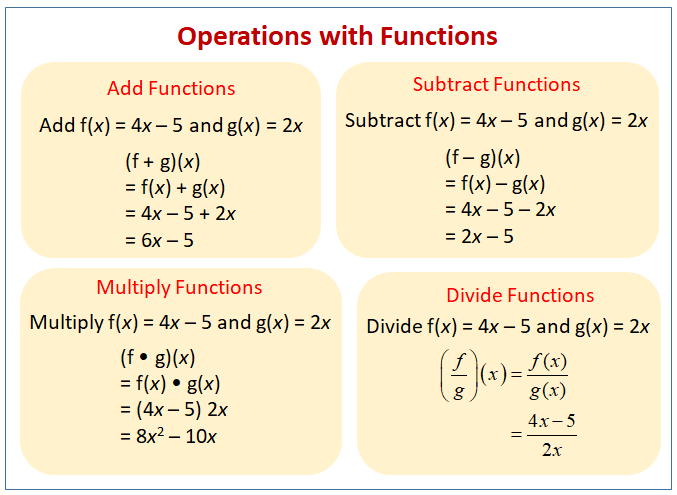
When we talk about arithmetic operations on functions, we mean combining two or more functions using the basic operations of addition, subtraction, multiplication, and division to create a new function.
The following diagram shows the operations with functions: addition, subtraction, multiplication, and division. Scroll down the page for more examples and solutions on function operations.
Functions Can Be Added
Example:
Add the functions f(x) = x + 2 and g(x) = 5x – 6
Solution:
(f + g)(x)
= f(x) + g(x)
= (x + 2) + (5x – 6)
= 6x – 4
Functions Can Be Subtracted
Example:
Given f(x) = x + 2 and g(x) = 5x – 6, find (f – g)(x)
Solution:
(f – g)(x)
= f(x) – g(x)
= (x + 2) – (5x – 6)
= –4x + 8
Functions Can Be Multiplied
Example:
Add the functions f(x) = x + 2 and g(x) = 5x – 6
Solution:
(f • g)(x)
= f(x) • g(x)
= (x + 2)(5x – 6)
= 5x2 + 4x – 12
Functions Can Be Divided
Example:
Given f(x) = x + 2 and g(x) = 5x – 6, find 
Solution:
 for g(x) ≠ 0
Functions: Adding And Subtracting
Examples:
- f(x) = x2 + 3x
g(x) = 8x + 9
(f+g)(x) = f(x) + g(x) = ? - f(x) = x2 + 2x + 8
g(x) = 3x2 - x + 7
(f-g)(x) = f(x) - g(x) = ?
Functions: Multiplying And Dividing
Example:
f(x) = (x2 - 1)
g(x) = (x + 1)
(fg)(x) = ?
(f/g)(x) = ?
Combining Functions By Addition Subtraction Multiplication And Division
Example:
f(x) = 3x2 + 4
g(x) = x - 5
(f + g)(x) = ?
(f - g)(x) = ?
(fg)(x) = ?
(f/g)(x) = ?
Sum, Difference, Product And Quotient Of Two Functions
How to find the sum, difference, product and quotient of two functions and determine the domain?
Example:
f(x) = 5x - 4
g(x) = -9x + 6
(f + g)(x) = ?
(f - g)(x) = ?
(fg)(x) = ?
(f/g)(x) = ?
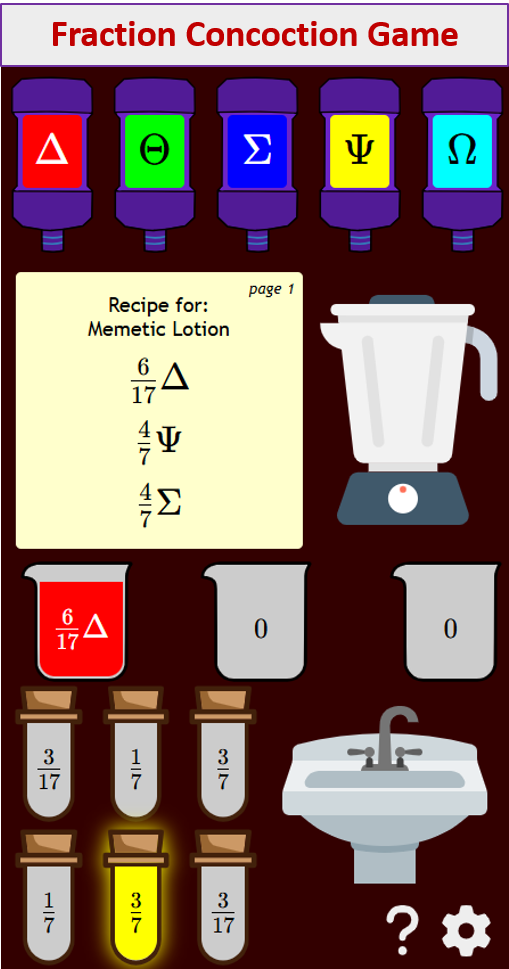
Try out our new and fun Fraction Concoction Game.
Add and subtract fractions to make exciting fraction concoctions following a recipe. There are four levels of difficulty: Easy, medium, hard and insane. Practice the basics of fraction addition and subtraction or challenge yourself with the insane level.
We welcome your feedback, comments and questions about this site or page. Please submit your feedback or enquiries via our Feedback page.