Upper and Lower Bounds
Related Pages
Upper And Lower Bounds - Sample GCSE Exam Questions
More Lessons for GCSE Maths
Math Worksheets
These lessons, with videos, examples and step-by-step solutions, help GCSE Maths students learn to calculate upper and lower bounds.
Upper and Lower Bounds
Bounds describe the range of possible values for a rounded or measured quantity.
Lower Bound (LB) = The smallest possible value before rounding up.
Upper Bound (UB) = The smallest value that would round up to the next number.
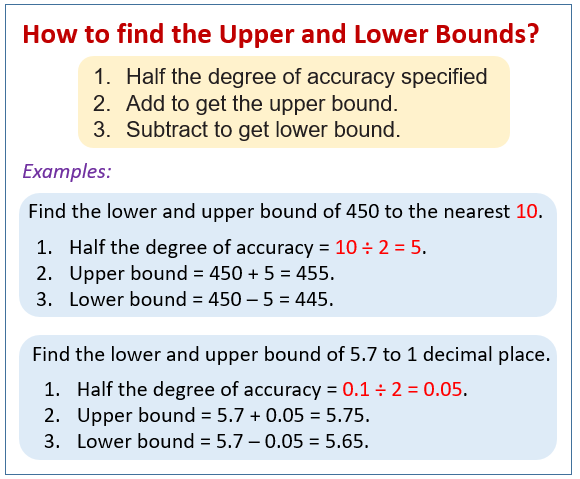
The following diagram gives the steps to find the upper and lower bounds. Scroll down the page for more examples and solutions on calculating upper and lower bounds.
Precision & Error Games
Greatest Possible Error
Upper & Lower Bounds
Upper & Lower Bound Calculations
Rounding Worksheets
Practice your skills with the following worksheets:
Printable & Online Rounding Worksheets
Steps to Calculate Upper and Lower Bounds:
- Identify the degree of accuracy: Determine what the number was rounded to (e.g., nearest whole number, nearest 10, nearest 0.1, 2 decimal places, 3 significant figures).
- Halve the degree of accuracy: Divide this degree of accuracy by 2. This gives you the “error margin."
- Calculate the Lower Bound (LB): Subtract the error margin from the rounded value.
- Calculate the Upper Bound (UB): Add the error margin to the rounded value.
Example: The number of people at a concert is estimated as 700 to the nearest 100.
- Degree of accuracy: Nearest 100.
- Half the degree of accuracy: 100÷2=50.
- Lower Bound: 700−50=650.
- Upper Bound: 700+50=750.
So, the actual number of people x is 650≤x<750.
Example: A distance is given as 3.0 km to 2 significant figures.
- Degree of accuracy: The last significant figure is in the tenths place, so the accuracy is to the nearest 0.1 km.
- Half the degree of accuracy: 0.1km÷2=0.05km.
- Lower Bound: 3.0−0.05=2.95km.
- Upper Bound: 3.0+0.05=3.05km.
So, the actual distance x is 2.95km≤x<3.05km.
GCSE Upper and Lower Bounds 1
Upper & lower bounds 2 (word problems)
Upper & lower bounds 3 (calculations)
How to do Upper and Lower Bounds A/A* GCSE Higher Maths Worked Exam question revision, practice & help
Calculating Bounds for Calculations (e.g., Sums, Products, Quotients)
When you have a calculation involving two or more rounded numbers, you can find the upper and lower bounds of the result by combining the individual bounds in specific ways.
Let A and B be two numbers with their own lower bounds (LBA, LBB) and upper bounds (UBA,UBB).
-
Addition (A+B):
Lower Bound: LBA + LBB
Upper Bound: UBA + UBB -
Subtraction (A−B):
Lower Bound: LBA − UBB (to make the result smallest, subtract the largest possible value of B from the smallest possible value of A)
Upper Bound: UBA − LBB (to make the result largest, subtract the smallest possible value of B from the largest possible value of A) -
Multiplication (A×B):
Lower Bound: LBA × LBB
Upper Bound: UBA × UBB -
Division (A÷B):
Lower Bound: LBA ÷ UBB (to make the result smallest, divide the smallest A by the largest B)
Upper Bound: UBA ÷ LBB (to make the result largest, divide the largest A by the smallest B)
| Check out our most popular games! | ||
|---|---|---|
 Fraction Concoction |
 Fact Family Game |
 Number Bond Garden |
 Online Addition Subtraction Game |
 Penguin Solitaire |
 Sawayama Solitaire |
 Ark Solitaire |
 Eldritch Invasion |
 Shenzhen Solitaire |
Check out more Solitaire games here.
We welcome your feedback, comments and questions about this site or page. Please submit your feedback or enquiries via our Feedback page.