Finding Terms in a Binomial Expansion
Related Topics:
More Lessons for A Level Maths
Math Worksheets
Examples, solutions, videos, activities, and worksheets that are suitable for A Level Maths.
Binomial Theorem
The Binomial Theorem provides a way to expand expressions of the form (a+b)n without multiplying them out manually.
The following diagram shows the Binomial Theorem Formula. Scroll down the page for more examples of how to use the Binomial Theorem.
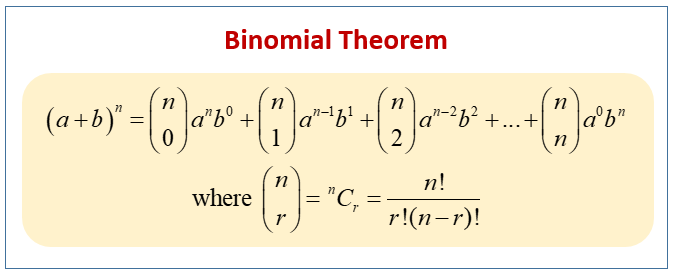
The Binomial Theorem can be written more compactly using summation notation:
\((a+b)^n= \sum_{r=0}^{n} \binom{n}{r} a^{n-r} b^r \)
where
\((a+b)^n\) is the binomial expression you want to expand.
a is the first term of the binomial.
b is the second term of the binomial.
n is the exponent (a non-negative integer).
\(\sum_{r=0}^{n}\) is the summation symbol, meaning you sum up the terms as r goes from 0 to n.
\(\binom{n}{r}\) is the binomial coefficient, often read as “n choose r” or “n C r”. It represents the number of ways to choose r items from a set of n distinct items. Its formula is:
\(\binom{n}{r} = \frac{n!}{r!(n-r)!}\)
Key Properties of Binomial Expansions:
- An expansion of (a+b)n will have n+1 terms.
- In each term, the sum of the exponents of a and b always equals n.
- Exponents of \(a\) starts at n and decreases to 0 and exponents of \(b\) starts at 0 and increases to n.
- Symmetry of Coefficients: The binomial coefficients are symmetric. That is, \(\binom{n}{r} = \binom{n}{n-r}\)
The Binomial Theorem’s General Term Formula
For a binomial expression of the form (a+b)n, the (r + 1)th term, denoted as Tr+1 is given by:
\(T_{r+1} = \binom{n}{r} a^{n-r}b^{n}\)
Core 4 Maths A-Level Edexcel - Binomial Theorem (1)
Examples:
- Find the first four terms in the binomial expansion of (1 + 2x)5
- Find the first four terms in the binomial expansion of (2 - x)6
Core 4 Maths A-Level Edexcel - Binomial Theorem (2)
With negative and fractional n
Examples:
- Find the first four terms in the binomial expansion of 1/(1 + x)
- Find the first four terms in the binomial expansion of √(1 - 3x)
- Find the binomial expansion of (1 - x)1/3 up to and including the term x3
- Find the binomial expansion of 1/(1 + 4x)2 up to and including the term x3
- Find the binomial expansion of √(1 - 2x) up to and including the term x3. By substituting in x = 0.001, find a suitable decimal approximation to √2
Core 4 Maths A-Level Edexcel - Binomial Theorem (3)
Binomial theorem of form (ax+b) to the power of n, where n is negative or fractional.
Examples:
- Use the binomial expansion to find the first four terms of √(4 + x)
- Use the binomial expansion to find the first four terms of 1/(2 + 3x)2
Core 4 Maths A-Level Edexcel - Binomial Theorem (4)
Partial fractions and binomial theorem
Example:
a) Express (4-5x)/(1+x)(2-x) as partial fractions.
b) Hence show that the cubic approximation of (4-5x)/(1+x)(2-x) is 2 - 7x/2 + 11/4x2 - 25/8x3.
c) State the range of values of x for which the expansion is valid.
| Check out our most popular games! | ||
|---|---|---|
 Fraction Concoction |
 Fact Family Game |
 Number Bond Garden |
 Online Addition Subtraction Game |
 Penguin Solitaire |
 Sawayama Solitaire |
 Ark Solitaire |
 Eldritch Invasion |
 Shenzhen Solitaire |
Check out more Solitaire games here.
We welcome your feedback, comments and questions about this site or page. Please submit your feedback or enquiries via our Feedback page.