Systems of Equations (Types of Solutions)
Related Pages
Common Core for Grade 8
Common Core for Mathematics
More Math Lessons for Grade 8
These lessons, with videos, examples, and solutions, help Grade 8 students learn how to analyze and solve pairs of simultaneous linear equations.
Solving Systems of Equations
A. Understand that solutions to a system of two linear equations in two variables correspond to points of intersection of their graphs, because points of intersection satisfy both equations simultaneously.
B. Solve systems of two linear equations in two variables algebraically, and estimate solutions by graphing the equations. Solve simple cases by inspection. For example, 3x + 2y = 5 and 3x + 2y = 6 have no solution because 3x + 2y cannot simultaneously be 5 and 6.
C. Solve real-world and mathematical problems leading to two linear equations in two variables. For example, given coordinates for two pairs of points, determine whether the line through the first pair of points intersects the line through the second pair.
Common Core: 8.EE.8ab
Suggested Learning Targets
- I can identify the solution(s) to a system of two linear equations in two variables as the point(s) of intersection of their graphs.
- I can describe the point(s) of intersection between two lines as the points that satisfy both equations simultaneously.
- I can define “inspection.”
- I can solve a system of two equations (linear) in two unknowns algebraically.
- I can identify cases in which a system of two equations in two unknowns has no solution.
- I can identify cases in which a system of two equations in two unknowns has an infinite number of solutions.
- I can solve simple cases of systems of two linear equations in two variables by inspection.
- I can estimate the point(s) of intersection for a system of two equations in two unknowns by graphing the equations.
- I can represent real-world and mathematical problems leading to two linear equations in two variables.
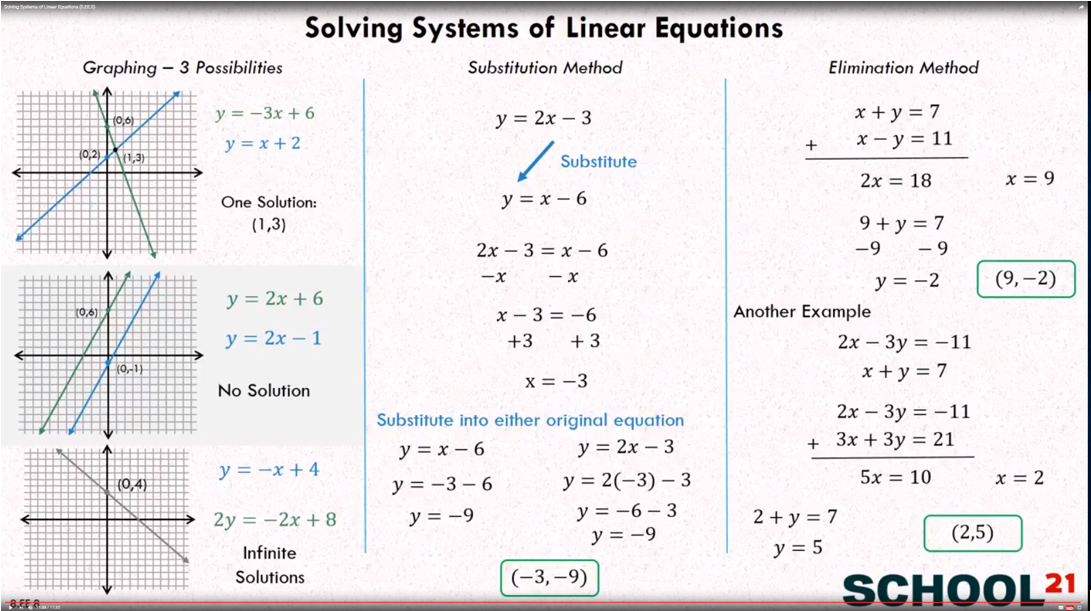
The following table shows examples of solving systems of two linear equations in two variables algebraically, and estimating solutions by graphing the equations.
Algebra Worksheets
Practice your skills with the following worksheets:
Printable & Online Algebra Worksheets
Solving Systems of Linear Equations (8.EE.8)
Graphing - 3 possibilities:
One solution, No solution and Infinite solutions.
Solve using the substitution method.
Solve using the elimination method.
1. Graphical Method
The graphical method involves plotting both equations on the coordinate plane. The solution to the system is the point where the graphs intersect.
Best for visualizing solutions or for approximating solutions when exact values are not critical. It can be less accurate for non-integer solutions.
2. Substitution Method
The substitution method involves solving one of the equations for one variable in terms of the other(s) and then substituting that expression into the other equation(s).
This method is often most efficient when one of the variables in either equation has a coefficient of 1 or -1, making it easy to isolate.
3. Elimination Method (or Addition Method)
The elimination method involves adding or subtracting the equations to eliminate one of the variables.
This method is effective when the coefficients of one variable are opposites or can be easily made opposites by multiplying one or both equations by a constant.
Types of Solutions for Linear Systems:
When solving a system of two linear equations with two variables, there are three possible outcomes:
- One Unique Solution: The lines intersect at exactly one point. This is the most common case. (Consistent and Independent)
- No Solution: The lines are parallel and never intersect. When solving algebraically, you will arrive at a false statement (e.g., 0=5). (Inconsistent)
- Infinitely Many Solutions: The two equations represent the exact same line (coincident lines). When solving algebraically, you will arrive at a true statement (e.g., 0=0). (Consistent and Dependent)
Using Systems of Linear Equations (8.EE.8)
Example:
- Sheila’s age and her dad’s age add up to 63. 5 years ago, Sheila’s dad’s age was 1 less than 5 times Sheila’s age. What are their ages now?
- For a guacamole recipe, you buy 3 lb of avocadoes and 2 lb of onions, which costs you $18 total. Your friend has a different recipe, so he buys 4 lb of avocadoes and 1 lb of onions for $19 total (at the same store, at the same per pound prices). Find the avocado price per pound and the onion price per pound.
Types of solutions for systems of equations
This video discusses the characteristics of solutions of linear equations that have one solution, no solutions, or an infinite number of solutions.
Three main types of solutions of linear equations with examples
| Check out our most popular games! | ||
|---|---|---|
 Fraction Concoction |
 Fact Family Game |
 Number Bond Garden |
 Online Addition Subtraction Game |
 Penguin Solitaire |
 Sawayama Solitaire |
 Ark Solitaire |
 Eldritch Invasion |
 Shenzhen Solitaire |
Check out more Solitaire games here.
We welcome your feedback, comments and questions about this site or page. Please submit your feedback or enquiries via our Feedback page.