Surveys, Experiments, and Observational Studies
Related Topics:
Common Core (Statistics & Probability)
Common Core for Mathematics
Examples, videos, and lessons to help High School students learn how to recognize the purposes of and differences among sample surveys, experiments, and observational studies; explain how randomization relates to each.
Common Core: HSS-IC.B.3
When conducting research, especially in fields like science, social sciences, and health, it’s crucial to understand the different methodologies used to collect data and draw conclusions. Surveys, experiments, and observational studies are three primary types of research designs, each with its own characteristics, strengths, and limitations.
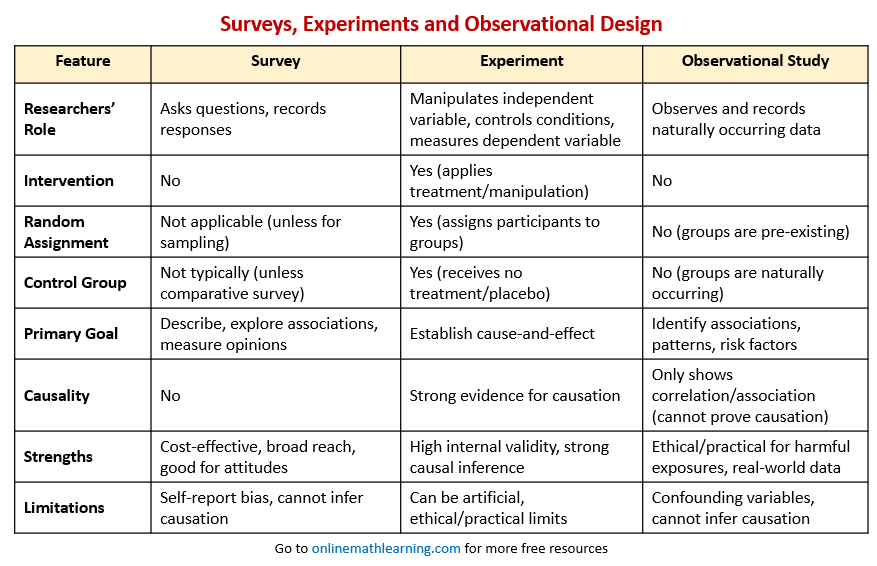
The following table gives a summary of the different research designs: Survey, Experiment, Observational Study. Scroll down the page for more examples and solutions.
Statistics Worksheets
Practice your skills with the following worksheets:
Printable & Online Statistics Worksheets
1. Surveys
A survey is a method of gathering information from a sample of individuals, usually through their responses to questions. The goal is typically to describe characteristics of a population, explore relationships between variables, or measure opinions, attitudes, and behaviors.
Key Characteristics of Surveys:
Data Collection Method: Information is collected directly from individuals, often through questionnaires (online, paper, mail), interviews (face-to-face, phone), or polls.
Purpose: Primarily descriptive or correlational. Surveys aim to describe “what is” or identify associations between variables. They do not establish cause-and-effect relationships.
Sampling: A subset of a larger population (a sample) is selected to represent that population. The quality of the sample (e.g., representativeness, size) is crucial for generalizing findings.
No Manipulation/Intervention: Researchers do not manipulate any variables or introduce any treatments. They simply ask questions and record responses.
Subjectivity: Data collected can be subjective, relying on respondents’ honesty, memory, and interpretation of questions.
Efficiency: Can gather data from a large number of people relatively quickly and cost-effectively.
2. Experiments
An experiment is a research method used to establish a cause-and-effect relationship between variables. It involves the researcher actively manipulating one or more independent variables to observe their effect on a dependent variable, while controlling for other factors.
Key Characteristics of Experiments:
Manipulation: The researcher deliberately changes or manipulates one or more independent variables (also called treatments or interventions).
Control: The researcher controls other variables that might influence the outcome, often by having a control group that does not receive the treatment (or receives a placebo).
Random Assignment: Participants are randomly assigned to different groups (e.g., experimental group, control group). This is a hallmark of a “true experiment” and helps ensure that groups are comparable at the start, minimizing pre-existing differences as alternative explanations for results.
Measurement: The dependent variable is measured to see if it changes in response to the manipulation.
Causality: Experiments are the strongest method for inferring causality because of the manipulation and control.
Internal Validity: High internal validity means that the observed effect on the dependent variable can be confidently attributed to the independent variable manipulation.
3. Observational Studies
An observational study is a research design where the researcher observes and collects data on variables without actively manipulating any of them or assigning treatments. Unlike experiments, the researcher does not intervene or control the conditions.
Key Characteristics of Observational Studies:
No Manipulation/Intervention: The researcher merely observes and records existing phenomena or relationships. They do not influence who is exposed to a factor or treatment.
Naturally Occurring Groups: Groups are formed based on pre-existing characteristics or exposures that occur naturally, not by random assignment by the researcher.
Purpose: Primarily to describe patterns, identify associations or correlations between variables, or explore potential risk factors.
Cannot Prove Causation: Because there is no manipulation or random assignment, observational studies can only suggest associations or correlations, not definitive cause-and-effect relationships. There’s a higher risk of confounding variables (other unmeasured factors) influencing the results.
External Validity: Often have higher external validity (generalizability) than experiments because they reflect real-world conditions.
Ethical/Practical Considerations: Often used when it would be unethical or impractical to conduct an experiment (e.g., studying the effects of smoking on lung cancer).
Videos
Surveys, Observational Studies, Experiments.
Survey, Experiments, and Observational Studies 2.
Experiments, Surveys, and Observational Studies
Going over the differences and applying them.
Observational Studies vs. Experiments.
Experiments and Observational Studies.
Observational Study vs Experiment
What’s the difference between an observational study and an experiment?
| Check out our most popular games! | ||
|---|---|---|
 Fraction Concoction |
 Fact Family Game |
 Number Bond Garden |
 Online Addition Subtraction Game |
 Penguin Solitaire |
 Sawayama Solitaire |
 Ark Solitaire |
 Eldritch Invasion |
 Shenzhen Solitaire |
Check out more Solitaire games here.
We welcome your feedback, comments and questions about this site or page. Please submit your feedback or enquiries via our Feedback page.