Solving Simultaneous Equations by Substitution
Related Topics:
More Lessons for GCSE Maths
Math Worksheets
Examples, solutions, and videos to help GCSE Maths students learn how to solve simultaneous equations by substitution.
Solving Simultaneous Equations
Solving simultaneous equations means finding the values of the variables that satisfy all equations in the system at the same time. There are several methods to do this, and the best choice often depends on the specific equations.
Some common methods are: Substitution Method, Elimination Method and Graphical Method.
In this lesson, you will learn how to solve simultaneous equations using the Substitution Method.
Check out this other lesson on how to use the Elimination Method.
Check out this other lesson on how to use the Graphical Method.
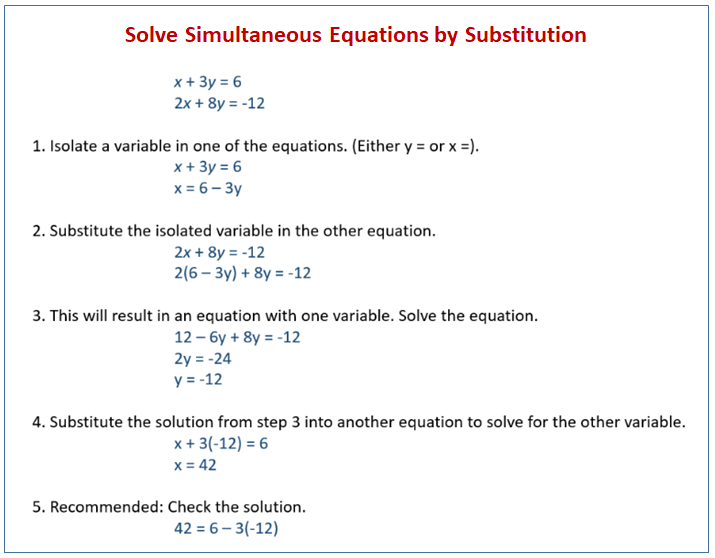
The following diagram shows how to solve simultaneous equations using substitution. Scroll down the page for more examples and solutions for solving simultaneous equations using substitution.
Algebra Worksheets
Practice your skills with the following Algebra worksheets:
Printable & Online Algebra Worksheets
Solving Simultaneous Equations using the Substitution Method
The substitution method involves solving one of the equations for one variable in terms of the other, and then substituting that expression into the other equation. It is usually used when one of the equations is already solved for a variable, or when it’s easy to isolate a variable with a coefficient of 1 or -1.
Steps:
- Solve one of the equations for one variable (e.g., solve for ‘y’ in terms of ‘x’).
- Substitute this expression into the other equation. This will result in a single equation with only one variable.
- Solve the new equation for that variable.
- Substitute the value you found back into the expression from step 1 to find the value of the other variable.
- Check your solution by substituting both values into the original equations.
Important Considerations:
No Solution: If the lines are parallel and distinct, there is no solution. When solving algebraically, you’ll end up with a false statement.
Infinite Solutions: If the lines are the same (coincident), there are infinitely many solutions. When solving algebraically, you’ll end up with a true statement.
Solving Simultaneous Equations by Substitution Example 1
This video demonstrates how to solve simultaneous equations by substitution.
Simultaneous Equations : Substitution Method : Example 1
In this tutorial you are shown how to solve a simultaneous equation by the substitution method. You are also shown how it relates to the intersection of two graphs and why there are two sets of solutions.
Simultaneous Equations : Substitution Method : Example 2
This is the second example of solving a simultaneous equation by substitution in which one equation contains an xy term. The aim is to demonstrate which variable makes for the easier substitution. You are also shown how it relates to the intersection of two graphs and why there are two sets of solutions.
The substitution method for solving simultaneous equations
Tutorial lesson on the substitution method for solving simultaneous equations.
| Check out our most popular games! | ||
|---|---|---|
 Fraction Concoction |
 Fact Family Game |
 Number Bond Garden |
 Online Addition Subtraction Game |
 Penguin Solitaire |
 Sawayama Solitaire |
 Ark Solitaire |
 Eldritch Invasion |
 Shenzhen Solitaire |
Check out more Solitaire games here.
We welcome your feedback, comments and questions about this site or page. Please submit your feedback or enquiries via our Feedback page.