Reciprocal of a Function
Related Topics:
More Lessons for PreCalculus
Math Worksheets
Examples, solutions, videos, worksheets, games, and activities to help PreCalculus students learn about the reciprocal of a function.
Reciprocal Transformation
One important concept in the study of polynomials is the reciprocal transformation. What happens when we take the reciprocal transformation of a function, or one over the function? Specifically, there are ways to create the graph of the reciprocal transformation of a function from the graph of the function itself. The reciprocal transformation is important in the definition of rational functions.
How to graph the reciprocal of a linear function?
When you graph the reciprocal of a linear function, \(f(x) = ax + b\), the resulting graph will be a hyperbola with specific characteristics determined by the original linear function. The reciprocal function is given by \(g(x) = \frac{1}{ax + b}\).
The following diagram shows how to graph the reciprocal of a linear function. Scroll down the page for more examples and solutions on graphing reciprocal functions.
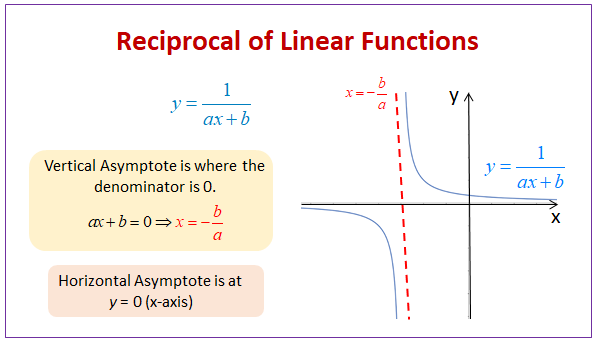
Steps to graphing the reciprocal of a linear function
- Identify the Vertical Asymptote:
The vertical asymptote occurs where the denominator of the reciprocal function equals zero.
Set the linear function equal to zero and solve for \(x\): \(ax + b = 0 \implies x = -\frac{b}{a}\)
The vertical asymptote is \(x = -\frac{b}{a}\) - Identify the Horizontal Asymptote:
As \(|x|\) becomes very large (approaches infinity), the term \(\frac{1}{ax + b}\) approaches 0.
The horizontal asymptote is \(y = 0\). There is no x-intercept. - Find the y-intercept:
Set \(x = 0\) in the reciprocal function: \(g(0) = \frac{1}{a(0) + b} = \frac{1}{b}\)
The y-intercept is at the point \((0, \frac{1}{b})\), provided \(b \neq 0\). If \(b = 0\), there is no y-intercept because the vertical asymptote is the y-axis. - Sketch the two branches of the hyperbola, ensuring they approach the asymptotes but do not cross them.
How to graph the reciprocal of a linear function?
Graphing Reciprocal Functions (Considering sign)
Graphing Reciprocal Functions (Considering symmetry)
Graphing Reciprocal Functions (Cubic + semi-circle examples)
Reciprocal of a Linear Function Part 1
This lesson is about the reciprocal of a linear function and discusses domain and range, along with behavior near both vertical and horizontal asymptotes. This is the first part of a two part lesson.
Reciprocal of a Linear Function Part 2
Reciprocal of a Function - part 1
Reciprocal of a Function - part 2
Reciprocal of a Function - part 3
| Check out our most popular games! | ||
|---|---|---|
 Fraction Concoction |
 Fact Family Game |
 Number Bond Garden |
 Online Addition Subtraction Game |
 Penguin Solitaire |
 Sawayama Solitaire |
 Ark Solitaire |
 Eldritch Invasion |
 Shenzhen Solitaire |
Check out more Solitaire games here.
We welcome your feedback, comments and questions about this site or page. Please submit your feedback or enquiries via our Feedback page.