Plurals Nouns, Add S
Related Pages
Phonic Sounds
Consonant Digraph
Other Consonant Sounds
More Lessons On English Grammar
English for Kids
Learning about plural “s” in English is essential for accurate grammar and communication. While it seems simple, there are a few rules and exceptions to keep in mind.
Learning the Plural S
The plural -s is a common way to make nouns plural in English. It’s added to the end of a word to indicate there is more than one of something.
Basic Rule: Add -s
The most common way to form the plural of a noun is by adding “-s” to the end.
cat → cats
dog → dogs
book → books
table → tables
chair → chairs
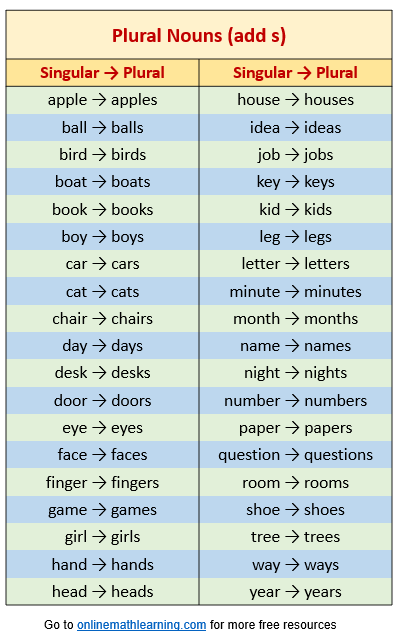
The following diagram shows some examples of adding s to form the plural of a noun. Scroll down the page for more examples.
Rules for Words Ending in Certain Sounds:
Words ending in -s, -ss, -sh, -ch, -x, or -z: Add “-es” to form the plural. This is because adding just “-s” would make the word difficult to pronounce.
bus → buses
dress → dresses
Make plural nouns by adding es
Words ending in consonant + -y: Change the “y” to “-ies”.
baby → babies
story → stories
Words ending in vowel + -y: Simply add “-s”.
boy → boys
day → days
Plural nouns for words ending in y
Words ending in -f or -fe: In many cases, change the “f” or “fe” to “-ves”. However, some words just add “-s”.
leaf → leaves
chief → chiefs
Plural nouns for words ending in f or fe
Words ending in -o: Generally add “-es,” but some words just add “-s.” There’s no perfect rule, so memorization is often necessary.
potato → potatoes
photo → photos
Plural nouns for words ending in o
Irregular Plurals:
Some nouns have irregular plural forms that don’t follow any of the above rules. These must be memorized.
man → men
child → children
foot → feet
ox → oxen
Nouns with the Same Singular and Plural Form:
Some nouns have the same form in both singular and plural.
sheep
deer
Irregular plural nouns
Add -S to make a plural: An Educational Rap Song
To make a noun plural add the suffix -s to the end of the word. This rule works for most nouns.
Adding “S” & “ES” to Words
Let’s learn about phonics and the different sounds each letter can make! “S” and “ES” are special letters that can make one thing turn into multiple things.
Plural Nouns in English | Regular & Irregular Plural Nouns | Plurals Spelling
Regular nouns adding -s to the end.
Nouns ending in s, ch, sh, x, and z (adding -es to the end)
Nouns ending in f or fe (the -ves rule)
Nouns ending in a vowel + y (add -s to the end)
Nouns ending in a consonant + y (the -ies rule)
Nouns ending in a vowel + o (add -s to the end)
Nouns ending in a consonant + o (the -es rule)
Irregular nouns that do not end in s in their plural form (e.g. child)
Nouns that remain the same in singular and plural form (e.g. sheep)
| Plural Nouns | ||
|---|---|---|
| Plural Nouns, add -s | Plural Nouns, add -es | Words ending with y |
| Words ending with f or fe | Words ending with o | Irregular Plural Nouns |
| Summary of Plural Nouns | ||
| Other Digraphs | ||
|---|---|---|
| AR Sound | Er,Ir,Ur | OR Sound |
| Ar,Er,Ir,Or,Ur | Ou, Ow | Oi, Oy |
| OO Sound | ||
Free Printable Worksheets for Consonant Digraphs
These worksheets focus on the consonant digraphs: ch, sh, th, qu and ng.
| Printable Worksheets (Consonant Digraphs) | |
|---|---|
|
Learning "ch" |
Learning "sh" |
|
Learning "th" |
Learning "qu" |
|
Learning "ng" |
|
Free Printable Worksheets for Digraphs
| Printable Worksheets (EE, OO, OU, OI, AW) | |
|---|---|
|
EE Words |
OO Words |
|
OI Words |
AW Words |
Learn the sound of the letters
Learning Short Vowels
| Short Vowels | ||
|---|---|---|
| Short A | Short E | Short I |
| Short O | Short U | Short Vowels |
Learning Long Vowels
| Long Vowels | ||
|---|---|---|
| Long A | Long E | Long I |
| Long O | Long U | Y (vowel) |
| Long Vowels | Short & Long Vowels | |
Compare Short & Long Vowels
| Short & Long Vowels | ||
|---|---|---|
| Short & Long A | Short & Long E | Short & Long I |
| Short & Long O | Short & Long U | |
Learning Consonants
| Check out our most popular games! | ||
|---|---|---|
 Fraction Concoction |
 Fact Family Game |
 Number Bond Garden |
 Online Addition Subtraction Game |
 Penguin Solitaire |
 Sawayama Solitaire |
 Ark Solitaire |
 Eldritch Invasion |
 Shenzhen Solitaire |
Check out more Solitaire games here.
We welcome your feedback, comments and questions about this site or page. Please submit your feedback or enquiries via our Feedback page.