Past Tense - Be
Welcome to our free online collection of English as a Second Language (ESL) tools & resources for students, teachers, and educators.
We have lots of free videos that will help you improve your English and also advice and tips that will help you in English proficiency examinations like TOEFL and IELTS.
Past Tense of the Verb “Be”
The verb “be” has two past tense forms in English:
Was (used with singular subjects: I, he, she, it)
Were (used with plural subjects: you, we, they)
The following diagram gives the present tense and past tense of the irregular verb “be”. Scroll down the page for more examples and solutions.
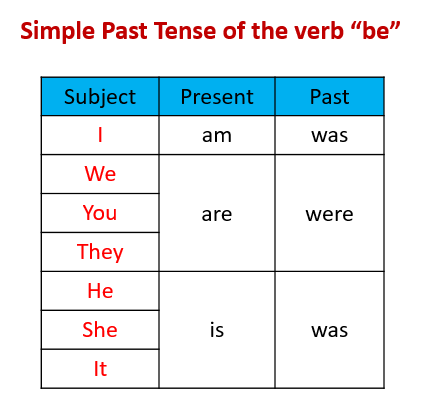
“To Be” - Past & Present Tense - Affirmative Sentences
This is an introduction to using “To Be” (was and were) in the past tense.
Examples are given in affirmative sentences (no negatives or questions).
Examples of simple time expressions such as:
Present: now, right now, and at the moment
Past: yesterday, last night, last week, last month, last year
How to join sentences in the Past with sentences in the Present tense with the conjunction “but”?
“But” is used to contrast or show a difference or change in what has already been mentioned.
e.g. They were noisy last night, but they are quiet now.
be - past tense
This video shows how to use the verb “be” in the past tense
** The verb “be” in the past tense**
This video shows how to conjugate the verb be in the affirmative and the negative
The Verb “Be” - Present and Past Tense
This video shows the difference between the verb “be” in the past and the present tense.
** The Verb “Be” – Past Tense Questions and Answers**
A teacher shows how to make yes-no questions and answers in the past tense using the verb “be.”
Using “be” and “do” in the past tense
A teacher shows the differences between “be” and “do” in the past tense when making statements, negatives, and questions.
Special Case: The Subjunctive Mood
One important exception where “were” is used even with singular subjects (I, he, she, it) is in the subjunctive mood. This mood is used for hypothetical, unreal, or contrary-to-fact situations, often after “if” or “wish."
If I were a bird, I would fly. (It’s hypothetical, I am not a bird)
I wish she were here. (She is not here, it’s a wish)
If it were easy, everyone would do it.
Check out our most popular games!
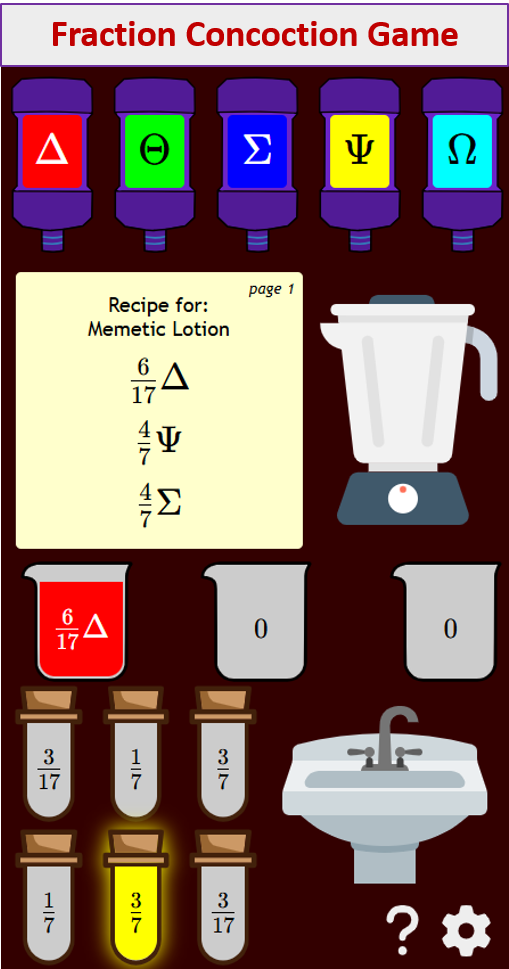
Fraction Concoction Game:
Master fractions in the lab: mix, add, and subtract beakers to create the perfect concoction!
Fact Family Game:
Complete fact families and master the link between addition & subtraction and multiplication & division.

Number Bond Garden:
Clear the board by matching number pairs that sum to ten in this garden-themed mental math puzzle.

Online Addition Subtraction Game:
Practice your addition and subtraction skills to help the penguin find its mummy.

We welcome your feedback, comments and questions about this site or page. Please submit your feedback or enquiries via our Feedback page.