Lowest Common Multiple (LCM) & Highest Common Factor (HCF)
Related Pages
More Lessons for GCSE Maths
Math Worksheets
These lessons, with videos, examples and step-by-step solutions, help GCSE Maths students learn how to find the highest common factor (HCF) and lowest common multiple (LCM).
Highest Common Factor (HCF)
The Highest Common Factor (HCF) of two or more numbers is the largest positive integer that divides each of the integers without leaving a remainder. It’s also often referred to as the Greatest Common Divisor (GCD).
Lowest Common Multiple (LCM)
The Lowest Common Multiple (LCM) of two or more numbers is the smallest positive integer that is a multiple of all the given integers.
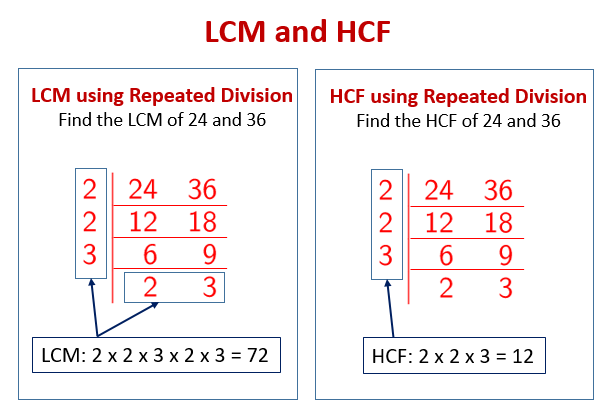
The following diagrams show how to find the lowest common multiple and highest common factor using the Ladder or Division Method. Scroll down the page for more examples and solutions on lowest common multiple and highest common factor.
Factors Worksheets/Games
Practice your skills with the following worksheets:
Printable & Online Factors & Multiples Worksheets
Factor Finder Game
Prime Factorization Game
Highest Common Factor Game
Least Common Multiple Game
Methods to find the HCF:
a) Listing Factors Method
List all the factors (divisors) for each number.
Identify the factors that are common to all numbers.
Choose the largest among the common factors.
b) Prime Factorization Method
Find the prime factorization of each number.
Identify all common prime factors.
Multiply these common prime factors, using the lowest power for each common prime factor.
c) The Ladder Method (Short Division)
Write the numbers side by side.
Divide by the smallest common prime factor (if none, stop).
Repeat until no common factors remain.
Multiply the left-side divisors to get HCF.
Methods to find the LCM:
a) Listing Multiples Method
List the first few multiples of each number.
Identify the multiples that are common to all numbers.
Choose the smallest among the common multiples.
b) Prime Factorization Method
Find the prime factorization of each number.
List all prime factors (common and uncommon) from all numbers.
Multiply these prime factors, using the highest power for each prime factor that appears.
c) The Ladder Method (Short Division)
Write the numbers side by side.
Divide by the smallest common prime factor (if none, stop).
Repeat until no common factors remain.
Multiply all left-side divisors and the bottom row numbers.
Videos
How to work out HCF and LCM using short division or ladder method?
How to work out the Highest Common Factor and Lowest Common Multiple using short division?
Useful for quick calculations where a factor tree isn’t required. GCSE.
Example:
Find the HCF and LCM of 108 and 24.
How to find HCF and LCM using the ladder method?
This video will teach you how to find the highest common factor (HCF) and lowest common multiple (LCM)
for 2 numbers.
Example:
Find the HCF and LCM of 24 and 36.
Finding the LCM using the “Ladder” Method
Example:
Find the LCM of 16 and 40.
Finding the GCF using the “Ladder” Method
Example:
Find the GCF and LCM of 24 and 40.
| Check out our most popular games! | ||
|---|---|---|
 Fraction Concoction |
 Fact Family Game |
 Number Bond Garden |
 Online Addition Subtraction Game |
 Penguin Solitaire |
 Sawayama Solitaire |
 Ark Solitaire |
 Eldritch Invasion |
 Shenzhen Solitaire |
Check out more Solitaire games here.
We welcome your feedback, comments and questions about this site or page. Please submit your feedback or enquiries via our Feedback page.