Kinematics - SUVAT equations
Related Pages
Kinematics - Vertical Motion
More Lessons for A Level Maths
Math Worksheets
These lessons, with videos, examples and step-by-step solutions, help A Level Maths students learn to use kinematics suvat formulas.
Kinematics: SUVAT Equations
Kinematics describes the motion of objects without considering the forces causing it. The SUVAT equations (also called kinematic equations) relate five key variables for motion under constant acceleration.
The following table gives the five SUVAT equations that can be used when an object has constant acceleration.
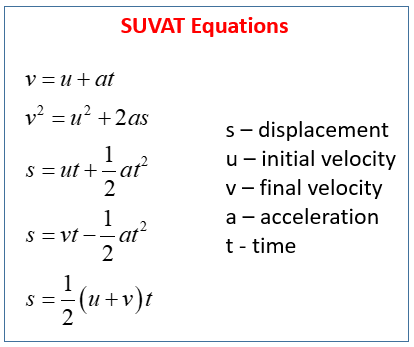
The SUVAT equations (also known as the equations of motion or kinematic equations) are a set of fundamental formulas used in kinematics to analyze motion with constant acceleration in a straight line. The acronym “SUVAT” comes from the five variables involved:
s = displacement (the change in position, a vector quantity, measured in meters (m))
u = initial velocity (the velocity at the start of the motion, a vector quantity, measured in meters per second (m/s))
v = final velocity (the velocity at the end of the motion, a vector quantity, measured in meters per second (m/s))
a = acceleration (the rate of change of velocity, a vector quantity, measured in meters per second squared (m/s²))
t = time (the duration of the motion, a scalar quantity, measured in seconds (s))
Important Note: These equations are only valid when the acceleration is constant. If acceleration changes, calculus is required.
The Five SUVAT Equations
Here are the five SUVAT equations:
- v=u+at
This equation relates final velocity, initial velocity, acceleration, and time.
Variable absent: Displacement (s) - \(s=\frac{1}{2}\left( u+v \right)t\)
This equation relates displacement, initial velocity, final velocity, and time.
Variable absent: Acceleration (a) - \(s=ut+\frac{1}{2}at^2\)
This equation relates displacement, initial velocity, acceleration, and time.
Variable absent: Final velocity (v) - \(s=vt-\frac{1}{2}at^2\)
This equation relates displacement, final velocity, acceleration, and time.
Variable absent: Initial velocity (u) - \(v^2=u^2 + 2as\)
This equation relates final velocity, initial velocity, acceleration, and displacement.
Variable absent: Time (t)
How to derive the suvat equations?
Equations for Constant Acceleration (suvat)
How to use the suvat equations?
Using SUVAT equations : M1 Edexcel June 2013 Q4
Mechanics 1 - M1 - Kinematics of a Particle (1) Intro-Constant Acceleration Equations SUVAT
Kinematics - SUVAT
How to derive the 4 main SUVAT equations graphically?
| Check out our most popular games! | ||
|---|---|---|
 Fraction Concoction |
 Fact Family Game |
 Number Bond Garden |
 Online Addition Subtraction Game |
 Penguin Solitaire |
 Sawayama Solitaire |
 Ark Solitaire |
 Eldritch Invasion |
 Shenzhen Solitaire |
Check out more Solitaire games here.
We welcome your feedback, comments and questions about this site or page. Please submit your feedback or enquiries via our Feedback page.