Irregular Verbs
Related Pages
Phonic Sounds
English for Kids
Irregular verbs are verbs that don’t follow the regular “-ed” pattern for forming the past simple and past participle. They’re a key part of English, and unfortunately, they mostly need to be memorized.
What makes a verb irregular?
Regular verbs form their past simple and past participle by adding “-ed” (or “-d” if the verb already ends in “e”). For example:
- walk → walked → walked
- play → played → played
Learn about regular verbs
Irregular verbs do not follow this pattern. They change in various ways, such as:
Changing vowels (sing → sang → sung)
Changing consonants (bring → brought → brought)
Having the same form for all three parts (cut → cut → cut)
The following diagram gives some examples of common irregular verbs, grouped by pattern. Scroll down the page for more examples.
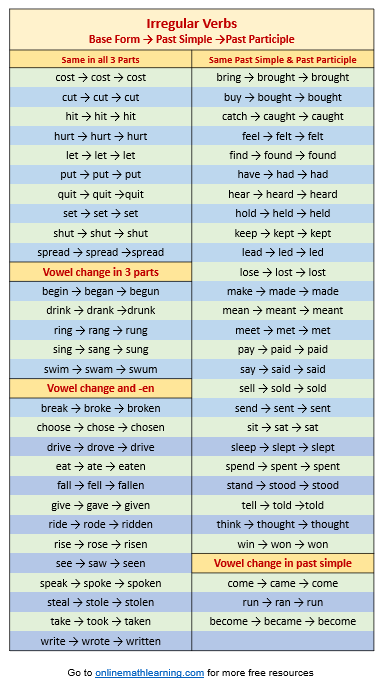
Common Irregular Verbs, Grouped by Pattern:
Grouping irregular verbs by similar patterns can make them easier to remember. Here are some common categories:
-
Same Form in All Three Parts:
cost → cost → cost
cut → cut → cut
hit → hit → hit -
Same Past Simple and Past Participle:
bring → brought → brought
buy → bought → bought
catch → caught → caught -
Vowel Change in Past Simple, Same Past Participle as Base Form:
come → came → come
run → ran → run -
Vowel Changes in Both Past Simple and Past Participle:
begin → began → begun
drink → drank → drunk
ring → rang → rung -
Vowel Change and -en Ending in Past Participle:
break → broke → broken
choose → chose → chosen
drive → drove → driven
Spelling Rules for Verbs
Adding -ed
Irregular Verbs
Adding -ing
Learning irregular verbs takes time and effort, but with consistent practice, you’ll master them.
Practice with the following videos and songs.
Irregular Verbs
Learn Irregular Verbs in Song
80 Irregular Verbs Song
Common Irregular Verbs | Definition & Examples
| Check out our most popular games! | ||
|---|---|---|
 Fraction Concoction |
 Fact Family Game |
 Number Bond Garden |
 Online Addition Subtraction Game |
 Penguin Solitaire |
 Sawayama Solitaire |
 Ark Solitaire |
 Eldritch Invasion |
 Shenzhen Solitaire |
Check out more Solitaire games here.
We welcome your feedback, comments and questions about this site or page. Please submit your feedback or enquiries via our Feedback page.