Introduction to Polynomials
Related Pages
More Lessons for Intermediate Algebra
More Lessons for Algebra
Math Worksheets
A series of free, online Intermediate Algebra Lessons or Algebra II lessons, with videos, examples, and solutions.
In these lessons, we will learn
- what are polynomials
- about polynomial functions
Types of Polynomials
Polynomials are fundamental algebraic expressions that consist of variables and coefficients, combined using only addition, subtraction, and multiplication, with non-negative integer exponents of the variables.
Polynomials can be classified in several ways, primarily based on their number of terms and their degree.
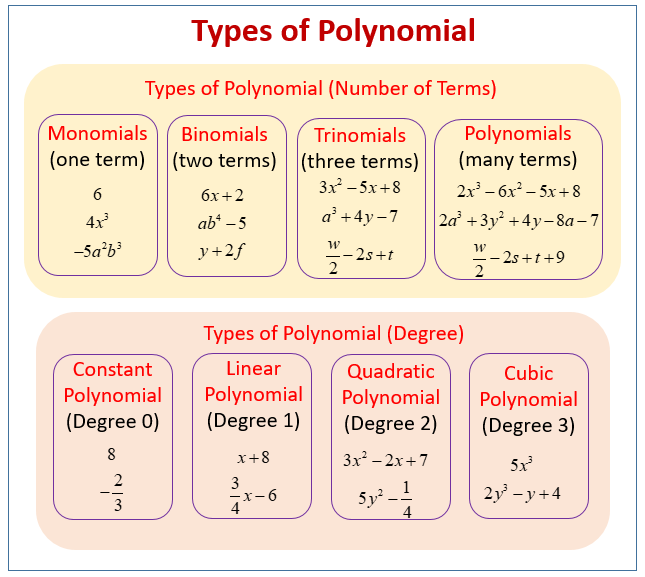
The following diagrams show the types of polynomial according to the number of terms: monomials, binomials, trinomials, polynomials and the degree of a polynomial. Scroll down the page for more examples and solutions on how to define polynomial functions.
Algebra Worksheets
Practice your skills with the following worksheets:
Printable & Online Algebra Worksheets
1. Classification by Number of Terms
This classification refers to how many non-zero terms are present in the polynomial. Terms are separated by addition or subtraction signs.
Monomial: A polynomial with one term.
Examples: 5x2, 7y, −3, 10xyz3
Binomial: A polynomial with two terms. The terms must be unlike (cannot be combined).
Examples: x + y, 3x2 − 4, 2a3 + 5b2
Trinomial: A polynomial with three terms. The terms must be unlike.
Examples: x2 + 2x − 1, a3 − 4ab + b2, 5y4 + 2y2 − 8
Polynomial (with more than three terms): For polynomials with four or more terms, they are generally just referred to as “polynomials” or “multinomials,” sometimes specifically by their number of terms (e.g., “four-term polynomial” or “quadrinomial”).
Examples: x4 + 3x3 − 2x2 + 5x − 7 (a five-term polynomial)
2. Classification by Degree
The degree of a polynomial is the highest exponent of the variable in a single-variable polynomial, or the highest sum of the exponents of variables in any single term for multi-variable polynomials.
Constant Polynomial (Degree 0): A polynomial with a degree of zero. It is just a constant number, as the variable would have an exponent of 0 (x0 =1 ).
Examples: 7, −15
Linear Polynomial (Degree 1): A polynomial with the highest exponent of 1.
Examples: x + 5, 2y − 3, 4z
Quadratic Polynomial (Degree 2): A polynomial with the highest exponent of 2.
Examples: x2 + 3x − 2, y2 − 9, 5a2
Cubic Polynomial (Degree 3): A polynomial with the highest exponent of 3.
Examples: x3 − 4x2 + x − 10, 7y3 + 2y, z3
Higher Degree Polynomials: Polynomials with degrees higher than 3 are typically just referred to by their specific degree (e.g., “a 6th-degree polynomial,” “a polynomial of degree n”).
Videos
Introduction to Polynomials
Before adding and subtracting polynomials or multiplying polynomials, it is important to have an introduction to polynomials with a definition of a polynomial and polynomial vocabulary. Important polynomial definitions include terms, monomial, the degree of a monomial, polynomial degree and standard form.
What is a term?
A term can be a number, a variable, a product of numbers and/or variables, or a quotient of numbers and/or variables.
What is a monomial?
A monomial is a real number and/or the product of variables with non-negative exponents.
What is a polynomial?
A polynomial is a monomial or a sum of monomials. Remember that subtraction can be rewritten as addition.
What is the degree of a term?
The degree of a term is the number of variable factors in the term. You can also say the degree of a term is the sum of the exponents on the variables.
What is the degree of a polynomial?
The leading term of a polynomial is the term of highest degree.
The degree of a polynomial is the same as the degree of the leading term.
How to talk about polynomials?
Polynomial Functions
A polynomial function is a function comprised of more than one power function where the coefficients are assumed to not equal zero. The term with the highest degree of the variable in polynomial functions is called the leading term. All subsequent terms in a polynomial function have exponents that decrease in value by one.
How to evaluate a polynomial in function notation.
How we define polynomial functions, and identify their leading coefficient and degree?
Polynomial Fundamentals (Identifying Polynomials and the Degree)
We look at the definition of a polynomial. We the practice identifying whether a function is a polynomial and if so what its degree is using 8 different examples.
| Check out our most popular games! | ||
|---|---|---|
 Fraction Concoction |
 Fact Family Game |
 Number Bond Garden |
 Online Addition Subtraction Game |
 Penguin Solitaire |
 Sawayama Solitaire |
 Ark Solitaire |
 Eldritch Invasion |
 Shenzhen Solitaire |
Check out more Solitaire games here.
We welcome your feedback, comments and questions about this site or page. Please submit your feedback or enquiries via our Feedback page.