Functions
This lesson is part of a series of lessons for the quantitative reasoning section of the GRE revised General Test. In this lesson, we will learn:
- Functions as equations
- Domain of Functions
Functions
An algebraic expression in one variable can be used to define a function of that variable. Functions are usually denoted by letters such as f, g and h.
For example, the algebraic expression 2x + 7 can be used to define a function f by
f(x) = 2x + 7
where f(x) is called the value of f at x and is obtained by substituting the value of x in the expression above.
For example, if x = 1 is substituted in the expression above,
the result is f (1) = 2(1) + 7 = 9.
It might be helpful to think of a function f as a machine that takes an input, which is a value of the variable x, and produces the corresponding output, f(x). For any function, each input x gives exactly one output f(x).
However, more than one value of x can give the same output f(x). For example, if g is the function defined by g(x) = x2 − 2x + 3 then and g(0) = 3 and g(2) = 3.
This video shows some examples of functions defined by equations.
Domain of Functions
The domain of a function is the set of all permissible inputs, that is, all permissible values of the variable x. For the functions f and g defined above, the domain is the set of all real numbers.
Sometimes the domain of the function is given explicitly and is restricted to a specific set of values of x. For example, we can define the function h by h(x) = x2 + 2 for −3 ≤ x ≤ 3*.* Without an explicit restriction, the domain is assumed to be the set of all values of x for which f(x) is a real number.
The following videos show how to find the domain of a function.
Check out our most popular games!
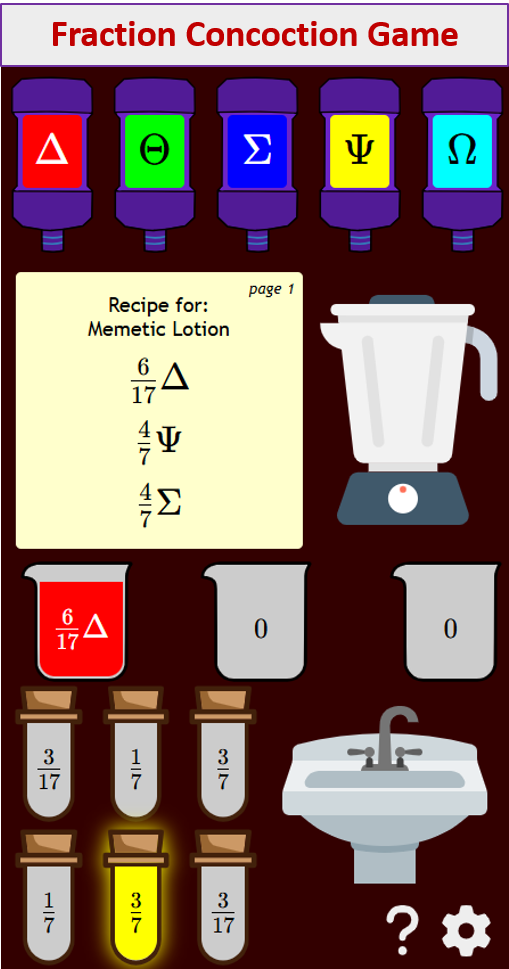
Fraction Concoction Game:
Master fractions in the lab: mix, add, and subtract beakers to create the perfect concoction!
Fact Family Game:
Complete fact families and master the link between addition & subtraction and multiplication & division.

Number Bond Garden:
Clear the board by matching number pairs that sum to ten in this garden-themed mental math puzzle.

Online Addition Subtraction Game:
Practice your addition and subtraction skills to help the penguin find its mummy.

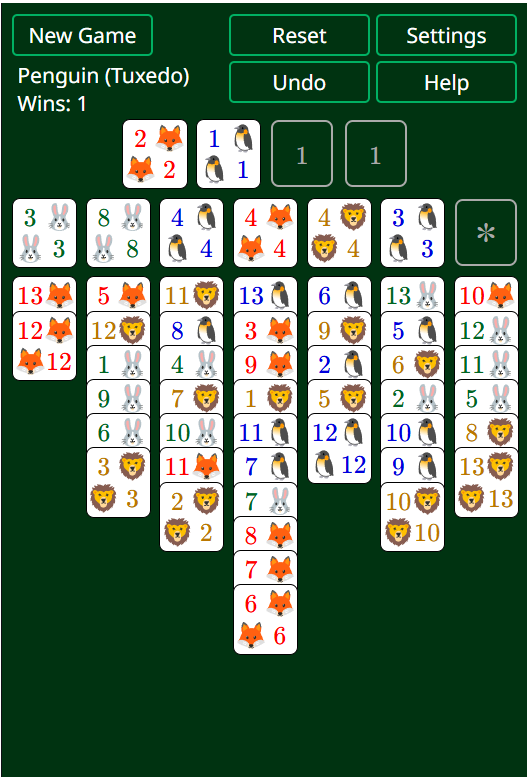
Penguin Solitaire
Penguin Solitaire is a fun game that aims to move all cards to the foundations to build four full sequences. There are two versions here: Penguin (Tuxedo) and Penguin (Original).
We welcome your feedback, comments and questions about this site or page. Please submit your feedback or enquiries via our Feedback page.