The FOIL Method
Related Topics:
More Lessons for Grade 6
Math Worksheets
The FOIL method is a technique used to multiply two binomials. FOIL stands for First, Outer, Inner, Last, which refers to the order in which you multiply the terms in the binomials. In this lesson, we will look into how to use the FOIL method to distribute two binomials.
The FOIL method is a mnemonic (a memory aid) used in algebra to help multiply two binomials. A binomial is a polynomial with two terms.
FOIL stands for
First
Outside
Inside
Last
It’s a systematic way to ensure that every term in the first binomial is multiplied by every term in the second binomial, which is essentially an application of the distributive property.
The following diagram shows how to use the FOIL method to distribute or multiply two binomials. Scroll down the page for more examples and solutions.
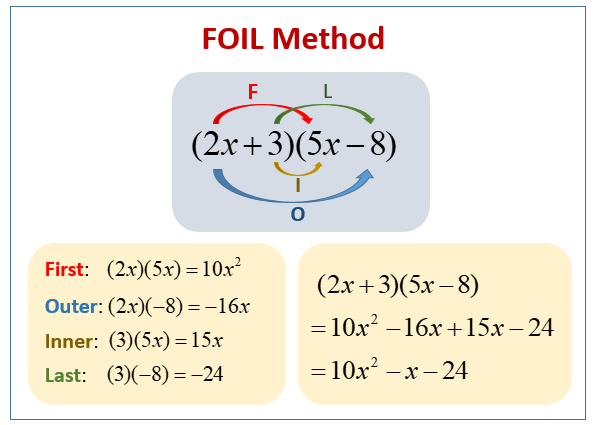
Important Notes:
- The FOIL method only works for multiplying two binomials. For more complex expressions, use the distributive property.
- After using FOIL, always check if you can simplify the resulting expression by combining like terms.
Algebra Worksheets
Practice your Algebra with the following worksheets.
Printable & Online Algebra Worksheets
How the FOIL Method Works
Let’s take two general binomials: (a+b) and (c+d).
-
F - First: Multiply the first term of each binomial.
a × c = ac -
O - Outer: Multiply the two outermost terms (the first term of the first binomial and the last term of the second binomial).
a × d = ad -
I - Inner: Multiply the two innermost terms (the second term of the first binomial and the first term of the second binomial).
b × c = bc -
L - Last: Multiply the last term of each binomial.
b × d = bd
After performing these four multiplications, you add the results together and then combine any like terms to simplify the expression.
So, (a+b)(c+d) = ac + ad + bc + bd.
Example:
Multiply the binomials (x + 1)(2x – 3)
Solution:
(x + 1)(2x – 3)
Multiply First : x • 2x = 2 x2
Multiply Outside : x • (–3) = –3x
Multiply Inside : 1 • 2x = 2x
Multiply Last : 1 • (–3) = –3
(x + 1)(2x – 3)
= 2x2 – 3x + 2x – 3
= 2x2 – x – 3
Multiplying Binomials FOIL Method
Multiplying binomials using the FOIL method. Explanation and examples.
(a + 3)(a + 7)
(x + 3)(x - 5)
(2x + 4)(3x + 5)
How to Use Foil to Distribute Two Binomials?
This video will show you how to use foil to distribute two binomials.
(x + 3)(x + 2)
(x + 4)(x - 5)
(x - 2)(x - 6)
FOIL Method for Multiplying Binomials - Distributive Property
In this video, we use the FOIL method to multiple binomials. FOIL helps you make sure all terms are distributed. (a+b)(c+d)
(x + 2)(3x - 7)
Practice Problems
- Multiply (x+4)(x+5)
Solution:
(x+4)(x+5)= x2 + 5x + 4x + 20 = x2 + 9x + 20 - Multiply (2x−3)(x+7)
Solution:
(2x−3)(x+7)=2x2 + 14x − 3x − 21 = 2x2 + 11x − 21 - Multiply (3y+2)(y−4)
Solution:
(3y+2)(y−4)=3y2 − 12y + 2y − 8 = 3y2 − 10y − 8
Check out our most popular games!
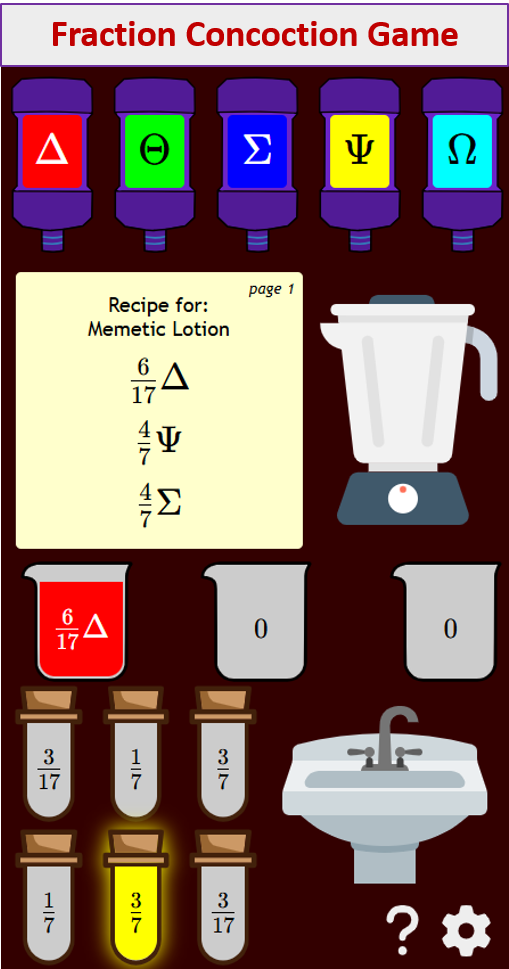
Fraction Concoction Game:
Master fractions in the lab: mix, add, and subtract beakers to create the perfect concoction!
Fact Family Game:
Complete fact families and master the link between addition & subtraction and multiplication & division.

Number Bond Garden:
Clear the board by matching number pairs that sum to ten in this garden-themed mental math puzzle.

Online Addition Subtraction Game:
Practice your addition and subtraction skills to help the penguin find its mummy.

We welcome your feedback, comments and questions about this site or page. Please submit your feedback or enquiries via our Feedback page.