Techniques For Factoring Polynomials
Related Pages
Factor Theorem
Solving Quadratic Equations
More Algebra Lessons
In these lessons, we will learn the different basic techniques for factoring polynomials.
Factoring
This is part of a series of free Basic Algebra Lessons. Here, we shall cover
- how to factor a polynomial by factoring out the greatest common factor.
- how to factor a polynomial by grouping.
- how to factor difference of perfect squares.
- how to factor trinomials with a = 1
- how to factor trinomials with a ≠ 1
Factoring in algebra is the reverse process of multiplication. When you factor an expression, you’re breaking it down into simpler expressions (factors) that, when multiplied together, give you the original expression. This skill is crucial for solving equations, simplifying rational expressions, and working with functions.
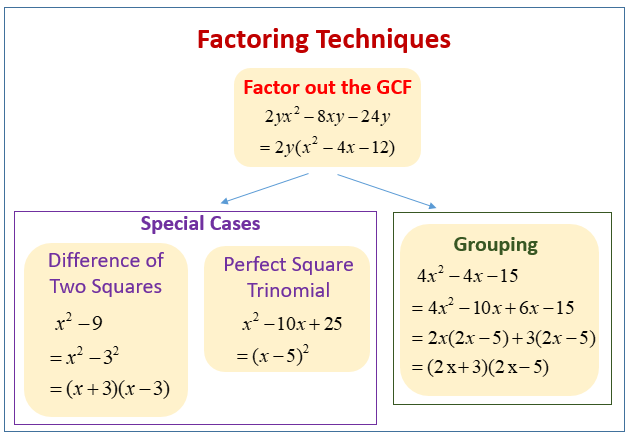
The following diagram shows some examples of Factoring Techniques. Scroll down the page for more examples and solutions of factoring techniques.
Algebra Worksheets
Practice your Algebra skills with the following worksheets:
Printable & Online Algebra Worksheets
Factoring Techniques
Here are some common factoring techniques:
1. Greatest Common Factor (GCF)
Always look for this first. The GCF is the largest term (number, variable, or both) that divides evenly into every term of the polynomial.
Find the GCF of coefficients and variables.
Factor it out.
2. Special Factoring Patterns
Recognizing these patterns can save a lot of time.
a) Difference of Squares:
a2 - b2 = (a - b)(a + b)
Recognize: Two terms, both perfect squares, separated by a minus sign.
b) Perfect Square Trinomials:
(a2 + 2ab + b2) = (a + b)2
(a2 - 2ab + b2) = (a - b)2
Recognize: Three terms, the first and last are perfect squares, and the middle term is twice the product of the square roots of the first and last terms.
3. Simple Trinomials (when a = 1)
How to do it:
Look for two numbers that multiply to c and add up to b.
If those numbers are p and q, the factored form is (x + p)(x + q)
4. Complex Trinomials (when a ≠ 1)
a) AC Method (Grouping)
Find the product a×c.
Find two numbers that multiply to ac and add up to b.
Rewrite the middle term (bx) using these two numbers as coefficients.
Group the terms into pairs.
Factor out the GCF from each pair.
If a common binomial factor emerges, factor that binomial out.
b) AC Method (Trial & Error)
Set up two binomials: (_x ± _)(_x ± _)
Fill in the first terms (factors of a) and the last terms (factors of c).
Check the outer and inner products to see if they add up to the middle term (bx). Adjust as needed.
Greatest Common Factors
When working with polynomials and complex fractions, it’s important to understand and be able to find greatest common factors. Being able to find greatest common factors will help when factoring trinomials by grouping. When factoring, we can either find the greatest common factors of two integers or find the greatest common factors of two complex expressions.
Factoring out the greatest common factor.
Factor By Grouping
Difference Of Perfect Squares
An important special case when trying to factor polynomials is a identifying the difference of perfect squares. We learn to recognize a difference of perfect squares because they have a special, easily factored form. It’s also important to recognize the factored form to make the multiplication of the binomials easier. Easily recognizing the difference of perfect squares is useful when factoring quadratics that are not a difference of perfect squares.
Factoring The Difference Of Two Squares - Ex 1
Factoring The Difference Of Two Squares - Ex 2
Factoring The Difference Of Two Squares - Ex 3
Factoring Trinomials, a = 1
When given a trinomial, or a quadratic, it can be useful for purposes of canceling and simplifying to factor it. Factoring trinomials is easiest when the leading coefficient (the coefficient on the squared term) is one. A more complex situation is factoring trinomials when the leading coefficient is not one. To factor trinomials we use methods that involve finding the factors of their coefficients.
Factoring a Trinomial with Leading Coefficient of 1 - The Basics
Factoring Basic Trinomials, with a = 1
Factoring Trinomials With “a” Not Equal To One
One of the final steps in learning to factor trinomials is factoring trinomials with “a” not equal to one. In this case, “a” is the leading coefficient, or the coefficient of the squared term. When factoring trinomials with “a” not equal to one, in addition to using the methods used when “a” is one we must take the factors of “a” into account when finding the terms of the factored binomials.
This video provides examples of how to factor a trinomial when the leading coefficient is not equal to 1 by using the grouping method.
How To Factor A Trinomial When The Leading Coefficient Is Not Equal To 1 By Using The Trial And Error Method?
Examples of how to factor a trinomial when the leading coefficient is not equal to 1 by using the bottoms up method
| Check out our most popular games! | ||
|---|---|---|
 Fraction Concoction |
 Fact Family Game |
 Number Bond Garden |
 Online Addition Subtraction Game |
 Penguin Solitaire |
 Sawayama Solitaire |
 Ark Solitaire |
 Eldritch Invasion |
 Shenzhen Solitaire |
Check out more Solitaire games here.
We welcome your feedback, comments and questions about this site or page. Please submit your feedback or enquiries via our Feedback page.