Distance-time Graphs
Related Topics:
More Science Worksheets
Math Worksheets
A series of free Science Lessons for 7th Grade and 8th Grade, KS3 and Checkpoint Science in preparation for GCSE and IGCSE Science.
How to interpret a Distance-Time Graph?
A distance-time graph is a visual representation of an object’s movement over a period. The horizontal axis (x-axis) represents time, and the vertical axis (y-axis) represents the distance traveled from a starting point. By analyzing the line on the graph, you can understand the object’s motion.
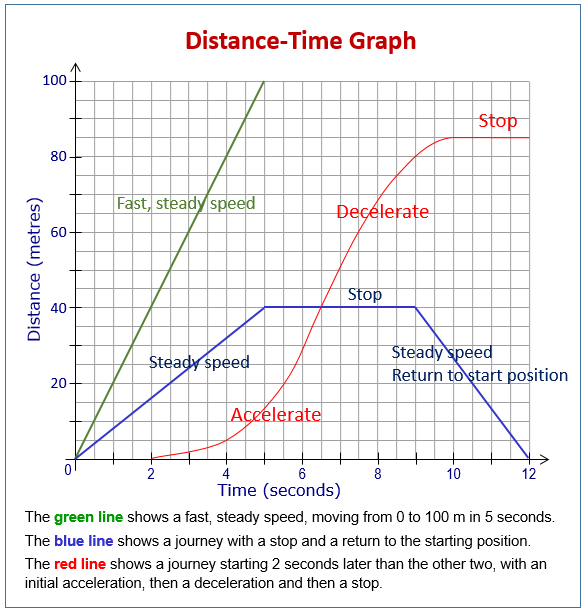
The following diagram shows examples of distance-time graphs. Scroll down the page for more examples on how to construct a distance-time-graph.
-
The Position of the Line:
Line above the x-axis: This indicates that the object has moved some distance away from its starting point.
Line on the x-axis: This means the object is at its starting point. -
The Slope of the Line:
The slope of a distance-time graph represents the speed of the object.
Speed = Slope = Distance/Time
Straight Line with a Positive Slope ↗: This indicates that the object is moving at a constant speed away from the starting point.
Horizontal Line (Slope = 0): This means that the object is stationary or stopped. The speed is zero.
Straight Line with a Negative Slope ↘: This indicates that the object is moving at a constant speed back towards the starting point.
Curved Line with an Increasing Slope: This shows that the object is accelerating – its speed is increasing over time.
Curved Line with a Decreasing Slope: This shows that the object is decelerating – its speed is decreasing over time.
Steeper Slope: Indicates a faster speed.
Shallower Slope: Indicates a slower speed.
Distance-time graphs
Construct a distance-time graph from given information.
Determine an object’s speed from a distance-time-graph.
Use a tangent to determine the speed of an accelerating object.
Example:
Draw a distance-time-graph of the following:
- A person walked 100m in a straight line in 100s. He then stopped for 40s and then walked another 70m in 50s.
- A person walks in a straight line 60m in 80s. He then walk a further 110m in 70s.
Gradient of a Distance-Time Graph
How to calculate the speed from a distance time graph?
The slope of a distance-time graph is the speed of the object.
Distance Time Graphs
Average Speed = distance/time
Slope of graph = average speed (y-axis = distance, x-axis = time)
- Easy to compare speeds
- The greater the gradient, the greater the speed
Distance-time graphs
Speed = Distance/Time
Example:
- A person walks to a shop 100 meters from their house. This takes 300 seconds. They spend 200 seconds at the shop and then return home in 500 seconds. They spend 200 seconds at the shop and then return home in 500 seconds.
- A motorcyclist leaves home and travels 500 meters in 100 seconds. They then stay in the same place for 300 seconds before traveling home in 200 seconds.
On a distance-time graph, the gradient (steepness) of the line represents the speed. The steeper the line, the faster the speed.
| Check out our most popular games! | ||
|---|---|---|
 Fraction Concoction |
 Fact Family Game |
 Number Bond Garden |
 Online Addition Subtraction Game |
 Penguin Solitaire |
 Sawayama Solitaire |
 Ark Solitaire |
 Eldritch Invasion |
 Shenzhen Solitaire |
Check out more Solitaire games here.
We welcome your feedback, comments and questions about this site or page. Please submit your feedback or enquiries via our Feedback page.