Compound Sentences
Related Pages
Types of Sentences
Parts of Sentence
IELTS, TOEFL And English As A Second Language
More Lessons On English Grammar
Welcome to our collection of English as a Second Language (ESL) tools & resources for students, teachers, and educators.
We have lots of free videos that will help you improve your English and also advice and tips that will help you in English proficiency examinations like TOEFL and IELTS.
A compound sentence is a sentence that consists of two or more independent clauses joined together. An independent clause is a part of a sentence that can stand alone as a complete sentence because it expresses a complete thought and has a subject and a verb.
The following diagram shows what is a compound sentence. The mnemonics FANBOY can be used to remember the coordinating conjunctions. Scroll down the page for more examples and solutions of compound sentences.
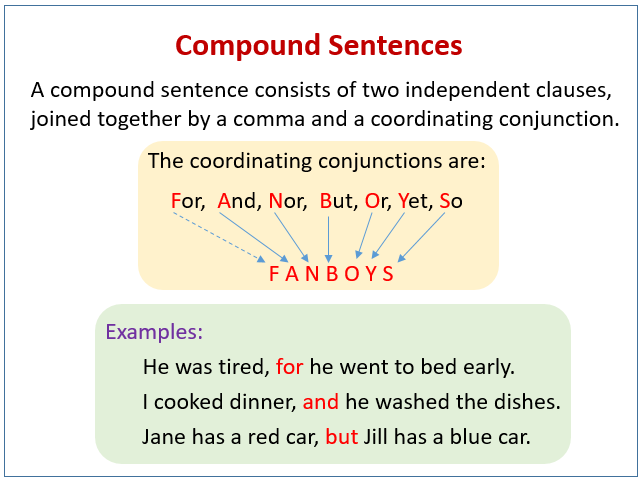
There are three main ways to join independent clauses to form a compound sentence:
1. Using a Coordinating Conjunction (and a comma):
Coordinating conjunctions connect words, phrases, or clauses of equal grammatical rank.
The seven coordinating conjunctions are often remembered by the acronym FANBOYS:
For, And, Nor, But, Or, Yet, So
Rule: Place a comma before the coordinating conjunction when joining two independent clauses.
Examples:
I wanted to go to the park, but it started to rain.
She studied hard for the exam, so she felt confident.
2. Using a Semicolon (;):
A semicolon can be used to join two closely related independent clauses when there is no coordinating conjunction.
The clauses should have a clear connection in meaning.
Examples:
The test was difficult; many students struggled.
I finished my homework early; I had plenty of time to relax.
3. Using a Semicolon (;) followed by a Conjunctive Adverb and a Comma (,):
Conjunctive adverbs (also called adverbial conjunctions) are words that connect two independent clauses by indicating a relationship between them (e.g., however, therefore, moreover, furthermore, consequently).
Rule: Place a semicolon after the first independent clause, followed by the conjunctive adverb, and then a comma before the second independent clause.
Examples:
The project was behind schedule; therefore, we had to work overtime.
She is very intelligent; furthermore, she is highly motivated.
What is a compound sentence?
A compound sentence is made by putting two independent clauses together with the use of a conjunction.
The Compound Sentence
Introduce the compound sentence and its parts, and learn how to construct good, grammatical compound sentences of various lengths.
English Grammar, Compound and Complex Sentences
| Check out our most popular games! | ||
|---|---|---|
 Fraction Concoction |
 Fact Family Game |
 Number Bond Garden |
 Online Addition Subtraction Game |
 Penguin Solitaire |
 Sawayama Solitaire |
 Ark Solitaire |
 Eldritch Invasion |
 Shenzhen Solitaire |
Check out more Solitaire games here.
We welcome your feedback, comments and questions about this site or page. Please submit your feedback or enquiries via our Feedback page.