Probability (Dependent, Independent, Exclusive & Inclusive Events)
Lessons with examples and solutions to help Grade 7 students learn how to find probabilities of compound events using organized lists, tables, tree diagrams and simulation.
Related Topics:
Grade 7 Math Lessons
Common Core Grade 7
A. Understand that, just as with simple events, the probability of a compound event is the fraction of outcomes in the sample space for which the compound event occurs.
B. Represent sample spaces for compound events using methods such as organized lists, tables and tree diagrams. For an event described in everyday language (e.g., rolling double sixes, identify the outcomes in the sample space which compose the event.
C. Design and use a simulation to generate frequencies for compound events. For example, use random digits as a simulation tool to approximate the answer to the question: If 40% of donors have type A blood, what is the probability that it will take at least 4 donors to find one with type A blood?
Common Core: 7.SP.8
Suggested Learning Targets
- I can explain that the fraction of outcomes in probability of a compound event is similar to the probability of a simple event.
- I can use tree diagrams, frequency tables, and organized lists to determine the probability of a compound event.
- I can identify the outcomes in a sample space.
- I can represent probability outcomes as fractions, decimals, or percents.
- I can design a simulation to estimate the probability of a compound event.
- I can use a simulation to estimate the probability of a compound event.
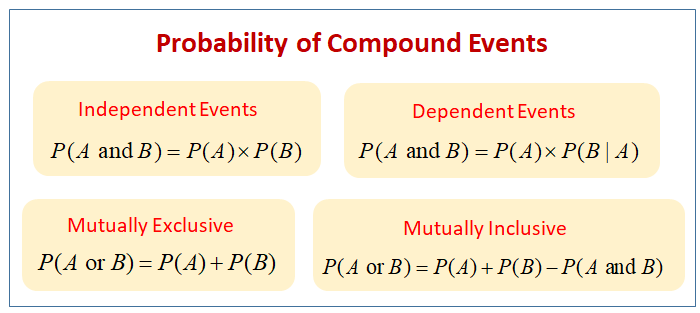
The following diagram shows the formulas for the probability of compound events: Dependent, Independent, Mutually Exclusive and Mutually Inclusive. Scroll down the page for more examples and solutions on how to calculate the probability of compound events.
Probability Worksheets
Practice your skills with the following worksheets:
Printable & Online Probability Worksheets
Types of Compound Events
Independent Events:
The outcome of one event does not affect the outcome of the other.
Example: Flipping a coin and rolling a die. The result of the coin flip (heads or tails) does not change the possible outcomes of the die roll (1, 2, 3, 4, 5, or 6).
If events A and B are independent, the probability of both occurring is the product of their individual probabilities:
P(A and B) = P(A) × P(B)
Dependent Events:
The outcome of one event affects the outcome of the other.
Example: Drawing two cards from a deck without replacement. The probability of the second card being a certain suit or rank depends on what the first card was.
If events A and B are dependent, the probability of both occurring is the product of the probability of A and the probability of B given that A has occurred:
P(A and B) = P(A) × P(B|A)
Mutually Exclusive Events:
Two events cannot occur at the same time.
Example: When flipping a coin, the outcome can be either heads or tails, but not both simultaneously.
If events A and B are mutually exclusive, the probability that either A or B occurs is the sum of their individual probabilities:
P(A or B) = P(A) + P(B)
Check out this lesson [Mutually Exclusive Events]
Mutually Inclusive Events:
Two events can occur at the same time.
Example: Drawing a card from a deck that is both a heart and a king (the king of hearts).
If events A and B are mutually inclusive, the probability that either A or B occurs is the sum of their individual probabilities minus the probability of both occurring:
P(A or B) = P(A) + P(B) - P(A and B)
Simple and Compound Probability - Grade 7 Common Core Mathematics
CC.7.SP.8A – Understand that, just as with simple events, the probability of a compound event is the fraction of outcomes in the sample space for which the compound event occurs.
Probability is the number of favorable outcomes for an event to occur divided by the number of all possible outcomes for the event to occur.
Probability can be expressed as a fraction, a decimal, or a percent.
A dependent event is two or more events in which the outcome of one event affects the outcome of other events.
The probability of two dependent events can depend on replacement or non-replacement of the object.
Independent vs Dependent Probability
Mutually Exclusive Events: Examples
- What is the probability of randomly picking a number from 1 to 10 that is even or randomly picking a number from 1 to 10 that is odd?
- Two fair dice are rolled. What is the probability of getting a sum less than 7 or a sum equal to 10?
Probability of Inclusive Events and Examples
- Find the probability on of rolling a 4 or an even number on a number cube.
- Find the probability of a card being a King or a Heart.
Independent and Dependent Probability
Example:
A bag contains 3 blue and 5 red marbles.
a. Find the probability of drawing 2 blue marbles in a row without replacing after the first marble is drawn.
b. Find the probability of drawing a red marble, replacing it and then drawing a blue marble.
Probability-Independent and Dependent Events
Probability-Independent and Dependent Events: Defining Independent and Dependent events, solving for the probability of multiple independent events, solving for the probability of dependent events by finding the conditional probability, and comparing the difference between independent and dependent probabilities.
Examples:
- a) What is the probability that a coin is flipped and lands heads up and then a face card is pulled from a deck of 52?
b) If a 4 is rolled with a single six-sided die,what is the probability of all three events occurring? - a) What is the probability of two aces being drawn consecutively from a deck of 52 cards?
b) What is the probability of the third card drawn also being an ace? - a) What is the probability of drawing 3 cards at random which are all aces if each card is replaced between each drawing?
b) What is the probability of drawing 3 cards at random which are all aces if the cards are not replaced between drawings?
| Check out our most popular games! | ||
|---|---|---|
 Fraction Concoction |
 Fact Family Game |
 Number Bond Garden |
 Online Addition Subtraction Game |
 Penguin Solitaire |
 Sawayama Solitaire |
 Ark Solitaire |
 Eldritch Invasion |
 Shenzhen Solitaire |
Check out more Solitaire games here.
We welcome your feedback, comments and questions about this site or page. Please submit your feedback or enquiries via our Feedback page.