Solving Compound Inequalities
Related Topics:
More Lessons for Algebra 1
Math Worksheets
Examples, worksheets, solutions, and activities to help Algebra 1 students learn how to solve compound inequalities.
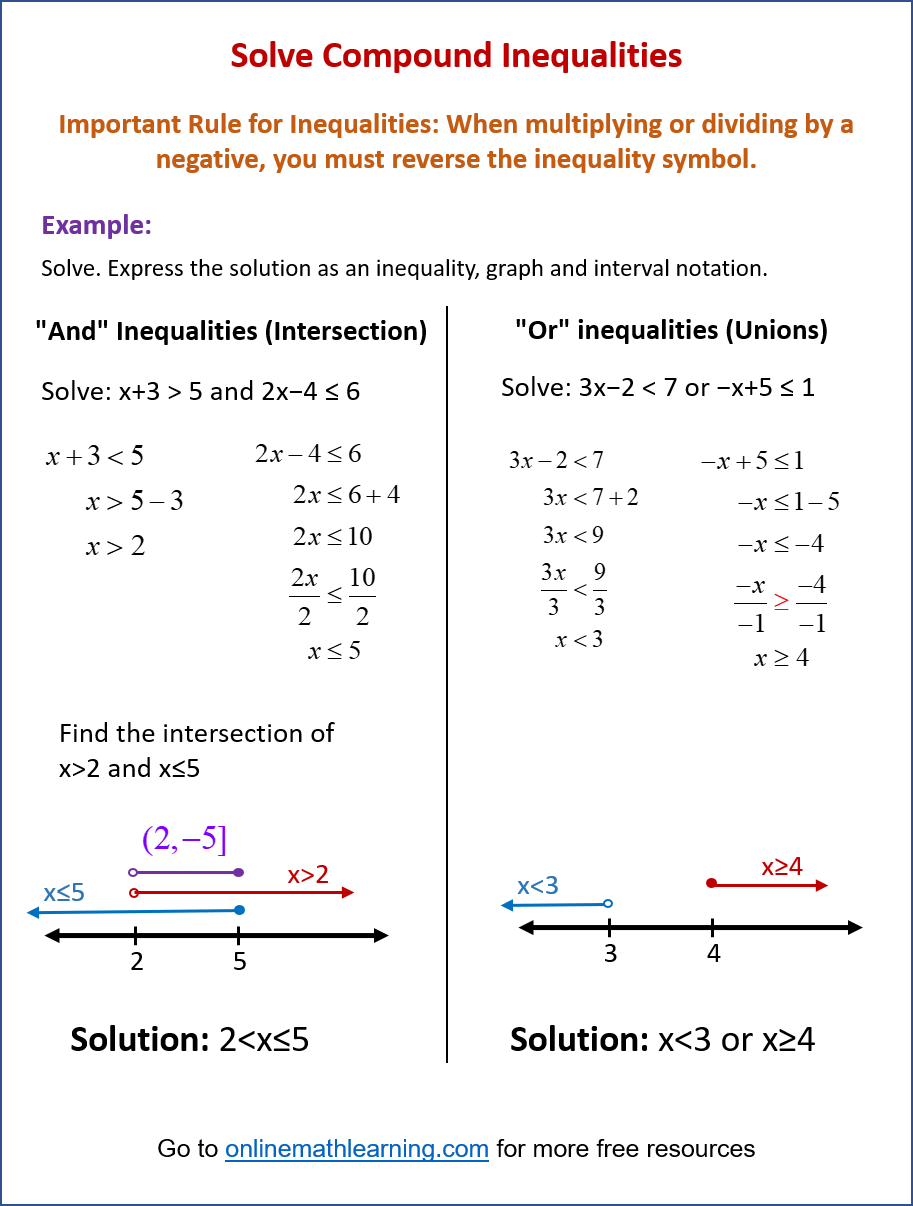
Solving compound inequalities involves finding the values of the variable that satisfy two or more inequalities at the same time. There are two main types of compound inequalities:
“And” inequalities (Intersections): These are inequalities where the solution must satisfy both conditions. They are often written as a single expression.
“Or” inequalities (Unions): These are inequalities where the solution must satisfy at least one of the conditions. They are always written as two separate inequalities connected by “or."
The following diagram shows how to solve compound inequalities. Scroll down the page for more examples and solutions on how to solve and graph compound inequalities on the number line.
Algebra Worksheets
Practice your skills with the following Algebra worksheets:
Printable & Online Algebra Worksheets
Compound Inequalities
In mathematics, it can be useful to limit the solution or even have multiple solutions for an inequality. For this we use compound inequalities which are inequalities with multiple inequality signs. When solving compound inequalities, we use some of the same methods used in solving multi-step inequalities.
Solving and Graphing Compound Inequalities
Compound Inequalities
Compound Inequality
Students learn that when solving a combined inequality “or” means “union”, or everything that’s mentioned in the two inequalities. And when solving a combined inequality “and” means “intersection”, or only what’s in common to the two inequalities.
So when graphing a combined inequality, the first step is to graph the inequalities above the number line, then combine them on the number line based on “or” (bring everything down to the number line) or “and” (only bring down the parts where the graphs overlap).
| Check out our most popular games! | ||
|---|---|---|
 Fraction Concoction |
 Fact Family Game |
 Number Bond Garden |
 Online Addition Subtraction Game |
 Penguin Solitaire |
 Sawayama Solitaire |
 Ark Solitaire |
 Eldritch Invasion |
 Shenzhen Solitaire |
Check out more Solitaire games here.
We welcome your feedback, comments and questions about this site or page. Please submit your feedback or enquiries via our Feedback page.