Complementary Angles
Examples, solutions, videos, worksheets, and stories to help Grade 6 students learn about complementary angles.
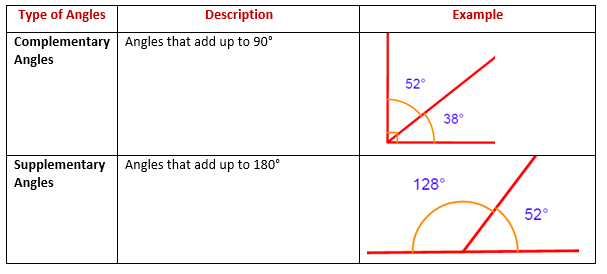
The following diagrams show examples of complementary and supplementary angles. Scroll down the page for more examples and step by step explanations.
Geometry Worksheets
Practice your skills with the following geometry worksheets:
Printable & Online Geometry Worksheets
Complementary Angles
Angles in a right angle add up to 90°.
When the sum of two angles is 90° those two angles are complementary angles.
Key Characteristics:
They can be adjacent (sharing a common vertex and side, forming a right angle together).
They can be non-adjacent (separate angles that just happen to add up to 90°).
The two acute angles in a right-angled triangle are always complementary.
Mnemonic: Think of “C” for Complementary and “C” for Corner (like a right angle, 90°).
Supplementary Angles
Angles in a straight line add up to 180°.
When the sum of two angles is 180° those two angles are supplementary angles.
Key Characteristics:
They can be adjacent (sharing a common vertex and side, forming a straight line together, also called a linear pair).
They can be non-adjacent (separate angles that just happen to add up to 180°).
Mnemonic: Think of “S” for Supplementary and “S” for Straight (like a straight line, 180°).
Angles around a point
The sum of angles at a point is 360°.
Key Points:
Common Vertex: All angles must share the exact same vertex.
No Gaps or Overlaps: The angles must completely fill the space around the point without any gaps or redundant overlaps.
Full Rotation: The concept is directly tied to the idea of a full rotation or a complete circle.
Vertical Opposite Angles
When two lines intersect, two pairs of vertically opposite angles are formed.
Vertical opposite angles are equal in size.
Angle Basics
Parallel lines are lines that will never cross even if they go on forever.
When lines intersect, they form angles.
Perpendicular lines form right angles or angles that are 90°.
An angle smaller than a right angle is called an acute angle.
An angle that is greater than a right angle is called an obtuse angle.
Any two angles that form a right angle are called complementary angles.
Any two angles that form a straight line are called supplementary angle.
See the following video, If you need help understanding angles.
Complementary & Supplementary Angles
See the following video if you need help understanding complementary and supplementary angles.
It will go through complementary and supplementary angle examples and explain the steps of how to find a missing complementary angle measure and/or supplementary angle measure.
| Check out our most popular games! | ||
|---|---|---|
 Fraction Concoction |
 Fact Family Game |
 Number Bond Garden |
 Online Addition Subtraction Game |
 Penguin Solitaire |
 Sawayama Solitaire |
 Ark Solitaire |
 Eldritch Invasion |
 Shenzhen Solitaire |
Check out more Solitaire games here.
We welcome your feedback, comments and questions about this site or page. Please submit your feedback or enquiries via our Feedback page.