Animal Facts - Albatross
In this page we will look at the amazing Albatross.
If you have any interesting or funny facts about animals or would like to find out more information about a particular animal, please fill up the Feedback form and we will be happy to add it to our list of animal facts.
Related Topics: More Amazing Animal Facts
Do albatrosses sleep while flying?
According to the Arctic Studies Center, albatrosses are sometimes seen asleep on the water, but this makes them easy targets for killer whales and hunters in kayaks. Apparently, most albatrosses sleep while gliding in the air. There’s strong evidence and a widely accepted theory that albatrosses do sleep while flying, though perhaps not in the same way humans do.
However, since recordings required to detect sleep in flight have not been performed, the evidence that they sleep in flight is circumstantial. We know that albatrosses are rarely seen on land, where they gather only to breed. They can’t sleep too long on the water or they will be eaten. Therefore, they would need to sleep while in flight. Scientists also believe that certain sleep patterns may allow birds to visually navigate during sleep in flight. However, this will only be confirmed when we can have recording devices that are small enough to be attached to the bird’s brain.
Like some other long-distance migratory birds (and marine mammals), albatrosses are thought to engage in unihemispheric slow-wave sleep (USWS). This means they can sleep with one half of their brain while the other half remains awake and alert. This allows them to continue flying, maintain aerodynamic control, and be aware of their surroundings (like predators or other birds) at the same time.
Albatrosses are masters of “dynamic soaring,” a highly energy-efficient gliding technique that allows them to cover vast distances with minimal wing flapping. They use the wind gradients over the ocean to gain lift and momentum. It’s theorized that they can rest and sleep during these long gliding periods, effectively “locking” their wings.
While directly measuring brain activity in a flying albatross is incredibly challenging, studies on closely related birds like frigatebirds (which also spend extended periods airborne) have confirmed in-flight sleep using implanted EEGs. The fact that albatrosses can spend months or even years at sea without touching land strongly suggests they must be getting sleep while airborne.
Albatrosses are large seabirds found in the southern oceans and the North Pacific. They are among the largest flying birds, and the Great Albatross has the largest wingspan of any living bird species, with a wingspan of 340 cm (11 ft).
Albatrosses are efficient long-distance flyers. Rather than flapping their wings to provide lift as most birds do, they glide on air currents. For every meter they drop while gliding, they can travel forward 22 meters. When their wings are fully extended, they are locked into place by a tendon so that the albatross does not have to expend energy keeping its wings outstretched.
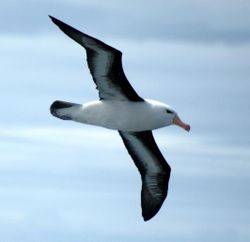
A Black-Browed Albatross.
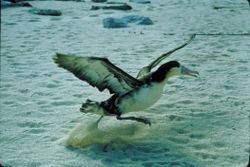
An albatross flapping its wings to take off.
An albatross’s bill is large and strong, ending in a hook shape. Along the sides of the bill are two “tubes”. These tubes are actually long nostrils that give albatrosses a keen sense of smell, which is unusual among birds. They have webbed feet and relatively strong legs. This enables them to walk quite well on land.
Shown below is a video of young albatrosses learning to fly with a little motivation from tiger sharks.
| Check out our most popular games! | ||
|---|---|---|
 Fraction Concoction |
 Fact Family Game |
 Number Bond Garden |
 Online Addition Subtraction Game |
 Penguin Solitaire |
 Sawayama Solitaire |
 Ark Solitaire |
 Eldritch Invasion |
 Shenzhen Solitaire |
Check out more Solitaire games here.
We welcome your feedback, comments and questions about this site or page. Please submit your feedback or enquiries via our Feedback page.