Solving Inequalities
Related Pages
Solving Equations
Algebraic Expressions
More Algebra Lessons
In these lessons, we will look at the rules, approaches, and techniques for solving inequalities.
The rules for solving inequalities are similar to those for solving linear equations. However, there is one exception when multiplying or dividing by a negative number.
When you multiply or divide both sides of an inequality by a negative number, you MUST reverse (flip) the direction of the inequality symbol.
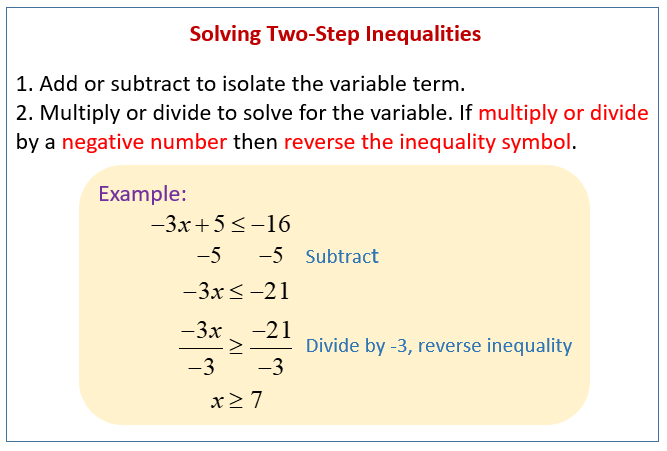
The following figure shows how to solve two-step inequalities. Scroll down the page for more examples and solutions.
-
Printable & Online Inequality Worksheets
Printable
Write & Graph InequalitiesSolve 1-step inequalities (addition & subtraction)
Solve 1-step inequalities (multiplication & division)
Solve 1-step inequalities (all operations)
Steps for Solving Two-Step Inequalities:
-
Undo Addition or Subtraction:
First, add or subtract the constant term from both sides of the inequality to get the term with the variable by itself.
The inequality symbol does not change direction in this step. -
Undo Multiplication or Division:
Next, multiply or divide both sides by the coefficient of the variable to isolate the variable.
If you multiply or divide by a negative number reverse the sign.
If you multiply or divide by a positive number, the symbol stays the same. -
Simplify:
Perform the arithmetic to get the final solution.
Inequalities Of The Form “x + a > b” or “x + a < b”
Example:
Solve x + 7 < 15
Solution:
x + 7 < 15
x + 7 – 7 < 15 – 7
x < 8
Inequalities Of The Form “x – a < b” or “x – a > b”
Example:
Solve x – 6 > 14
Solution:
x – 6 > 14
x – 6+ 6 > 14 + 6
x > 20
Example:
Solve the inequality x – 3 + 2 < 10
Solution:
x – 3 + 2 < 10
x – 1 < 10
x – 1 + 1 < 10 + 1
x < 11
Inequalities Of The Form “a – x < b” or “a – x > b”
Example:
Solve the inequality 7 – x < 9
Solution:
7 – x < 9
7 – x – 7 < 9 – 7
– x < 2
x > –2 (remember to reverse the symbol when
multiplying by –1)
Example:
Solve the inequality 12 > 18 – y
Solution:
12 > 18 – y
18 – y < 12
18 – y – 18 < 12 –18
– y < –6
y > 6 (remember to reverse the symbol when multiplying
by –1)
Inequalities Of The Form “  < b” or “ > b”
 < b” or “
 Example:
Solve  > 3
> 3
Solution:
> 3
× 5 > 3 × 5
x > 15
Example:
Solve 
Solution:

Solving Linear Inequalities With Like Terms
If an equation has like terms, we simplify the equation and then solve it. We do the same when solving inequalities with like terms.
Example:
Evaluate 3x – 8 + 2x < 12
Solution:
3x – 8 + 2x < 12
3x + 2x < 12 + 8
5x < 20
x < 4
Example:
Evaluate 6x – 8 > x + 7
Solution:
6x – 8 > x + 7
6x – x > 7 + 8
5x > 15
x > 3
Example:
Evaluate 2(8 – p) ≤ 3(p + 7)
Solution:
2(8 – p) ≤ 3(p + 7)
16 – 2p ≤ 3p + 21
16 – 21 ≤ 3p + 2p
–5 ≤ 5p
–1 ≤ p
p ≥ –1 (a < b is equivalent to b > a)
An Introduction To Solving Inequalities
Solving One-Step Linear Inequalities In One Variable
The solutions to linear inequalities can be expressed several ways: using inequalities, using a graph, or using interval notation.
The steps to solve linear inequalities are the same as linear equations, except if you multiply or divide by a negative when solving for the variable, you must reverse the inequality symbol.
Example:
Solve. Express the solution as an inequality, graph and interval notation.
x + 4 > 7
-2x > 8
x/-2 > -1
x - 9 ≥ -12
7x > -7
x - 9 ≤ -12
Solving Two-Step Linear Inequalities In One Variable
Example:
Solve. Express the solution as an inequality, graph and interval notation.
3x + 4 ≥ 10
-2x - 1 > 9
10 ≥ -3x - 2
-8 > 5x + 12
Solving Linear Inequalities
Main rule to remember: If you multiply or divide by a negative number, the inequality flips direction.
Examples of how to solve linear inequalities are shown:
Example:
Solve:
3x - 6 > 8x - 7
Solving Inequalities
Students learn that when solving an inequality, such as -3x is less than 12, the goal is the same as when solving an equation: to get the variable by itself on one side.
Note that when multiplying or dividing both sides of an inequality by a negative number, the direction of the inequality sign must be switched.
For example, to solve -3x is less than 12, divide both sides by -3, to get x is greater than -4.
And when graphing an inequality on a number line, less than or greater than is shown with an open dot, and less than or equal to or greater than or equal to is shown with a closed dot.
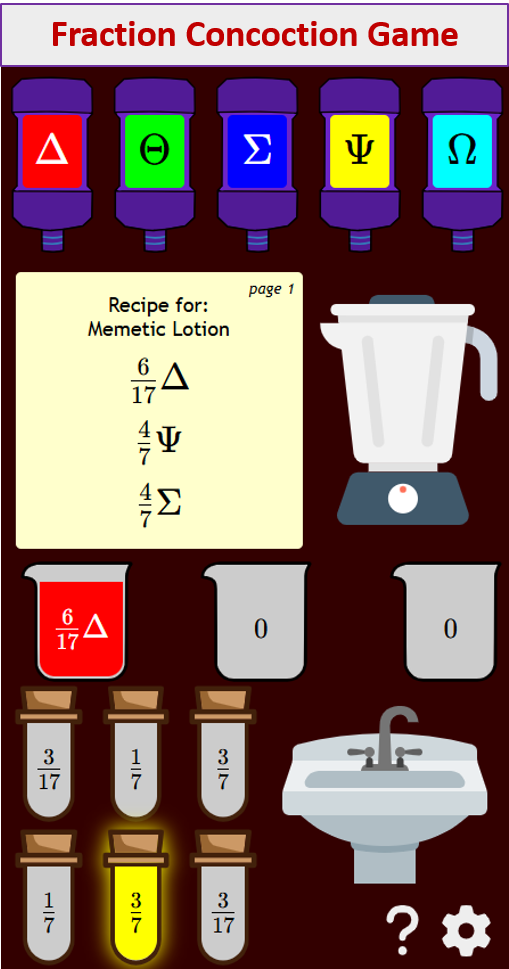
Try out our new and fun Fraction Concoction Game.
Add and subtract fractions to make exciting fraction concoctions following a recipe. There are four levels of difficulty: Easy, medium, hard and insane. Practice the basics of fraction addition and subtraction or challenge yourself with the insane level.
We welcome your feedback, comments and questions about this site or page. Please submit your feedback or enquiries via our Feedback page.