

Solving Equations by Division, Multiplication or taking the Reciprocal
More Lessons for Algebra
Math Worksheets
In this lesson, we will look at solving equations by division, multiplication or taking the reciprocal.
Solving Equations by Division
Consider the equation 4x = 24. The variable is being multiplied by 4. To write an equivalent equation with the variable isolated, divide by 4 on both sides.
Example:
Solve 4x = 24
Solution:
4x = 24
 (Divide by 4 on both sides)
x = 6
Check:
4x = 24
4 • 6 = 24 (Substitute x = 6 into original equation)Example of solving equations using division.
Example:
2x = -140
Solving Equations by Multiplication
To solve the equation  , we notice that the variable is being divided by 5. To write an equivalent equation with the variable isolated, multiply by 5 on both sides.
Example:
Solve
Solution:
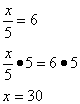
Check:

 (Substitute x = 30 in the original equation)
Example of solving equations by multiplication.
Example:
x/9 = -6
Solving equations by taking the reciprocal
Consider the equation  . The variable is being multiplied by
  . To write an equivalent equation with the variable isolated, multiply by the reciprocal, which is
  , on both sides.
Example:
Solve
Solution:
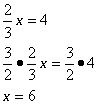
Check:

Example of solving equations by taking the reciprocal.
Example:
2/3 x = -4/3
Try the free Mathway calculator and
problem solver below to practice various math topics. Try the given examples, or type in your own
problem and check your answer with the step-by-step explanations.
We welcome your feedback, comments and questions about this site or page. Please submit your feedback or enquiries via our Feedback page.