Matrix Multiplication
In these lessons, we will learn how to perform matrix multiplication.
Related Pages
Scalar Multiplication
More Lessons on Matrices
We will illustrate matrix multiplication or matrix product by the following example.
Example:
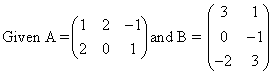
Find C = A × B
Solution:
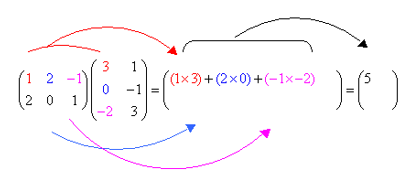
Step 1: Multiply the elements in the first row of A with the corresponding elements in the first column of B. Add the products to get the element C11.
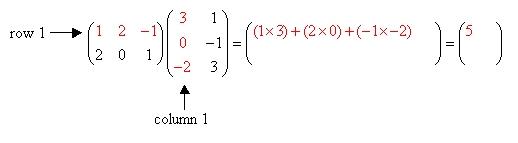
**Showing Step 1 in detail:**
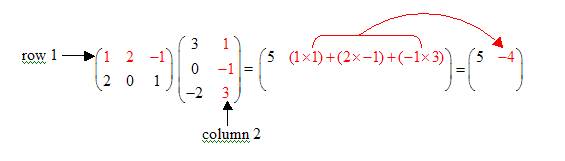
Step 2: Multiply the elements in the first row of A with the corresponding elements in the second column of B. Add the products to get the element C12.
Step 3: Multiply the elements in the second row of A with the corresponding elements in the first column of B. Add the products to get the element C21.
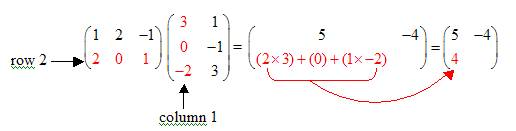
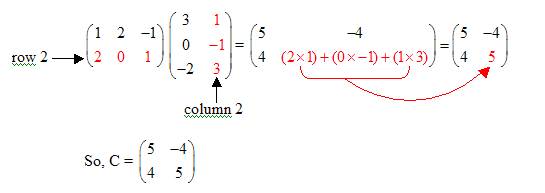
Step 4: Multiply the elements in the second row of A with the corresponding elements in the second column of B. Add the products to get the element C 22.
Matrices that can or cannot be Multiplied
Not all matrices can be multiplied together.

For example, the product of A and B is not defined.

We cannot multiply A and B because there are 3 elements in the row to be multiplied with 2 elements in the column
This means that we can only multiply two matrices if the number of columns in the first matrix is equal to the number of rows in the second matrix.
An easy method to determine whether two matrices can be multiplied together would be to check the order of the matrices.
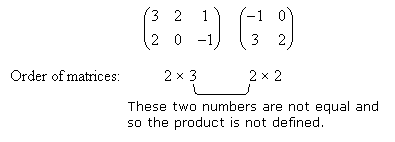

Can we multiply matrix A and matrix C?

We can also know the order of the product.

Working it out we can see that
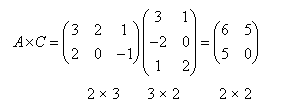
Checking the orders of the matrices will also help you to make sure that you multiplied the elements in the correct way.
Take note that matrix multiplication is not commutative that is
A × B ≠ B × A
Videos
Multiplying Matrices
Two examples of multiplying a matrix by another matrix are shown
Multiplying Matrices - Example 2
This video shows how to multiply a 2 × 3 matrix by a 3 × 1 matrix.
Multiplying Matrices - Example 3
This video shows how to multiply a 2 × 3 matrix by a 3 × 2 matrix.
Example of matrix multiplication
Matrix Multiplication
How to multiply matrices?
Try the free Mathway calculator and
problem solver below to practice various math topics. Try the given examples, or type in your own
problem and check your answer with the step-by-step explanations.
We welcome your feedback, comments and questions about this site or page. Please submit your feedback or enquiries via our Feedback page.