Graphing Linear Equations
A series of free Basic Algebra Lessons.
In this lesson, we will learn
- Intercepts of Linear Equations
- Graphing Lines Using Slope-Intercept Form
- Point-Slope Form of Linear Equations
- Graphing Lines Using Intercepts
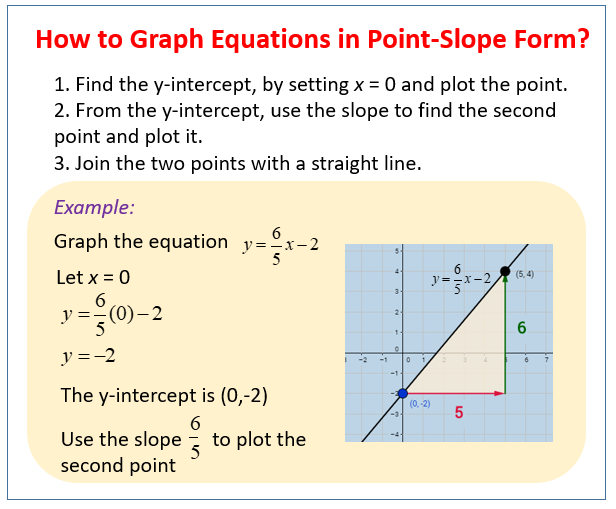
The following diagram shows how we can graph a linear equation in point-slope form or slope-intercept form. Scroll down the page for more examples and solutions on how to graph linear equations.
Intercepts of Linear Equations
The x-intercept and y-intercept of a line, or linear equation intercepts, are often used in problems involving lines and their graphs. Linear equation intercepts are important points to be able to understand and decipher in applications of linear equations problems and can also be used when graphing lines. The y-intercept is used when writing an equation in slope-intercept form.
The following video shows how to find the x-intercept and y-intercept of a linear equation.
Point-Slope Form of Linear Equations
Sometimes we’re only given a couple of points on a line and then asked to write a linear equation. When given this information, it’s easiest to use point slope form. Point slope form can be written using one point and the slope or when given two points since we can calculate the slope from the two points. Once we have an equation in point slope form it can be rewritten in slope-intercept or standard form.
Writing Equations in Point-Slope Form
This video looks at writing linear equations in point-slope form, given a point and a slope, or two points. It includes four examples.
Find the Equation of a Line Using Point-Slope Form
Point Slope Form of a Line
Graph a Linear Equation in Point-Slope Form
This video provides two examples of how to graph a linear equation in point-slope form.
Graphing Lines using Slope-Intercept Form
When given an equation in the form y = mx + b, or slope-intercept form, we should know how to graph a line without having to compute two points on it. If we have an equation in slope-intercept form, we automatically know the slope and the y-intercept and can use that information to more quickly and efficiently graph the line. Another method of graphing a line is using a table of values or the intercepts.
This video explains how to graph a linear equation given in slope intercept form.
How to graph a line in slope intercept form with a positive integer slope and a negative y-intercept?
Graphing Lines Using Intercepts
We use many different techniques to graph lines, but one of the most efficient and straightforward, when given the equation of the line, is graphing lines using intercepts. If we are not given a table of values, the easiest two points to find are usually the x- and y-intercepts. Graphing lines using intercepts is not the only method, we can also graph using the slope and the y-intercept.
Graphing Linear Functions by Finding the X-Intercept and Y-Intercept of the Function.
The basic idea and two full examples are shown.
Find intercepts, use intercepts to graph linear equation
Try the free Mathway calculator and
problem solver below to practice various math topics. Try the given examples, or type in your own
problem and check your answer with the step-by-step explanations.

We welcome your feedback, comments and questions about this site or page. Please submit your feedback or enquiries via our Feedback page.