Geometry Building Blocks: Angles
Related Topics:
More Lessons for High School Geometry
Types of Angles
Math Worksheets
A series of free, online High School Geometry Video Lessons and solutions.
Videos, worksheets, and activities to help Geometry students.
In this lesson, we will learn
- types of angles and how to label angles
- how to use a protractor to measure angles
- what is an angle bisector and how to construct an angle bisector
- how to identify and remember complementary and supplementary angles
Angles: Types and Labeling
There are four types of angles: acute, right, obtuse, and straight. Each name indicates a specific range of degree measurements. Congruent angles have equivalent measures. Adjacent angles share a vertex and a common side.
How to label an angle and how to differentiate between acute, right, obtuse, and straight angles.
Using a Protractor
In Geometry, it is important to know how to measure an angle. Using a protractor helps us determine the angle measurement so we can label it as acute, right or obtuse. Every protractor is a little bit different, but all will have a location on the bottom edge where we align the vertex of the angle we are measuring. After lining up the vertex, we line up the bottom edge of the protractor with one side of the angle and use the marks on the top to measure.
Using a Protractor
How to use a protractor to measure an angle?
Angle Bisectors
An angle is formed by two rays with a common endpoint. The angle bisector is a ray or line segment that bisects the angle, creating two congruent angles. To construct an angle bisector you need a compass and straightedge. Bisectors are very important in identifying corresponding parts of similar triangles and in solving proofs.
How to label an angle bisector; how to use an angle bisector to find a missing variable.
This video shows how to construct an angle bisector
Supplementary and Complementary Angles
Supplementary angles are two angles whose sum is 180 degrees while complementary angles are two angles whose sum is 90 degrees. Supplementary and complementary angles do not have to be adjacent (sharing a vertex and side, or next to), but they can be.
How to identify supplementary and complementary angles.
How to remember complementary and supplementary angles?
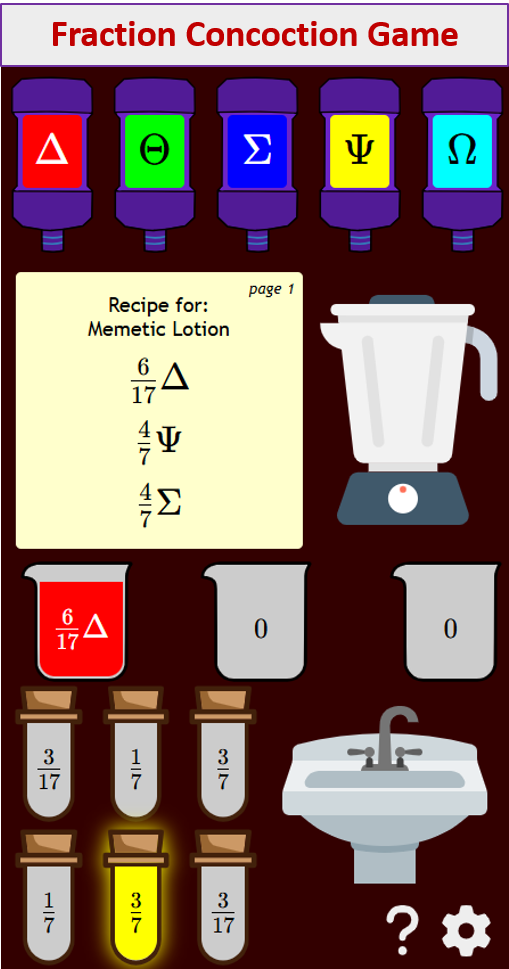
Try out our new and fun Fraction Concoction Game.
Add and subtract fractions to make exciting fraction concoctions following a recipe. There are four levels of difficulty: Easy, medium, hard and insane. Practice the basics of fraction addition and subtraction or challenge yourself with the insane level.
We welcome your feedback, comments and questions about this site or page. Please submit your feedback or enquiries via our Feedback page.