Factoring Difference of Squares
In some cases recognizing some common patterns in the trinomial or binomial will help you to factor it faster. For example, we could check whether the binomial is a difference of squares.
The following diagram gives examples of factoring difference of squares. Scroll down the page for more examples and solutions.
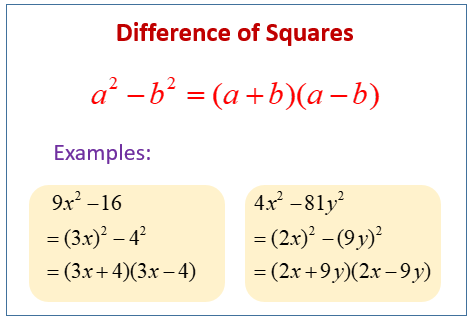
How to factor Difference of Squares?
A difference of squares is a binomial of the form:
a2 – b2
Take note that the first term and the last term are both perfect squares.
When we factor a difference of two squares, we will get
a2 – b2 = (a + b)(a – b)
This is because (a + b)(a – b) = a2– ab + ab – b2 = a2– b2
Example:
x2 – 25 = 0
x2 – 52 = 0
(x + 5)(x – 5) = 0
We get two values for x: x + 5 ⇒ x = –5
x – 5 ⇒ x = 5
Be careful! This method only works for difference of two squares and not for the sum of two squares:
a2 + b2 ≠ (a + b)(a – b)
Example:
Factor
a) x2– 9
b) 4x2– 25
c) 2x2– 32
d) πR2– πr2
Solution:
a) x2– 9
= x2– 32
= (x + 3)(x – 3)
b) 4x2– 25
= (2x)2– (5)2
= (2x + 5)(2x – 5)
c) 2x2– 32
= 2(x2– 16)
= 2(x2 – 42)
= 2(x + 4)(x – 4)
d) πR2– πr2
= π(R2– r2)
= π(R + r)(R – r)
The following videos explain how to factor a difference of squares.
Example:
Factor
x2 - 9
y2 - 1
16x2 - 25y2
x4 - 1
2x2 - 72
Example:
Factor
w2 - 81
b2 - 1/4
27a2 - 147
Try out our new and fun Fraction Concoction Game.
Add and subtract fractions to make exciting fraction concoctions following a recipe. There are four levels of difficulty: Easy, medium, hard and insane. Practice the basics of fraction addition and subtraction or challenge yourself with the insane level.

We welcome your feedback, comments and questions about this site or page. Please submit your feedback or enquiries via our Feedback page.