Fundamental Counting Principle
Related Pages
Permutations & Combinations
More Algebra II Lessons
These lessons, with videos, examples and step-by-step solutions, help Algebra II students learn about fundamental counting principle.
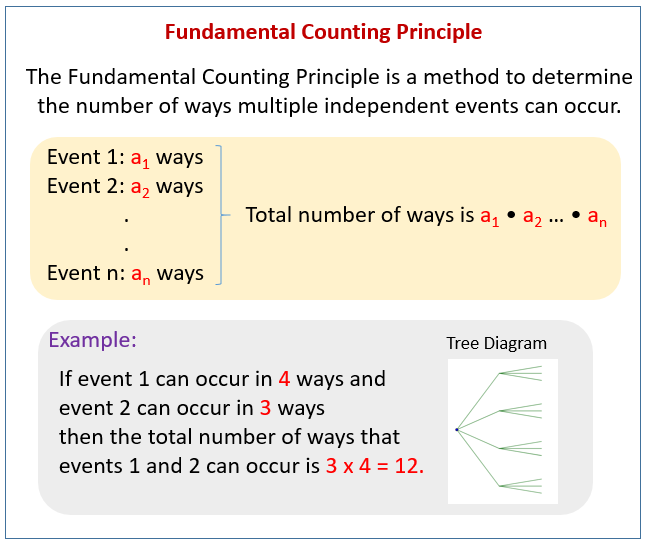
The following figure shows the Fundamental Counting Principle. Scroll down the page for more examples and step by step solutions.
What is the Fundamental Counting Principle?
Given a set of possible events, we often want to find the number of outcomes that can result. We can do this using the fundamental counting principal. For example, the fundamental counting principal can be used to calculate the number of possible lottery ticket combinations. The fundamental counting principal can be used in day to day life and is encountered often in probability.
The fundamental counting principle states that if there are ’m’ ways to do the first thing, ’n’ ways to do the second thing,
‘p’ ways to do the third thing, and so on…
Then there are m × n × p × … ways to do all the things.
Key Points:
- Independent Events: The fundamental counting principle applies when the events are independent, meaning the outcome of one event does not affect the outcome of the other events.
- Sequential Decisions: It’s helpful to think of it as a series of sequential decisions. For each decision, you have a certain number of choices.
- Total Outcomes: The result gives the total number of possible outcomes.
How to use the fundamental counting principle?
Example:
A sandwich comes with a choice of soda or tea and a side of fries, chips, slaw or salad. Find the number of different combo.
Examples of using the fundamental counting principle
Example 1:
An apartment complex offers apartments with four different options, designated by A through D.
A: One Bedroom, Two Bedrooms, Three Bedrooms
B. One Bathroom, Two Bathrooms
C. First Floor, Second Floor
D. Lake View, Golf Course View, No Special View
How many apartment options are available? Describe two such options.
Example 2:
A car model comes in nine colors, with or without air conditioning, with or without sunroof, with or without automatic transmission, and with or without antilock brakes. In how many ways can the ca be ordered with regard to these options.
Example 3:
How many different four-letter radio station call letters can letters van be formed if the first letter must be W or K?
Example 4:
A social security number contains nine digits, such as 074-66-7795. How many different social security numbers can be formed?
How to distinguish between the Sum Counting Principle and the Product Counting Principle?
This video demonstrates how to find the total possible number of options for given situations. For example if you have 3 shirts, two pants and 4 hats, how many different outfits can you pick?
Examples for the sum counting principle:
-
I have 3 red hats and 2 green hats. If I choose one hat, how many ways can I choose a hat?
-
On a number cube there are 3 even numbers and 1 multiple of five. If you roll the cube, how many ways can you get an even number or a multiple of 5?
Examples for the product counting principle:
Jim has 3 pairs of pants, 2 shirts and 2 hats, how many different ways can he dress?
Which principle should be used?
-
Jim has a box of coins, it has 200 pennies, 2 nickels, 3 dimes, and 5 quarters. By choosing one coin, how many ways can he get more than 6 cents.
-
MaryBeth has 3 types of bagels in the fridge, 2 types of cream cheeze and 3 veggies. If she wants one of each, how many different lunch options does she have?
Multiplication Principle - Counting Techniques
A fundamental idea to count the number of ways that some event can happen.
Examples:
-
How many different combinations can be made for a briefcase that has a 3-dial lock with each dial having numbers 0-9 available?
-
How many license plates can be made if the first 3 entries must be letters, followed by 3 numbers?
-
Suppose you take a multiple choice exam that has 10 questions, each question has 5 answers. How many different ways could the exam be answered?
How the fundamental counting principle can help you determine the number of possible outcomes or combinations very quickly?
Examples:
-
You flip a coin and spin the spinner. How many outcomes are possible?
-
You pick a marble and roll a die. How many outcomes are possible?
-
Hunter wants to buy a new pair of skates. He can buy speed skates, figure skates, or hockey skates. A pair of skates can come in blue or silver, and can be decorated with blue streaks or green clovers. How many different combinations can Hunter choose from?
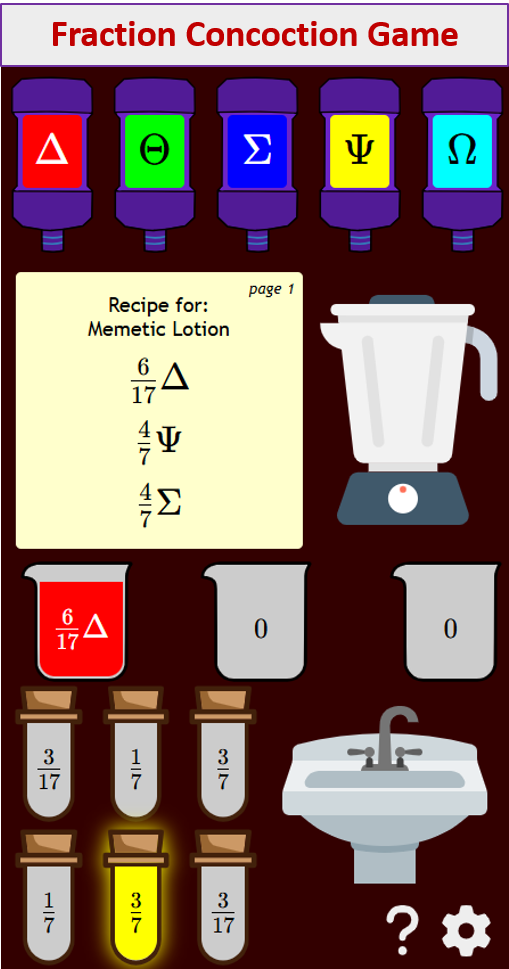
Try out our new and fun Fraction Concoction Game.
Add and subtract fractions to make exciting fraction concoctions following a recipe. There are four levels of difficulty: Easy, medium, hard and insane. Practice the basics of fraction addition and subtraction or challenge yourself with the insane level.
We welcome your feedback, comments and questions about this site or page. Please submit your feedback or enquiries via our Feedback page.