Algebra Mixture Problems
Related Topics:
More Lessons for Algebra
Math Worksheets
Mixture Problem (Adding to the Solution)
Mixture Problem (Removing from the Solution)
Mixture Problem (Replacing the Solution)
Mixture Problem (Mixing Quantities of Different Costs)
Mixture problems are word problems where items or quantities of different values are mixed together.
We recommend using a table to organize your information for mixture problems. Using a table allows you to think of one number at a time instead of trying to handle the whole mixture problem at once.
Removing From The Solution
Example:
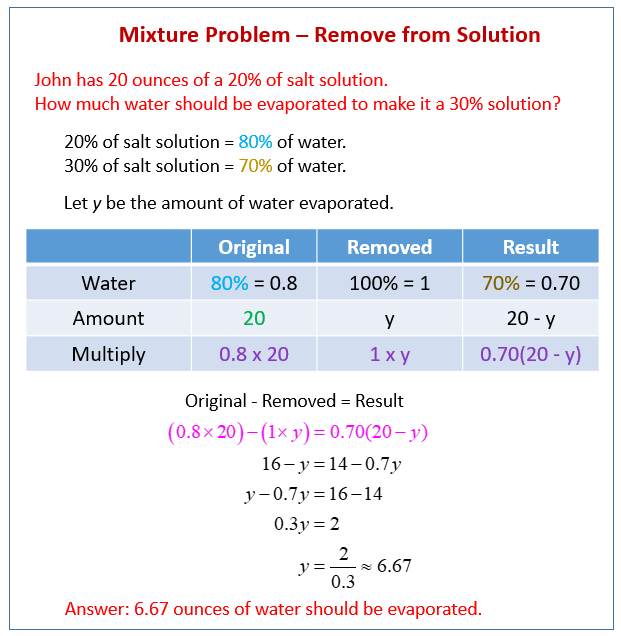
John has 20 ounces of a 20% of salt solution. How much water should he evaporate to make it a 30% solution?
Solution:
Set up a table for water. The water is removed from the original.
Mixture Problems
Some word problems using systems of equations involve mixing two quantities with different prices. To solve mixture problems, knowledge of solving systems of equations. is necessary. Most often, these problems will have two variables, but more advanced problems have systems of equations with three variables. Other types of word problems using systems of equations include rate word problems and work word problems.
Percent Mixture Problem #1
This video, explains using picture, how to solve this percent mixture problem using one variable:
Example: How many pounds of dogfood that is 50% rice must be mixed with 400 pounds of dogfood that is 80% rice to make a dogfood that is 75% rice?
Percent Mixture Problem #2
Example: Ten quarts of pure apple juice are added to 90 quarts of a fruit juice that is 10% pure apple juice. What is the percent concentration of pure apple juice in the resulting mixture?
Percent Mixture Problem #3
How to solve percent mixture problem using one variable?
Example: Five pounds of candy that is 20% chocolate is combined with a candy that is 40% chocolate. How many pounds of the candy that is 40% chocolate should be used to get a candy that is 25% chocolate?
Percent Mixture Problem #4
Example: How much water should be added to 30 cups of juice that is 70% juice to get a diluted mixture that is only 60% juice?
Try the free Mathway calculator and
problem solver below to practice various math topics. Try the given examples, or type in your own
problem and check your answer with the step-by-step explanations.
We welcome your feedback, comments and questions about this site or page. Please submit your feedback or enquiries via our Feedback page.